
Michael Burry intensifies bearish bet against Micron stock, warns AI rally is nearing its end

Michael Burry, the investor who became a household name by betting against the US housing market before the 2008 financial crisis, is now putting serious money behind his conviction that the AI-fueled semiconductor rally has gone too far. In a Substack post dated June 30 to July 1, Burry revealed he has taken a direct short position in Micron Technology at approximately $1,051.87 per share.
The full scope of Burry’s bearish playbook
The Micron short is just the most visible piece of a broader bearish thesis Burry has been constructing over recent months. He has also refreshed his put options on the iShares Semiconductor ETF (SOXX), now targeting strikes in the low-to-mid $400s with March 2027 expiration dates. Given that SOXX has been trading between $560 and $640, those strikes imply Burry is positioning for a decline of roughly 30% to 41% from current levels.
SOXX has climbed approximately 65% in 2026 alone. From its previous lows, the ETF has roughly quadrupled.
Beyond Micron, Burry has disclosed short positions against Nvidia, Applied Materials, Tesla, and Caterpillar. On the long side, he maintains positions in PayPal and selected financial stocks, suggesting a deliberate rotation away from momentum-driven tech names and into sectors he views as more defensively positioned.
In his Substack posts, Burry has described the current moment as the “beginning of the end” for inflated AI-related stock valuations. He draws explicit parallels to the dot-com bubble of 1999-2000, arguing that the semiconductor rally is being driven by FOMO rather than fundamental strength.
What investors should be watching
Burry’s comparison to the dot-com era is instructive but imperfect. The late-1990s tech bubble was characterized by companies with zero revenue commanding massive valuations. Today’s semiconductor companies, Nvidia and Micron included, are posting record earnings. The question isn’t whether the revenue is real. It’s whether current prices have already priced in several years of future growth that may or may not materialize.
The March 2027 expiration on Burry’s SOXX puts gives a rough timeline for when he expects the correction to unfold. That’s roughly nine months of runway, during which any number of catalysts, from earnings misses to capex guidance cuts, could trigger the repricing he’s anticipating.
Disclaimer: The content of this article solely reflects the author's opinion and does not represent the platform in any capacity. This article is not intended to serve as a reference for making investment decisions.
You may also like
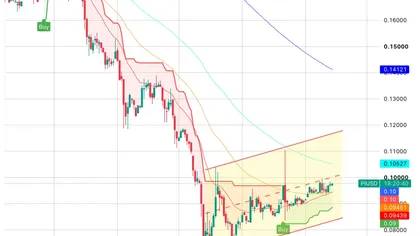
Pi Network Price Prediction: Can PI Hold Its Wedge Breakout Before the Upgrade?
As AI controversies escalate, hedge funds buy tech stocks at the fastest pace in 15 months
Hedge funds have recorded net purchases of US TMT stocks on 10 out of the past 11 trading days, rebuilding tech long positions at the fastest pace in 15 months. However, an AI policy storm has struck at the "worst possible time"—calls by AI giants to slow down development have been rejected, and regulatory uncertainty has directly hit Asian tech stocks such as Softbank. As the tech sector's bullish run coincides with Super Central Bank Week, the sector now faces a severe test.
Apple Pre-sale Tracker: iPhone 18 Pro Series Shows Weak Overseas Demand Signals, Duo Review Positive but Hardware Lags Behind
According to a survey by Jefferies, after the launch of the iPhone 18 Pro, delivery wait times in the four major markets—the US, UK, Germany, and Japan—have shortened by 5 to 11 days compared to last year, with no wait time in the US. Given stable production capacity, this is a clear sign of weak demand. Although the China and Hong Kong markets have performed better against the trend, there are still suspicions of speculative stockpiling. The new foldable Duo has been praised for its software experience, but its $2,000 price tag comes with a 254-gram body and dual-camera setup, leaving its hardware lagging significantly behind Android competitors. Jefferies maintains an "underperform" rating, with a target price implying a 21% downside from the current level.
SUI holds $0.71 support as analysts cite key buy signal, eyes on possible recovery
Crypto prices
More


