
Bitcoin Whales Go on a $16.7 Billion Shopping Spree While Funds Clear Out

There is a major disconnect happening in the crypto world right now. While U.S. spot Bitcoin exchange-traded funds (ETFs) had their worst month on record in June, shedding $4.06 billion, the biggest individual players were doing the opposite. These major holders, known as whales, quietly picked up over 270,000 Bitcoin (BTC-USD) worth $16.7 billion in just two weeks.
4th of July Sale - 70% Off
- Unlock powerful investing tools and data-driven insights with TipRanks Premium for more confident investment decisions.
- Discover top stock picks and new investment opportunities through TipRanks' Smart Investor Newsletter.
This difference in behavior has created a rare situation where individual investors are soaking up BTC coins as fast as institutions can sell them. It is a pattern that has appeared at the bottom of past market cycles, where long-term holders buy coins from discouraged sellers before prices start to climb again.
Smart Money Is Buying Bitcoin
Analysts at Bitfinex noted that this behavior is a sign that savvy investors are spotting a deal. Because the spot premium, which measures how eager U.S. buyers are, stayed low, it is clear that this buying came from private wallets rather than typical trading desks that feed into Bitcoin ETFs.
This movement suggests that the “smart money” is comfortable buying Bitcoin at these levels because so much of the downside risk has already been pushed out of the market. While the funds struggled, this buying shows that deep-pocketed holders are ready to build their BTC positions while everyone else is scared.
Solana Breaks the Mold
Even with Bitcoin dealing with this pressure from fund managers, Solana (SOL-USD) is acting differently than the rest of the market. The token climbed roughly 15% since the start of June, even while BTC hit a 21-month low. Network improvements and a 120% surge in activity for real-world assets on the Solana chain helped the coin stand out.
However, not all smaller coins had the same luck
. Tokens connected to the Optimism network hit record lows after Coinbase’s Base chain moved away from their shared tech, which took away the main reason many people held those coins .Inflation Will Dictate Where Bitcoin Goes Next
Everything now comes down to the next round of inflation numbers. May inflation was 4.2%, which is still quite high, but recent comments from central bankers suggest the path forward might be smoother. If the next report shows lower inflation, it could change the tone for interest rates and give Bitcoin the push it needs to break out of this month-long slump.
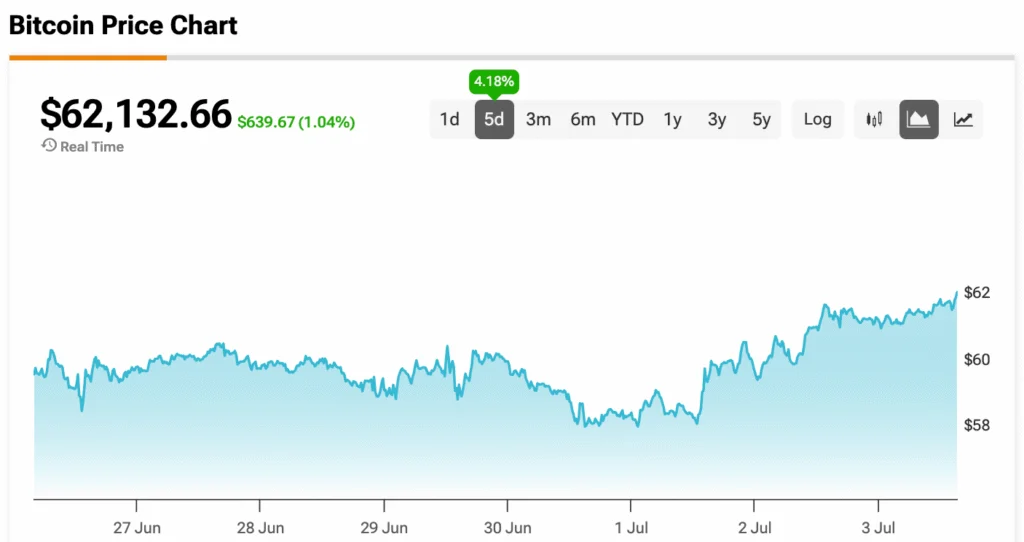
At the time of writing, Bitcoin’s price is sitting at $62,132.66.
Copyright © 2026, TipRanks. All rights reserved.
Disclaimer: The content of this article solely reflects the author's opinion and does not represent the platform in any capacity. This article is not intended to serve as a reference for making investment decisions.
You may also like
The Great Debate on AI Bottlenecks: 2027 Peak Bottleneck vs 2028 Capacity Boom and Price Collapse
Analyst Ben Bajarin believes that the demand for AI computing power will continue to grow, and 2027 will be the "bottleneck" year with the most severe industry-wide supply constraints. In 2028, supply and demand are expected to remain slightly tight but balanced. Jay Goldberg, on the other hand, warns that the historical cycle's iron law suggests that massive production capacity from companies like TSMC could lead to a collapse in pricing power and a reversion of profit margins to the mean. Both agree that the era of "blindly buying into the AI supply chain and seeing instant surges" has ended, and investors must now carefully select core assets with resilience in cross-cycle pricing.
Japan Is Dragging the World Down
Japan's government bond yields have surpassed 3% for the first time in 30 years, triggering global alarm. Nomura states that the epicenter of this global rise in long-term interest rates is within Japan itself—driven by uncontrolled fiscal expansion and expectations of central bank rate hikes, making fiscal risk premiums the main driving force. What’s more concerning to the market is that the continuous rise in Japanese bond yields not only threatens the balance sheets of global financial institutions, but may also burst the AI tech stock bubble and trigger a sudden economic slowdown.
Australian Dollar weakens to near 0.7200 as traders await US PPI inflation data

Crypto prices
More


