
Citadel Strategy Chief: The Market Underestimates the Possibility of a Fed Rate Hike in July

The Federal Reserve’s policy framework is shifting from “inertia” to “adaptability”, and the fixed income market may be facing a brutal summer.
On July 5th, Citadel Securities’ Head of Macro Strategy Frank Flight warned in his latest report that the market is currently severely underestimating the probability of a rate hike by the Federal Reserve at its July meeting. He maintains his baseline forecast of two rate hikes this year, but thinks investors are still constrained by an "inertia policy framework", mistakenly assuming that the Fed will only act when data unequivocally force its hand.
Flight emphasized that Federal Reserve Chair Walsh delivered for an “A+” performance at the June FOMC meeting—breakeven inflation rates trended downward, the yield curve flattened, the dollar strengthened, and any brief pullback in risk assets was quickly absorbed. This market reaction indicates that consecutive and rapid “credibility rate hikes” are tolerable for markets, even if not fully priced in beforehand. At the same time, his cross-asset macro framework and U.S. Treasury cash flow data both point to upside risks in yields, meaning the pressure on the fixed income market may persist.
From “Inertia” to “Adaptability”: Market Underestimates Policy Framework Shift
Flight believes the core misjudgment in current market pricing is that investors are still using the old “inertia policy framework”—that is, assuming the Fed will act only slowly and passively when data accumulation is substantial. He argues that the Fed’s shift to an “adaptability policy framework” is real and far from fully recognized by the market.
Under the adaptability policy framework, the central bank’s optimal strategy is to respond quickly as soon as deviation from its dual mandate appears, preventing such deviations from becoming entrenched. This mechanism can guide wage and price-setting behavior to embed 2% inflation expectations, thus increasing the likelihood of achieving targets and reducing the magnitude of tightening ultimately required compared to the “slam-on-the-brakes-after-delay” path inherent in the inertia framework.
He especially emphasized that if the Federal Reserve forfeits its first chance to “match words with actions” at the July meeting, it will make Chair Walsh’s remarks at the June press conference appear superficial and could lead the market to give back some of the hard-won credibility premium already priced in.
Cross-Asset Signals and Treasury Cash Flow Both Point to Rising Yields
On a technical and capital flow level, Citadel Securities’ quantitative signals also support the case for higher yields.
Flight recalled that on May 19th he warned of rapid strengthening risk in global duration, triggered by two factors at the time:
First, the growth factor (PC1) in the cross-asset decomposition model reached the mean-reversion threshold of +2 standard deviations, suggesting downside risk for yields; second, U.S. Treasury cash flow data showed a sharp rise in net buying intensity. May 19th subsequently became a staged high point for yields this year.
However, both factors supporting long duration have now fully reversed. In recent weeks, the PC1 factor in the macro framework has moved more than 3 standard deviations, with the current reading at -1.17 standard deviations; meanwhile, U.S. Treasury cash flow data now shows a clear step up in net selling intensity.
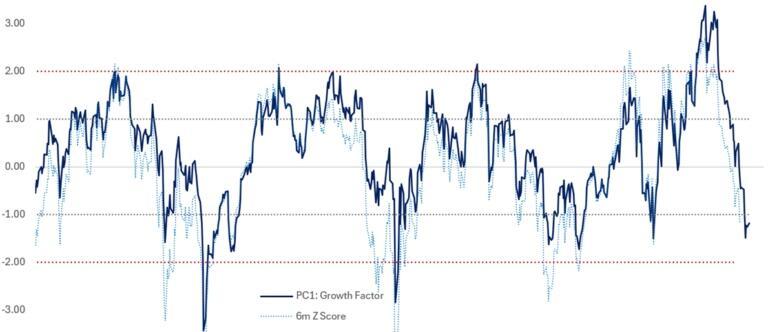
Flight concluded that these signals collectively point to further upside risks for yields, and that pressure on the fixed income market may intensify throughout the summer.
Disclaimer: The content of this article solely reflects the author's opinion and does not represent the platform in any capacity. This article is not intended to serve as a reference for making investment decisions.
You may also like
As AI controversies escalate, hedge funds buy tech stocks at the fastest pace in 15 months
Hedge funds have recorded net purchases of US TMT stocks on 10 out of the past 11 trading days, rebuilding tech long positions at the fastest pace in 15 months. However, an AI policy storm has struck at the "worst possible time"—calls by AI giants to slow down development have been rejected, and regulatory uncertainty has directly hit Asian tech stocks such as Softbank. As the tech sector's bullish run coincides with Super Central Bank Week, the sector now faces a severe test.
Apple Pre-sale Tracker: iPhone 18 Pro Series Shows Weak Overseas Demand Signals, Duo Review Positive but Hardware Lags Behind
According to a survey by Jefferies, after the launch of the iPhone 18 Pro, delivery wait times in the four major markets—the US, UK, Germany, and Japan—have shortened by 5 to 11 days compared to last year, with no wait time in the US. Given stable production capacity, this is a clear sign of weak demand. Although the China and Hong Kong markets have performed better against the trend, there are still suspicions of speculative stockpiling. The new foldable Duo has been praised for its software experience, but its $2,000 price tag comes with a 254-gram body and dual-camera setup, leaving its hardware lagging significantly behind Android competitors. Jefferies maintains an "underperform" rating, with a target price implying a 21% downside from the current level.
SUI holds $0.71 support as analysts cite key buy signal, eyes on possible recovery
UBS Health Benefit Survey: Elevance Health (ELV.US) Leads, U.S. Employers Prepare for Rising Medical Costs
In the annual survey by UBS for employee benefits management institutions, Elevance Health (ELV.US) emerged as the highest-rated US health insurance company.

Crypto prices
More


