
$4,180 Becomes the Key Threshold, Gold’s Comeback Still Needs One Last Push

Huitong Network July 8 – On Wednesday, July 8, spot gold slightly recovered after the previous day's pullback, currently trading above $4,100 with an intraday gain of about 0.5%. However, it is still down about 3.08% over the past month. This indicates that the current movement is not merely a safe-haven surge, but rather a result of the simultaneous tug-of-war between “conflict premium, oil price rebound, and rate expectation repricing.” Meanwhile, the Federal Reserve’s June meeting minutes are scheduled for release at 2:00 a.m. on Thursday, and the market is waiting for more signals regarding the future interest rate path.
On Wednesday, July 8, spot gold slightly recovered after the previous day's pullback, currently trading above $4,100 with an intraday gain of about 0.5%. However, it is still down about 3.08% over the past month. This indicates that the current movement is not merely a safe-haven surge, but rather a result of the simultaneous tug-of-war between “conflict premium, oil price rebound, and rate expectation repricing.” Meanwhile, the Federal Reserve’s June meeting minutes are scheduled for release at 2:00 a.m. on Thursday, and the market is waiting for more signals regarding the future interest rate path.
Gold Rebound Is Weak, Core Pressure Comes from Real Rate Expectations
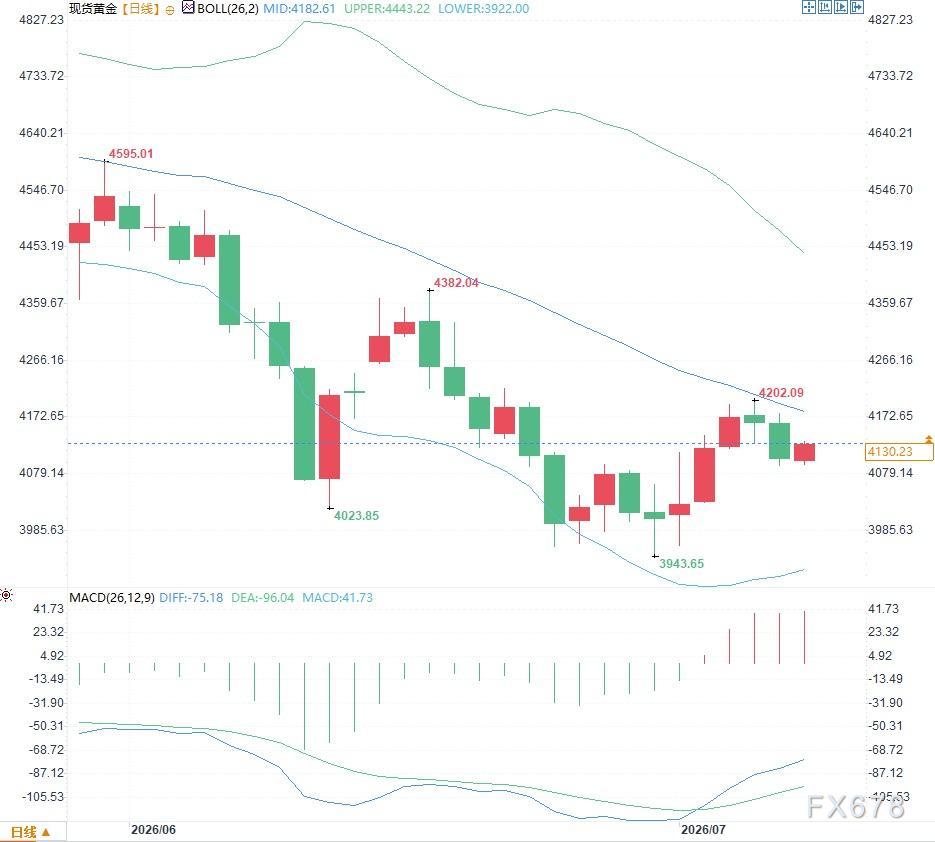
From a market structure perspective, spot gold is holding above $4,100 in the short term, but its upward momentum is not smooth. The daily chart shows that the price previously fell all the way from around $4,595, hitting a low at the $3,943 area before rebounding to around $4,130. The Bollinger middle band is near $4,182, meaning gold has yet to reclaim this medium-term resistance level. As long as the price fails to effectively recover above the middle band, the rebound is more of a technical correction rather than a trend reversal.
The issue for gold is that it benefits from conflict-related uncertainty but is also suppressed by rate expectations. Rising conflict usually boosts safe-haven demand, but a rebound in oil prices rekindles inflation concerns, leading the market to bet that the Federal Reserve will maintain a tighter monetary stance. For zero-yielding assets, higher nominal and real rates directly increase the cost of holding. Therefore, although gold appears to be supported by safe-haven demand in the short term, its upside is actually limited by the repricing of interest rates.
The Oil Price Rebound Has Changed Market Pricing for Inflation
The key variable for this round of gold’s weak rebound is oil. Brent crude is currently rising to $76 per barrel (UTC+8), and WTI is up to $72 per barrel (UTC+8). Renewed risks related to the Strait of Hormuz have brought energy supply concerns back into traders’ view, as this channel accounts for about one-fifth of global oil supply flows.
This is not simply a one-way positive for gold. Rising oil prices initially bring about safe-haven sentiment, but they also increase expectations for sticky inflation. If the market anticipates energy prices will push up inflation again, US Treasury yields and the US dollar tend to get support, and gold’s safe-haven attribute is partly offset by rate pressures. This is why gold has not broken out directly on conflict news, but rather is caught in a tug-of-war just above $4,100.
The Fed Minutes Become a Short-Term Pricing Watershed
The Federal Reserve’s June statement indicated the federal funds rate target range remained at 3.50% to 3.75%, while emphasizing inflation remains above the 2% target, with some price pressures coming from supply shocks including energy. The official schedule shows the meeting minutes will be released during the North American session, and traders’ key focus is not “whether rates have already been raised,” but rather the committee’s internal weighing of energy shocks, slowing employment, and inflation stickiness.
Recent data is not one-sided. Nonfarm payrolls in June increased by just 57,000 (UTC+8), with the unemployment rate at 4.2% (UTC+8), and the April and May jobs data were revised down by a combined 74,000, indicating the job market expansion is slowing. Meanwhile, the June services PMI was 54.0 (UTC+8), still in expansion territory but lower than May’s 54.5 (UTC+8). New orders and business activities both cooled, and although the price index fell to 67.7 (UTC+8), it remains at a relatively high level.
This data mix is particularly complicated for gold. Slower job growth would normally weaken rate hike expectations, but a rebound in energy prices has brought inflation risks back to the forefront. Rate futures pricing shows the probability of a September rate hike has risen from about 57% the previous day (UTC+8) to over 63% (UTC+8), indicating the market is repricing conflict and oil price risks with a higher chance of a policy rate increase.
Technical Indicators Show Repair, but Trend Confirmation Still Needs a Key Breakthrough
From the daily chart perspective, gold’s technical signals are improving but are still not strong. The MACD histogram has returned to positive territory, indicating a moderation in downside momentum. However, both the DIFF and DEA lines remain below zero, signaling the medium-term trend has yet to recover. The price stabilizing short-term around $4,100 only means there is still buying interest below, but the $4,180–$4,200 area is a more significant resistance zone.
If the minutes reveal a stronger anti-inflation stance, gold may continue to be suppressed by interest rates, and the support near $4,100 will be tested again. If the minutes put more emphasis on labor market cooling, the market may lower rate hike bets going forward, giving gold more room to challenge above $4,180. The current trading logic is not simply about watching conflict, but whether conflict translates into higher inflation through higher oil prices, and then suppresses gold indirectly via rate expectations.
Disclaimer: The content of this article solely reflects the author's opinion and does not represent the platform in any capacity. This article is not intended to serve as a reference for making investment decisions.
You may also like
Swiss Franc weakens as US Dollar gains on Fed rate hike odds
From "chasing the light" to "going upstream toward the light"! Morgan Stanley asserts: In the tsunami of computing power, fiberglass fabric and copper foil ignite a super cycle in materials.
Morgan Stanley's latest research report points out that the global frenzy of AI infrastructure expansion is shifting from downstream GPU and wafer foundry to a comprehensive upstream spread in critical base material sectors.

As "AI slowdown" impacts the semiconductor sector, Goldman Sachs issues a bullish report! Target prices for the "Korean memory chip giants" indicate nearly 90% upside potential.
Goldman Sachs reaffirmed its “Buy” rating for the world’s two largest memory chip giants — Samsung Electronics and SK Hynix. Samsung Electronics continues to be on Goldman Sachs’ Conviction List.

Anthropic has been profitable for two consecutive quarters ahead of its IPO
Anthropic has achieved positive adjusted operating profit for two consecutive quarters, with Q2 revenue surging 14-fold year-on-year to $11.5 billion and annualized revenue reaching $65 billion. The gross margin exceeds 80%. The company has chosen to list on Nasdaq, with a potential valuation of up to $2 trillion. Dramatically, the CEO has made a rare call to slow down AI development just before the IPO. Analysts believe that balancing safety concerns with commercial competition will become the core challenge.
Crypto prices
More


