
Base to activate B20 standard for stablecoins, RWAs and other tokens

Coinbase-backed Ethereum layer-2 network Base is set to activate its B20 token standard on mainnet, introducing a native framework for stablecoins, tokenized real-world assets (RWAs) and other fungible tokens.
According to Base documentation, B20 is scheduled to go live at 6 pm UTC on the mainnet, enabling developers to begin creating tokens under the new standard.
The activation will enable developers to use Base's native token standard to create stablecoins, RWAs, tokenized equities and other fungible tokens without requiring them to build and audit custom ERC-20 contracts.
The standard supports two variants: asset and stablecoin. The asset variant has configurable decimals between six and 18, while the stablecoin variant has fixed six-decimal formatting and requires issuers to specify a fiat currency denomination, such as the US dollar or euro.
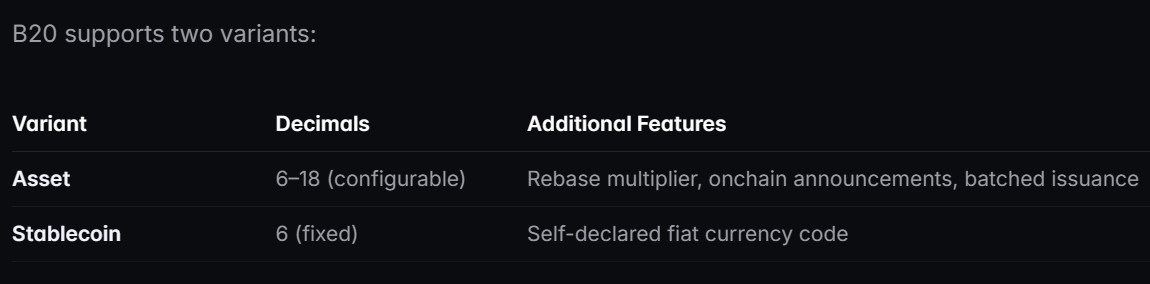
B20 supports two variants. Source: Base
B20 was introduced as part of the network’s Beryl upgrade, which went live on June 26. The upgrade shortened withdrawal waiting periods from seven days to five days and added technical changes aimed at improving network performance.
Base said B20 tokens are compatible with standard ERC-20 tokens but come with built-in issuer controls. Those features include supply limits, transfer rules, minting, burning, pausing and transaction notes.
B20 activation follows Base outages
The B20 activation follows back-to-back outages linked to its sequencer infrastructure.
On June 25, Base encountered an outage caused by a consensus issue. At the time, the network said an invalid block had been sequenced, preventing new blocks from being created. Base resumed block production on the same day, after a nearly two-hour halt.
Related: Coinbase restores trading after AWS outage disrupts markets
In a post-mortem, Base said that a sequencer bug caused back-to-back outages on June 25 and June 26. The first incident lasted for about 116 minutes, while a second outage lasted about 20 minutes after a race condition prevented sequencers from catching up after a system reset.
The initial outage occurred hours before the scheduled Beryl upgrade, which was delayed by one day due to a separate B20 activation registry timing issue.
Magazine: Has Bitcoin bottomed for this cycle? Analysts say 'not yet'
Disclaimer: The content of this article solely reflects the author's opinion and does not represent the platform in any capacity. This article is not intended to serve as a reference for making investment decisions.
You may also like
XRP Outperforms Bitcoin and Major Stocks Over 10 Years but Numbers Are Easy to Misread
Federal Reserve Chair Waller: Number of Rate-Setting Meetings Will Be Reduced in Coming Years
Federal Reserve Chair Walsh pointed out that although eight meetings per year is "an appropriate number" for the FOMC, starting in 2027, one meeting will focus on macro monetary policy strategy without interest rate voting or policy statement issuance. In 2028, such strategic meetings will increase to two, and the number of policy-setting meetings will be reduced correspondingly to six. Walsh stated that this adjustment aims to provide the committee with space to consider more long-term "major issues."
The Federal Reserve holds rates steady as expected, with divisions resurfacing but fewer hawkish voices; Cook and two other voting members support a rate hike.
After three dissenting votes in July, there was once again division in this rate decision, with two of the 12 FOMC members opposed, indicating a decrease in hawkish dissent. Among the dissenters, Harker had already voted against holding rates steady in July due to his support for a rate hike, while Cook’s dissent is seen as a rebuke to Trump’s attempt to remove her. This statement changed the description of the economy from “steadily expanding” to “strong expansion,” continued to emphasize that inflation remains high, and newly added that accumulating information will help determine the policy stance needed to ensure inflation returns to target in a timely manner. According to the “New Fed News Agency,” the Fed’s decision to hold rates steady aims to gain time to assess whether further rate hikes are necessary.
Crypto prices
More


