BlackRock’s USD Institutional Digital Liquidity Fund, known as BUIDL, has passed $900 million in assets on Avalanche. The figure rose from about $464 million within seven days, adding roughly $436 million and marking a 105% weekly increase.Wu Blockchain cited current RWA.xyz data when reporting the move on July 12.
RWA.xyz’s BUIDL dashboard places the fund’s total asset value at about $2.87 billion across supported networks. Its Avalanche position now represents close to one-third of the full fund. Current data also puts Avalanche behind Ethereum as BUIDL’s second-largest network allocation. The increase comes without a change to the token’s target value of $1 per share.
BUIDL gives institutions on-chain Treasury access
BlackRock launched BUIDL in March 2024 through tokenization platform Securitize. The fund invests mainly in U.S. Treasury bills, cash, and repurchase agreements. Its stated goal is “current income” while maintaining liquidity and stability of principal. Investors receive tokenized fund shares and daily accrued dividends, subject to eligibility and transfer controls.
BUIDL first launched on Ethereum before expanding to Aptos, Arbitrum, Avalanche, Optimism, and Polygon in November 2024. It later reached Solana and BNB Chain.Crypto.news reported that the added share classes gave approved investors more options for transfers, settlement, and on-chain yield across several blockchain environments.
BNY Mellon supports the fund’s administration across digital and traditional systems. RWA.xyz lists a seven-day annualized yield of 3.40% and management fees ranging from 0.20% to 0.50%. These figures can change with short-term interest rates, expenses, and the share class used by each investor. BUIDL’s on-chain tokens record ownership, while the underlying portfolio remains managed under the fund’s legal structure. The fund reports a net asset value of $1.
Avalanche’s tokenized asset market expands
Current RWA.xyz Avalanche data shows about $2.10 billion in distributed real-world asset value on the network, up more than 58% over 30 days. Based on those figures, the Avalanche share of BUIDL accounts for roughly 43% of the network’s distributed asset value. Avalanche also hosts tokenized products from Franklin Templeton and other asset managers.
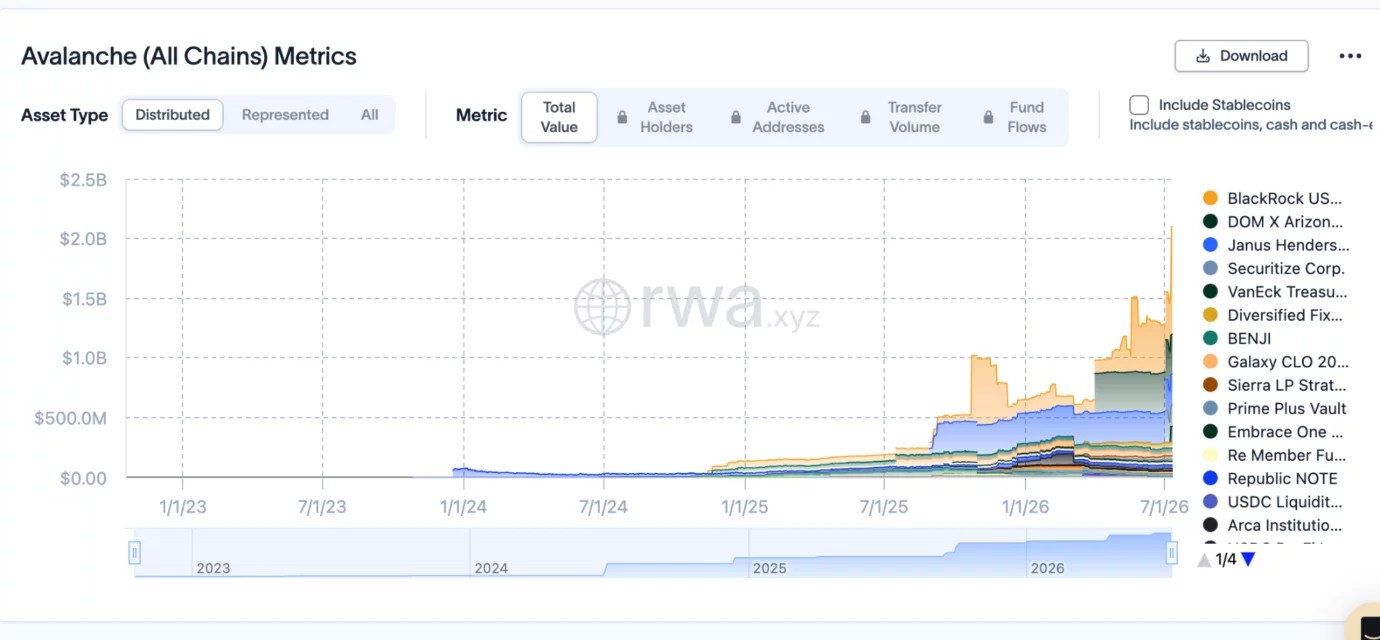
Source: RWA.xyz Avalanche data
BUIDL has also entered decentralized finance on Avalanche. Crypto.news reported that sBUIDL, a token backed one-to-one by BUIDL and issued by Securitize, became collateral on Euler in May 2025. Eligible users can borrow USDC or AUSD against the asset through curated lending markets.
Tokenized Treasury demand continues growing
The BUIDL increase comes as tokenized real-world assets gain a larger place in institutional crypto activity.Crypto.news reported in June that tokenized real-world assets had crossed $29 billion by April 2026. Tokenized U.S. Treasuries rose from about $380 million in 2023 to $13.4 billion during the same period.
BUIDL remains concentrated among a limited number of approved investors. RWA.xyz lists 113 holders, even as the fund approaches $2.87 billion in value. That structure reflects its focus on qualified purchasers rather than broad retail access. The latest Avalanche increase may therefore represent one or several large allocations rather than a broad rise in wallet numbers.
BlackRock and Securitize have not publicly identified the investors behind the weekly Avalanche increase. The available data confirms the asset growth but does not show whether the capital came from new subscriptions, network transfers, or both. Market participants can track future changes through the RWA.xyz dashboards as BUIDL’s multi-chain distribution develops.