
Velocity raises $38M to build stablecoin treasury infrastructure for enterprises

Stablecoin treasury platform Velocity has raised $38 million in a Series A funding round to expand infrastructure that helps enterprises and financial institutions use stablecoins for cross-border settlement and treasury operations.
The funding round was led by Dragonfly and FirstMark, with participation from Activant Capital, Capital One Ventures, QED Investors, Coinbase Ventures, Wintermute Ventures and Ripple. Velocity said it plans to use the capital to expand its banking and payments network, develop new products and strengthen its regulatory capabilities.
Founded in 2025, Velocity develops software that connects stablecoin networks with banking, custody, compliance and settlement systems. The company targets enterprise finance teams, payment providers, fintech firms and financial institutions using stablecoins for cross-border payments and treasury operations.
The latest financing brings Velocity’s total funding to nearly $50 million since it launched in 2025, according to the company.
Related:
The funding comes as competition in the enterprise stablecoin market intensifies. In June, more than 140 companies backed the launch of Open USD (OUSD), a dollar-pegged stablecoin supported by companies including Visa, Mastercard, Coinbase and Ripple.
Stablecoin infrastructure investment accelerates
Investment in stablecoin infrastructure has accelerated this year as companies build the software and network infrastructure supporting payments, settlement and enterprise financial services.
In March, Tether participated in a $5.2 million funding round for Ark Labs, a startup building infrastructure for stablecoin issuance and settlement on Bitcoin. The company is developing a programmable execution layer to enable faster payments and more complex financial applications on the network.
Later that month, OpenFX raised $94 million in a Series A funding round to expand its stablecoin-based foreign exchange network, which is designed to speed up cross-border payments for businesses. The company said it would use the capital to expand into Southeast Asia and Latin America while increasing liquidity across its network.
Trace Finance secured $32 million the following month to expand its cross-border payment infrastructure, which combines banking, foreign exchange and stablecoin settlement services for businesses operating across multiple markets.
The investments come as stablecoin payments continue to expand. A joint analysis by McKinsey and Artemis Analytics estimated that stablecoins processed $390 billion in annualized real-world payments in 2025, including about $226 billion in business-to-business transactions.
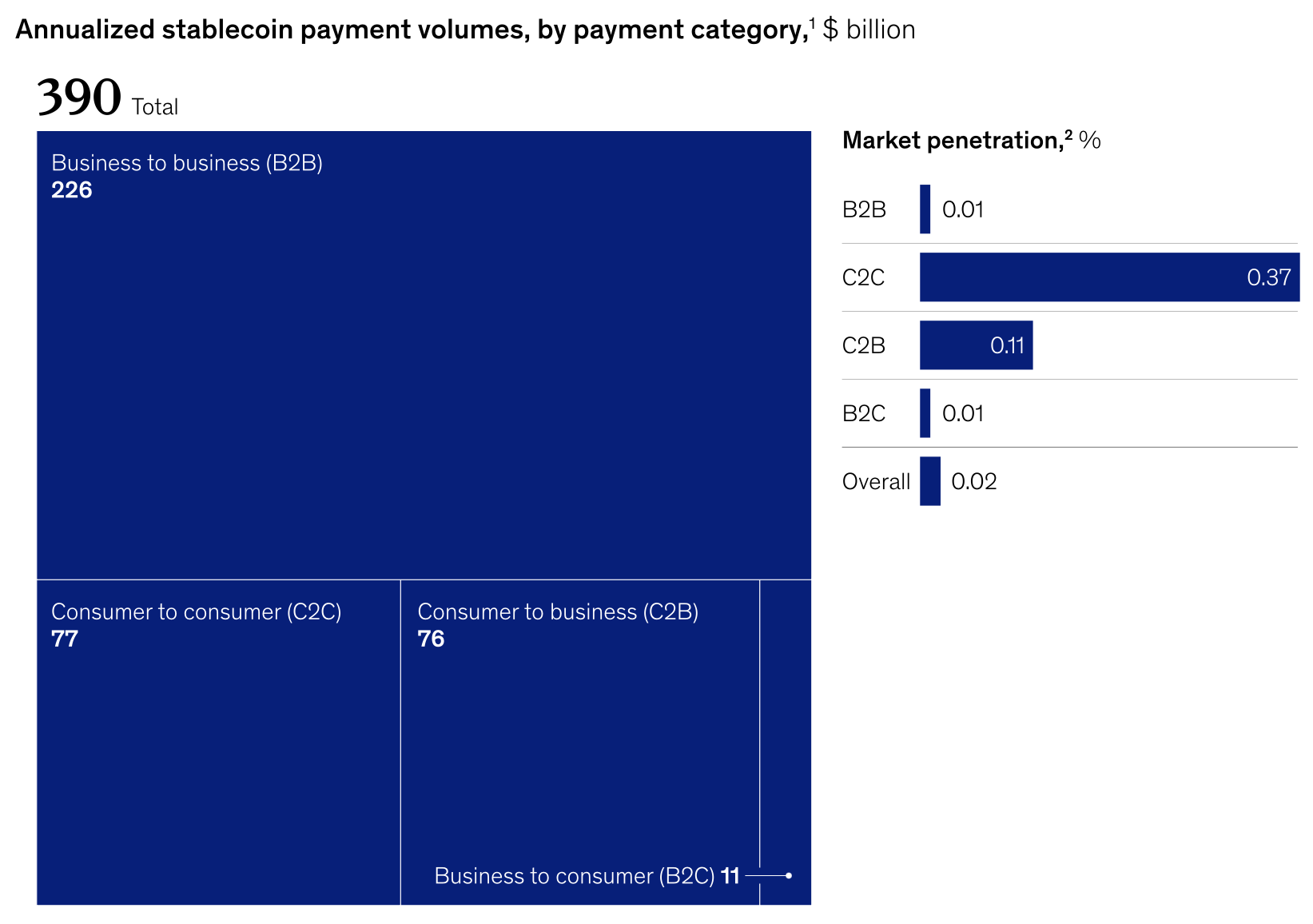
Annualized real-world stablecoin payment volume by use case. Source: McKinsey, Artemis Analytics
Magazine:
Disclaimer: The content of this article solely reflects the author's opinion and does not represent the platform in any capacity. This article is not intended to serve as a reference for making investment decisions.
You may also like
Once frenzied buying, now the "ammunition warehouse" shrinks by 51 trillion KRW! Korean retail investors can no longer afford to buy
In four months, Korean retail investors' "ammunition stockpile" has dropped by 36.5%, returning to levels seen at the beginning of the year. Although retail investors have collectively made net purchases exceeding 75 trillion won, they are still absorbing the sell-off, but the influx of new funds has dried up, and the replenishment rate lags far behind the consumption rate. Combined with the KOSPI plunging nearly 20% this month, continued net selling by foreign investors, and concerns over AI-related credit risks, the Korean stock market may find it difficult to see a sustained rebound in the short term without support from private investors' funds.
Apple Prints TD Sequential Sell 9 — Last Two Led to 15.66% and 13.63% Corrections

The Collapse of "Consensus Trading" and the Birth of a New Consensus! Goldman Sachs Explains: Why Institutions Are Currently Significantly Reducing AI Holdings
The extremely crowded trade of "going long on AI, short on everything else" is undergoing a painful unwinding—markets are no longer satisfied with the "burn rate narrative." Mega-scale cloud providers must deliver real, visible revenue conversions alongside $1.1 trillion in capital expenditures. A power gap of 40-50 gigawatts, rising capital costs, and a macro paradigm shift from an era of "overspending" are turning AI trades from a matter of faith into a harsh test of monetization.

Starknet TVL crashes 3.7x to $42M after getting 93% vote to become L1
Crypto prices
More


