
Bitcoin Price Rises as Whales Add 11000 BTC in One Week

- Whale wallets accumulated approximately 11,000 BTC in one week.
- Softer U.S. inflation briefly pushed Bitcoin Price above $64,000.
- Markets remain focused on Fed policy and institutional ETF demand.
Bitcoin Price moved higher after large holders increased their accumulation and softer-than-expected U.S. inflation data improved market sentiment. According to Santiment, wallets holding between 10 and 10,000 BTC added approximately 11,000 BTC over the past week. The Bitcoin Price also climbed above $64,000 briefly after June inflation figures strengthened expectations that the Federal Reserve could slow monetary tightening.
Bitcoin Price Gains Support From Whale Accumulation
Santiment data show that Bitcoin whales and shark wallets resumed steady accumulation in July. Historically, this wallet category has closely tracked major Bitcoin Price trends. At the same time, smaller retail holders continued buying despite recent volatility, indicating that interest in accumulating BTC remains intact.
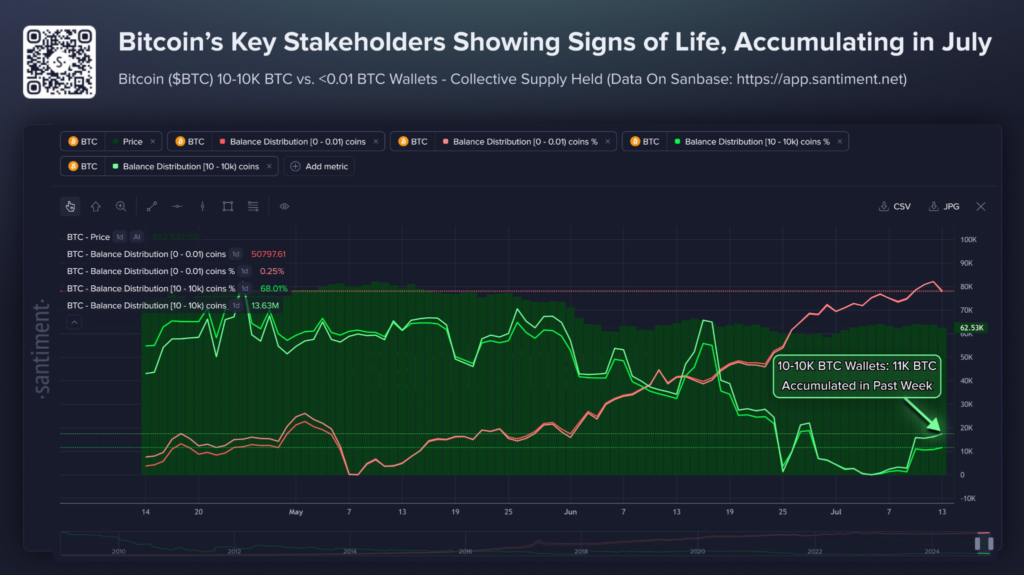
Analysts noted that the strongest bullish setup would emerge if large holders continue adding Bitcoin while retail investors begin reducing exposure. Such behavior often reflects stronger investors absorbing available supply before broader sentiment improves.
Bitcoin Price Reacts to Inflation Data and Fed Outlook
The Bitcoin Price also benefited from weaker U.S. inflation data. Headline Consumer Price Index declined 0.1% in June, lowering the annual inflation rate to approximately 3.9%. Treasury yields eased while the U.S. dollar weakened, supporting risk assets, including cryptocurrencies.
Despite the positive reaction, core inflation remained above the Federal Reserve’s 2% target, leaving uncertainty around future interest rate decisions. Meanwhile, Bitfinex analysts observed that demand for spot Bitcoin ETFs continues to depend heavily on macroeconomic conditions, with institutional flows remaining in a net outflow trend since mid-May.
The Bitcoin Price recently traded between $61,600 and $64,700 before recovering to around $63,780, as investors continued monitoring whale accumulation, ETF flows, upcoming bank earnings, and the Federal Reserve’s next policy meeting.
Disclaimer: The content of this article solely reflects the author's opinion and does not represent the platform in any capacity. This article is not intended to serve as a reference for making investment decisions.
You may also like
10-year US Treasury yields approach 5%, US stocks pull back: Goldman Sachs remains bullish against the trend—an “insurance-rate hike” or the restart of the tightening cycle?
This week, the biggest suspense in the Federal Reserve meeting may no longer be whether there will be a rate hike.


Australian Dollar declines to near 0.7150 as hot US inflation data boost case for Fed rate hike
The AI super bull market still has room for imagination, but Wall Street has quietly prepared "two types of insurance": to guard against slow declines eroding returns, as well as to protect from sudden crashes.
Due to rising interest rates and oil prices causing the stock market rally to stall, investors are divided—some worry about a rapid sell-off, while others are concerned about a slow market decline. Some traders have become more creative with bearish strategies, such as buying put options on the Chicago Board Options Exchange Volatility Index or the S&P 500, or using double binary options to bet on a gradual price drop.

Crypto prices
More


