
BubbleMaps warns about brutal Robinhood trenches as CASHCAT wrecks traders

Reportedly, only 37% of the 164,538 traders active across the network’s top 50 tokens have made a profit, while the remaining 63% have lost money.
Are traders making money on Robinhood Chain?
“Robinhood trenches are brutal,” BubbleMaps, an on-chain analytics firm, wrote on X, calling the memecoin market “a tough game.”
Robinhood Chain, an Arbitrum Orbit layer-2 blockchain built on top of Ethereum to cut fees, went live on July 1, 2026.
However, of the 164,538 traders active across the network’s top 50 tokens, only 37% have made a profit. The remaining 63% have lost money.
CASHCAT (CASHCAT), the token modeled on Robinhood’s old cat mascot, jumped 718% in 24 hours to a $68 million market cap on July 8, when Robinhood CEO Vlad Tenev publicly warmed to memecoins on the network. However, since then, the token has bled out.
The token is trading at roughly $0.0557, down about 75% from its July 11 all-time high of $0.2252, with a market cap near $55.7 million and about 4,840 holders. Around 25,000 wallets reportedly held CASHCAT on July 13, when the token carried a market cap near $150 million.
Are Robinhood Chain meme price drops coordinated dumps?
Beyond tallying winners and losers, BubbleMaps ran distribution checks on individual tokens and found that CASHCAT shows no major holder clusters and a solid spread of ownership.
A handful of clusters that were present at token launch have already sold out of their positions. The checks show that the losses on CASHCAT come from ordinary price action, not from a concentrated group sitting on the supply.
CASHDOG, on the other hand, was flagged and labeled as heavily bundled. BubbleMaps said its holders were funded through one-time contracts, implying a coordinated setup rather than organic buying.
Robinhood is currently covering gas fees for wallet transactions during the first 90 days in order to pull in more users. That incentive, paired with the CASHCAT frenzy, has brought $3.1 billion in volume over a seven-day stretch to the decentralized exchanges on the chain.
Meme tokens such as Wen Lambo, Tendies, and Hoodrat follow closely behind. DeFiLlama pegged the total value locked on the chain at about $227 million on Saturday.
The tokenized stocks Robinhood actually built the chain to sell have drawn far less interest so far, accounting for just $12.66 million in market cap on the network. At its peak, CASHCAT alone was worth twelve times that figure.
The industry is observing whether activity on the chain remains constant once the gas subsidy expires in late September and traders start covering their own fees.
Disclaimer: The content of this article solely reflects the author's opinion and does not represent the platform in any capacity. This article is not intended to serve as a reference for making investment decisions.
You may also like
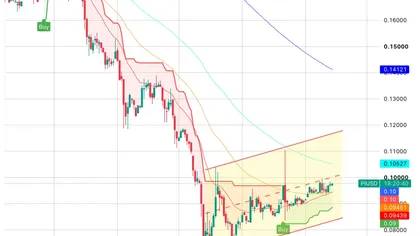
Pi Network Price Prediction: Can PI Hold Its Wedge Breakout Before the Upgrade?
As AI controversies escalate, hedge funds buy tech stocks at the fastest pace in 15 months
Hedge funds have recorded net purchases of US TMT stocks on 10 out of the past 11 trading days, rebuilding tech long positions at the fastest pace in 15 months. However, an AI policy storm has struck at the "worst possible time"—calls by AI giants to slow down development have been rejected, and regulatory uncertainty has directly hit Asian tech stocks such as Softbank. As the tech sector's bullish run coincides with Super Central Bank Week, the sector now faces a severe test.
Apple Pre-sale Tracker: iPhone 18 Pro Series Shows Weak Overseas Demand Signals, Duo Review Positive but Hardware Lags Behind
According to a survey by Jefferies, after the launch of the iPhone 18 Pro, delivery wait times in the four major markets—the US, UK, Germany, and Japan—have shortened by 5 to 11 days compared to last year, with no wait time in the US. Given stable production capacity, this is a clear sign of weak demand. Although the China and Hong Kong markets have performed better against the trend, there are still suspicions of speculative stockpiling. The new foldable Duo has been praised for its software experience, but its $2,000 price tag comes with a 254-gram body and dual-camera setup, leaving its hardware lagging significantly behind Android competitors. Jefferies maintains an "underperform" rating, with a target price implying a 21% downside from the current level.
SUI holds $0.71 support as analysts cite key buy signal, eyes on possible recovery
Crypto prices
More


