
U.S. and Iran resume negotiations; will gold prices rebound in the short term?

Financial News July 20—— Global markets are in turmoil, while gold prices remain steady, consolidating and looking for direction.
On Monday (July 20) during the Asian and European sessions,
At local time on July 20, Iran’s Ministry of Foreign Affairs spokesperson Baghaei stated at a press conference that war and diplomacy are both means to safeguard national interests, and the channel for negotiations has not been completely closed.
He mentioned that Iran’s diplomatic team will not refrain from fulfilling their duties due to potential risks in negotiations, nor will the military abandon their mission to defend national territory because of the adversary’s advantage in equipment.
Currently, the Middle East situation remains tense, with the standoff between the U.S. and Iran continuing to escalate. Shipping in the Strait of Hormuz and local oil and gas facilities face frequent attacks. Geopolitical risks would usually fuel increased safe-haven buying of gold, but this time, the market is displaying an anomaly where the safe-haven logic has failed. Overall, gold prices remain under weak and volatile pressure, continuing to hover around the $4,000 mark since this week’s market open, and last week gold was even weaker.
A Strong U.S. Dollar and Global High Interest Rates Are the Core Factors Pressuring Gold Prices
The primary drivers behind the recent sharp weakness in gold prices are the strengthening U.S. dollar and the globally tightening monetary environment, both of which create headwinds for gold.
More importantly, gold is a non-interest-bearing asset, and its allocation value has been significantly diminished under the global anti-inflation policy backdrop.
Historically, funds would flock to gold during periods of high inflation to hedge against currency depreciation and preserve purchasing power, but the market logic in 2026 has now reversed.
Unlike U.S. Treasuries and other risk-free bonds that can provide continuously rising returns, gold cannot generate interest or dividends, so capital naturally continues to flow out of precious metals.
As long as central banks around the world maintain tight monetary policies to suppress inflation, the upside potential for gold’s fundamentals will remain constrained.
Geopolitical Conflict Logic Has Reversed: Safe-Haven Benefits Turn Into Downside Pressure for Gold
Various dollar-supportive news has been brewing, pushing both the U.S. dollar and Treasury yields higher, further reducing gold’s appeal. Even as Middle East conflicts escalate, geopolitical risk aversion is unable to provide effective support to gold prices; instead, intensified conflict amplifies expectations for prolonged high interest rates, which adds further downward pressure on gold.
Several senior Fed officials have recently sent out hawkish signals, but the likelihood of inflation peaking is increasing as well. Chair Kevin Walsh, Governor Christopher Waller, and New York Fed President John Williams have all stated that the top policy priority is still managing inflation risk; only reliable data showing persistent declines in prices would lead them to consider rate cuts. For now, however, it appears that inflation may have already peaked.
Domestically in China, the central bank maintained the loan prime rate as expected, keeping liquidity conditions stable. This has limited impact on the trend of international gold prices.
Key Market Indicators to Watch Going Forward
In the short term, gold price trends are primarily anchored by three variables: crude oil prices, U.S. Treasury yields, and the U.S. Dollar Index. Any escalation of geopolitical conflict will only increase overall market volatility, but is unlikely to change the direction for gold.
Investors should closely monitor preliminary PMI data for manufacturing and services sectors in major global economies, European Central Bank rate decisions, and keep an eye on the latest developments in the Middle East, which may offer signals for a short-term turning point in gold prices.
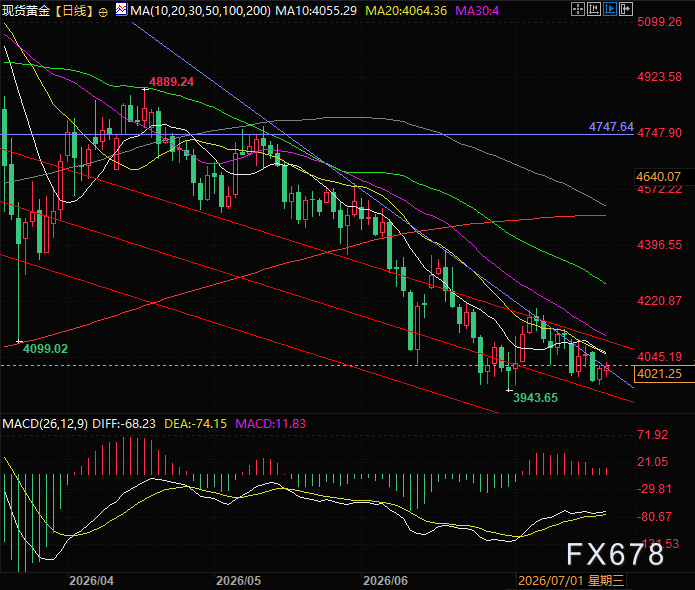
(Spot gold daily chart, source: easyMarkets)
Beijing Time 18:12, spot gold is trading at $4,020 per ounce.
Disclaimer: The content of this article solely reflects the author's opinion and does not represent the platform in any capacity. This article is not intended to serve as a reference for making investment decisions.
You may also like
Bitcoin vs. Gold: Where would $10K perform better in the next macro shock?
A Liquidity Crunch Could Spark Violent Crypto Repricing: 5 Altcoins and Memecoins Worth Risking Before Euphoria Takes Over

The Next Crypto Rally May Depend on One Simple Question: 5 Altcoins Worth Buying This Week as Washington Defines the Rules

SHIB price nears breakout as 95% of supply held by 808 wallets
Crypto prices
More


