
Euro: Entering Garbage Time

Morning FX
Since late June, the euro has been fluctuating around 1.14 against the US dollar, with a range of just 100 pips. Actual volatility has declined, and implied volatility has also dropped to a low level.One-month implied volatility has fallen below 5.0%, nearing its lowest in five years.
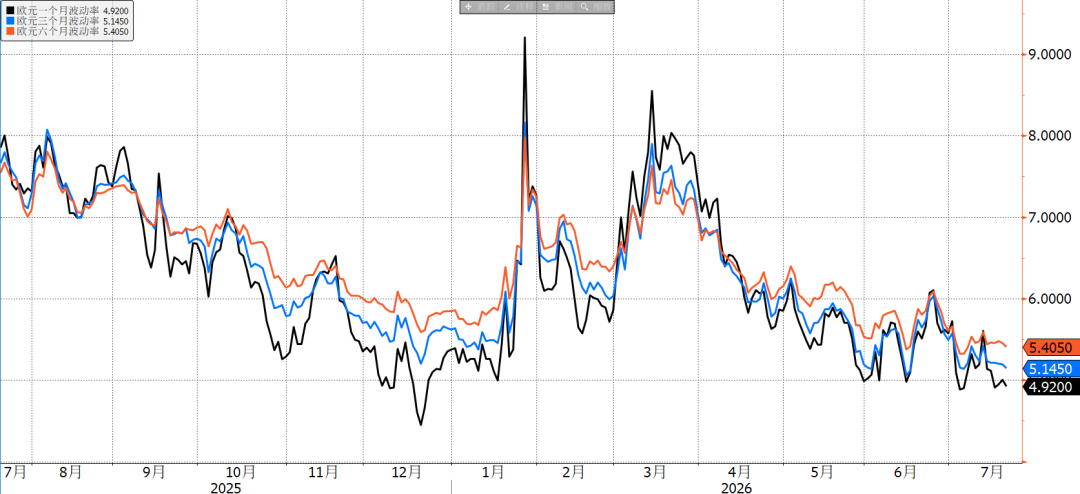
Chart: EUR/USD Implied Volatility
As the largest factor affecting the dollar index, the euro’s low volatility has directly led to an overall downturn in the forex market. After the themes of de-dollarization and aggressive monetary policy faded, the euro has entered "garbage time."
I. Monetary Policy Coming into Alignment
At the beginning of the year, the market expected the Federal Reserve to preemptively cut rates twice due to labor market pressure, while the ECB, with lower real interest rates, had the confidence to stay put.However, as crude oil prices surpassed $100, US and European monetary policy began to align.
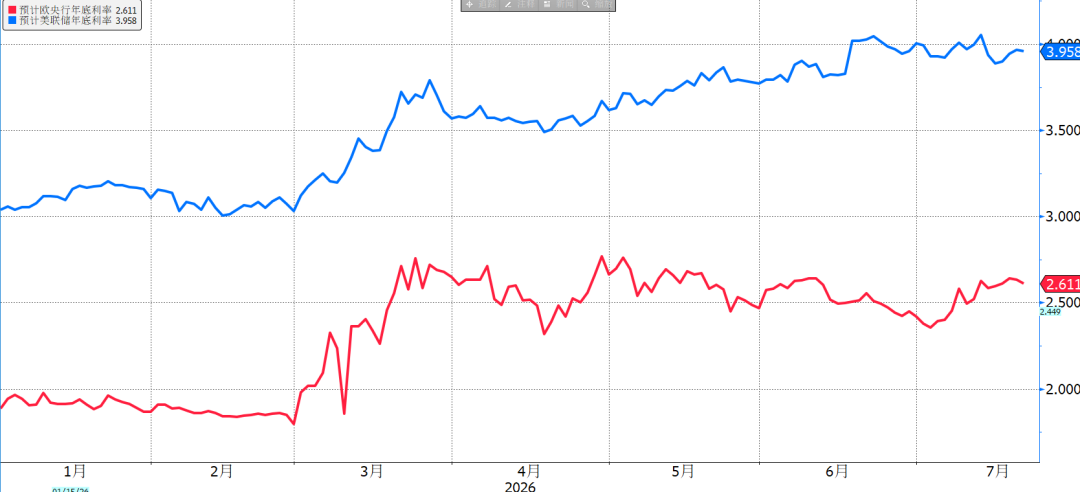
Chart: ECB and Federal Reserve Expected Policy Rates by Year-end
Although the ECB took the lead in hiking rates in June, President Lagarde dramatically changed her tone at the end of the month, indicating there was ample reason to pause moving forward. This statement defined the current inflation as a second-category external shock, meaning inflation only marginally and temporarily deviates from the target, so the central bank should adjust policy moderately and prudently.They chose a rate hike first to prevent inflation expectations from de-anchoring, then shifted to observation mode.
But the Federal Reserve's commitment to combating inflation remains unchanged. After June CPI cooled more than expected, Waller still emphasized that fighting inflation is a must, and a rate hike in July was still possible.Currently, both the ECB and the Federal Reserve have odds for one to two rate hikes this year. Policy convergence is the main reason for the euro’s low volatility.
II. A New Trade Dynamic: Euro/Yuan Drops to Lows
The war has pushed up oil prices, and subsequent China-EU trade frictions have exposed the vulnerability of the eurozone economy. Once the de-dollarization theme ends, the euro faces a structurally insufficient trade surplus.
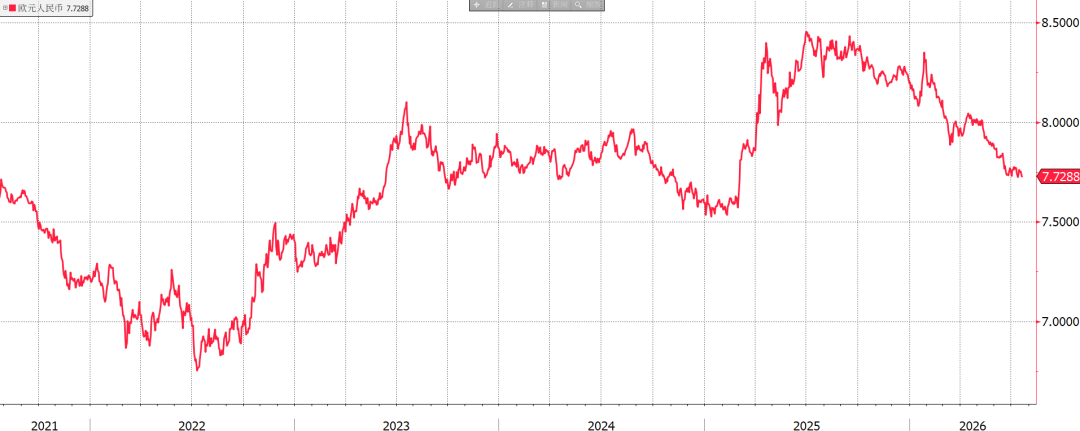
Chart: Euro/Yuan
Reflected in the exchange rate, EUR/CNY dropped from a year-high of 8.34 to the current 7.72, a depreciation second only to the yen.June trade data showed that China’s bilateral trade surplus with the EU hit a record high. As speculative positions vanish, continuous euro settlement flows will only continue to pull EUR/CNY back from inflated levels.As the competitiveness gap in exports between China and the EU widens, the euro will face both cyclical and structural downward pressure.
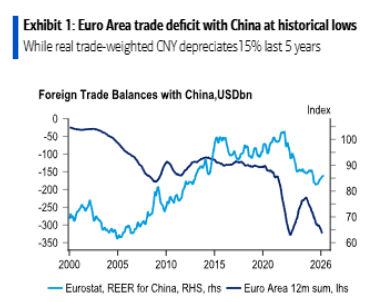
Chart: Europe’s Trade Deficit with China
III. Summary
(1) The euro has fallen into low volatility since June, with implied volatility at low levels; policy convergence between the US and Europe is the main reason.
(2) EUR/CNY has also fallen to a new low for the year as China-EU trade remains extremely unbalanced, placing structural downward pressure on the euro.
Disclaimer: The content of this article solely reflects the author's opinion and does not represent the platform in any capacity. This article is not intended to serve as a reference for making investment decisions.
You may also like
Tokenized funds expand across chains, yet liquidity remains fragmented – Why?
Japan Reportedly Plans to Double Defense Spending to 3.5% of GDP, Ministry of Defense Denies, Yet Japanese Bond Yields Hit 30-Year High
According to reports, Japanese defense officials have expressed their willingness to significantly increase defense spending during meetings with the United States. One proposal is to raise defense spending to 3.5% of GDP within ten years, while another, lower target is 3%. Japanese officials previously stated that this fiscal year's defense and related expenditures are approximately $68.8 billion, equivalent to about 1.9% of Japan's nominal GDP in 2022.
Besent Defends US Intervention to Buy Yen: Only "Symbolic" Funds Invested; Yen Appreciation Benefits US Exports and Treasury Market
U.S. Treasury Secretary Janet Yellen said on Tuesday that when the U.S. Treasury coordinated with Japan to purchase yen, only a "symbolic" amount of funds was used. She defended this rare intervention in the foreign exchange market.

Overnight US Stocks | Three Major Indexes Fall for Second Consecutive Day, 10-Year Treasury Yield Rises to Highest Level Since 2007, WTI Crude Oil Surges 4%
At the close, the Dow Jones fell 328.09 points, down 0.63%, to 52,093.10 points; the S&P 500 Index fell 34.25 points, down 0.45%, to 7,585.73 points; the Nasdaq fell 204.84 points, down 0.78%, to 25,981.57 points.

Crypto prices
More


