
Diplomatic Breakthrough Between the US and Iran Fuels Bull Run as Gold Prices Soar Near 4150! Will the Fed "Pour Cold Water"?

Huitong Net, July 22nd — The market is looking to U.S.-Iran diplomacy to ease energy prices and moderate the Federal Reserve's hawkish expectations, providing gold prices with a chance to rebound, pushing gold to near a two-week high. The "negotiation and confrontation" between the U.S. and Iran has heightened energy inflation concerns, and the probability of a Fed rate hike by year-end stands at 88%, capping the upside for gold. Technically, focus is on the $4,100 level and the 200-period moving average on the 4-hour chart; in the short term, gold is expected to maintain high volatility and a two-way oscillating pattern.
International gold prices extended their short-term bullish momentum in the Asian session on Monday (July 22), briefly touching a two-week high around $4141.59/oz (UTC+8), which is close to the 200-period moving average on the 4-hour K-line chart, and currently pulling back slightly to near $4130/oz (UTC+8). Market sentiment is delicately balanced: on one hand, the hope that U.S.-Iran diplomacy will ease energy prices and dampen the Fed's hawkish expectations offers a rebound opportunity for gold; on the other hand, ongoing geopolitical tensions and persistently high rate hike odds maintain caution among gold bulls.
After four consecutive days of strengthening, the U.S. Dollar Index paused, giving gold prices a breather. The core dilemma is that investors are weighing the likelihood of the Fed maintaining a tightening stance to curb energy-driven inflation, against the geopolitical risk premium from the uncertain U.S.-Iran situation.
Diplomatic Engagement and Military Strikes in Parallel, Middle East Tensions Touch Global Nerves
U.S. Secretary of State Marco Rubio stated on Sunday that Washington remains open to talks with Tehran, a signal interpreted by markets as a possible sign of easing tensions. Meanwhile, Iran's Interior Minister Eskandar Momeni visited intermediary Pakistan, asking Islamabad to continue its mediation role, indicating that diplomatic channels are not entirely closed.
Beneath this surface of peace, however, military confrontation has intensified rather than eased. The U.S. military confirmed that it had carried out the 11th round of night strikes on Iranian mainland targets on Wednesday morning, focusing on destroying aircraft hangars and drone storage facilities. Iran, for its part, ramped up harassment of U.S. assets in the Gulf region, with targets expanding to military sites in Bahrain, Kuwait, and Jordan. Further rattling the energy markets, Iranian forces attacked two oil tankers attempting to pass through the Strait of Hormuz, while Yemen’s Houthi forces announced a maritime blockade on Saudi Arabia, making the conflict increasingly multi-front.
U.S. Secretary of State Rubio stated on Wednesday that the United States remains open to resolving the Middle East conflict, and is willing to engage with Iran in talks to address differences, but that Tehran has not approached negotiations seriously.
“If they take the talks seriously, we will as well; if not, we will take necessary measures to safeguard both our interests and those of our allies.”
Energy Inflation Shadow Looms, Fed Rate Hike Expectations Heat Up
Heightened transit risk in the world’s energy chokepoint, the Strait of Hormuz, has directly pushed crude oil prices to the highest level since June 12. The surge in energy costs is reviving market fears of imported inflation, which could force the Federal Reserve to maintain its hawkish monetary policy as price pressures return.
The CME Group’s FedWatch tool shows that traders now estimate an 88% probability the Fed will raise rates at least once more by year-end. This expectation has boosted U.S. Treasury yields and raised the holding cost of non-yielding assets like gold, capping gold’s upside.
OCBC analysts point out that in the current macro environment, gold is likely to trade in a “range-bound two-way oscillation pattern,” with any rebound facing tough resistance. They believe a sustained gold rally would require three preconditions: a significant pullback in oil prices, a moderate fall in real yields, and a cooling of Fed tightening expectations. Until these conditions are met, gold's upside will remain capped.
Technical Perspective: $4,100 Level Becomes the Short-term Pivot
From a technical standpoint on the 4-hour chart, if gold can effectively break through the 38.2% Fibonacci retracement level of the mid-June downtrend (at $4120), the short-term bullish signal will strengthen further. Current momentum indicators remain firm, with the 14-day Relative Strength Index (RSI) rising to around 72, near overbought territory; the Moving Average Convergence Divergence (MACD) remains above zero, indicating that buying momentum has not yet faded.
However, bulls should exercise caution, as a more sustainable uptrend requires gold to consistently close above the 4-hour 200-period Simple Moving Average (SMA, now around $4,138).
On upside targets, should gold break the 200-period SMA resistance, the next target will be the 50.0% Fibonacci retracement ($4,170), then a challenge at the 61.8% retracement ($4,220). On the broader time frame, the 78.6% Fibonacci level ($4,282) and the previous cycle high at $4,382 form the ultimate medium-term bull target zone.
On the downside, near-term support levels are at the $4,100 mark, the 38.2% retracement ($4,120), and the 23.6% Fibonacci level ($4,059). If these supports fail, gold may again test support at $4,000, and could even accelerate down towards the structural low near $3,943.
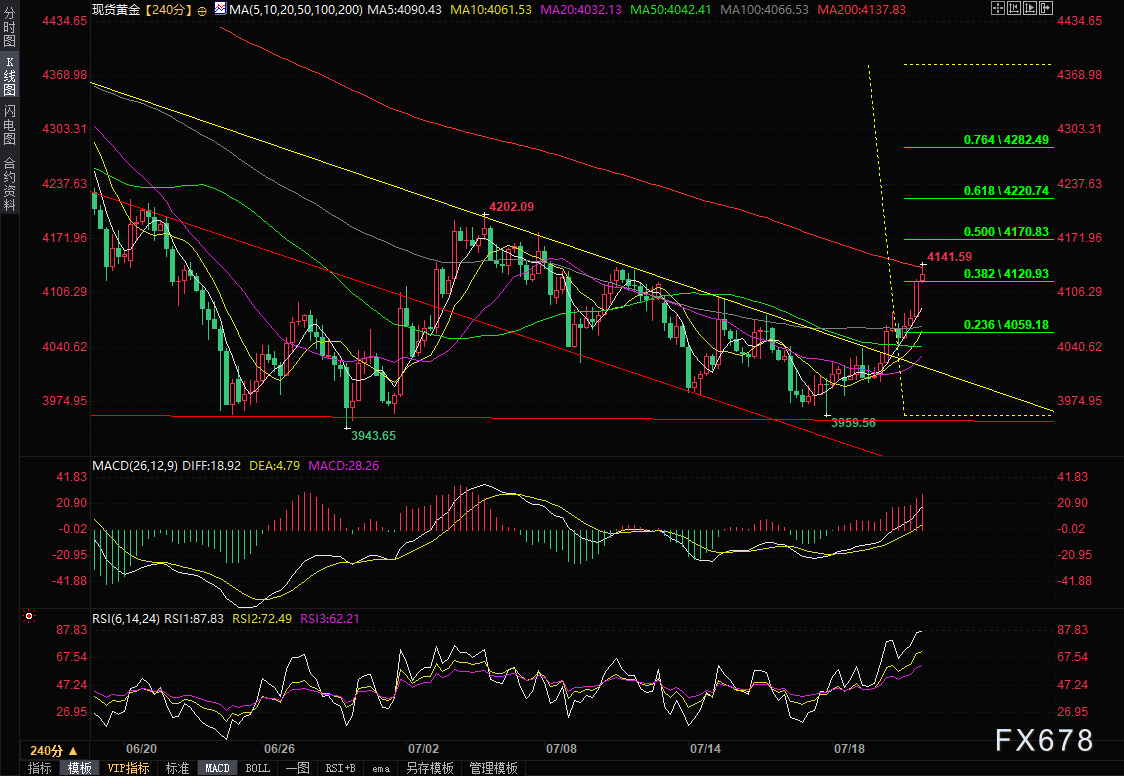
(Spot gold 4-hour chart, source: YiHuitong)
Editor’s Summary
The gold market is currently caught between geopolitical risk premium and tightening monetary policy expectations. Technical dip-buying gives gold support, but the unpredictable nature of U.S.-Iran talks keeps energy prices prone to rising, intensifying global inflation concerns and solidifying expectations that the Fed will maintain high interest rates—thus exerting pressure on gold. Technically, gold sits above key Fibonacci support, but faces the dual test of the 200-period moving average and overbought conditions. In the short term, gold’s trend will be highly dependent on developments in the Middle East and U.S. inflation data, with the $4,100 level serving as a key reference for the next direction.
At 13:57 (UTC+8), spot gold is quoted at $4128.85/oz.
Disclaimer: The content of this article solely reflects the author's opinion and does not represent the platform in any capacity. This article is not intended to serve as a reference for making investment decisions.
You may also like
Bitcoin: $85M whale buy meets Fed FUD – Is BTC setting up a bear trap?
SHIB Bulls Face a Test as 463 Billion Tokens Move in Just 24 Hours

Chainlink price hovers above $11.46 support, trades 78% below all-time high
Apple’s foldable display supplier Samsung to pocket $1.8 billion from iPhone Duo
Crypto prices
More


