
Galaxy pledges $5M for developers quantum-proofing Bitcoin

Galaxy Digital has pledged up to $5 million in grants to open-source developers building post-quantum cryptography for Bitcoin.
The company also formed a quantum advisory council under its Bitcoin Quantum Readiness Initiative, which it announced Tuesday. The council includes Barry Sanders, professor and scientific director of Quantum City at the University of Calgary; Damien Bérubé, an MIT Sea Grant Knauss fellow; and Eran Tromer, professor of computer science at Boston University.
The grants will fund quantum-resistant upgrade proposals, post-quantum cryptography, Bitcoin signature schemes, wallet and custodian migration tooling and formal security audits.
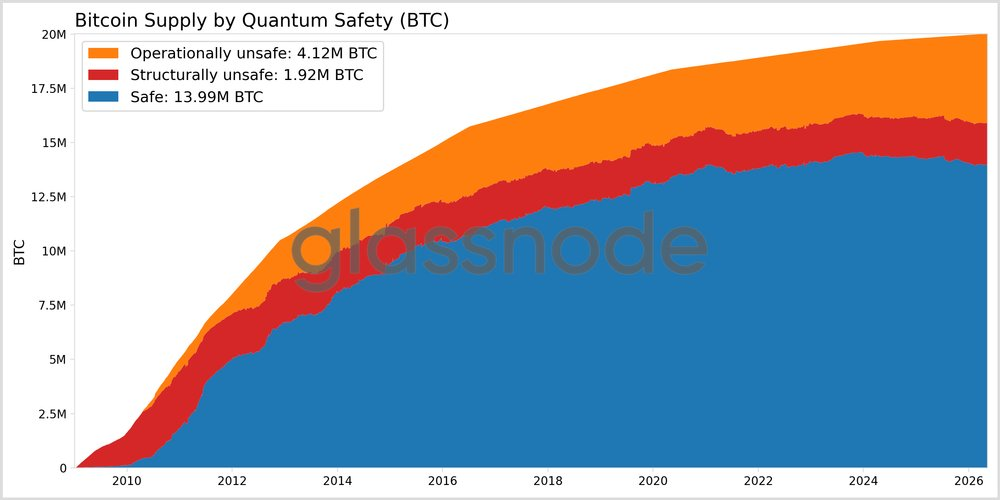
Bitcoin’s quantum security is a growing concern, as about 30% of Bitcoin’s supply could be exposed if cryptographically relevant quantum computers emerge, according to analytics provider Glassnode. This includes 10% of the supply considered “structurally unsafe” because of its output type, and 20% considered “operationally unsafe” because of key or address management practices.
Community split over quantum breakthrough timeline
The timeline for a practical quantum computing breakthrough remains hotly debated.
In November 2025, Blockstream CEO Adam Back that Bitcoin faces no meaningful quantum threat for at least the next 20 to 40 years. Back said this gives the network ample time to adopt the post-quantum cryptography standards approved by the US Department of Commerce’s National Institute of Standards and Technology (NIST).
In August 2024, NIST published three post-quantum cryptography standards for key establishment and digital signatures. The standards include key exchange, digital signature and hash-based signature algorithms that could underpin future post-quantum migrations across industries, including potential Bitcoin upgrades.
In December 2025, Blockstream Research released a paper proposing a hash-based signature scheme as a “promising path for securing Bitcoin in a post-quantum world.” The proposal would replace Bitcoin’s ECDSA and Schnorr signatures with a scheme whose security relies solely on cryptographic hash functions.
Wealth management company Bernstein said in an April report that Bitcoin has about three to five years to prepare for a post-quantum security upgrade.
Disclaimer: The content of this article solely reflects the author's opinion and does not represent the platform in any capacity. This article is not intended to serve as a reference for making investment decisions.
You may also like
Bitcoin: $85M whale buy meets Fed FUD – Is BTC setting up a bear trap?
SHIB Bulls Face a Test as 463 Billion Tokens Move in Just 24 Hours

Chainlink price hovers above $11.46 support, trades 78% below all-time high
Apple’s foldable display supplier Samsung to pocket $1.8 billion from iPhone Duo
Crypto prices
More


