
The CPU Roadmap Battle in the Agent Era: Nvidia Bets on “Faster Single-Core”, AMD Bets on “More Concurrency”

The competition between Nvidia and AMD is not just about whose CPU is faster, but who gets to define the evaluation standard for CPUs in the AI era.
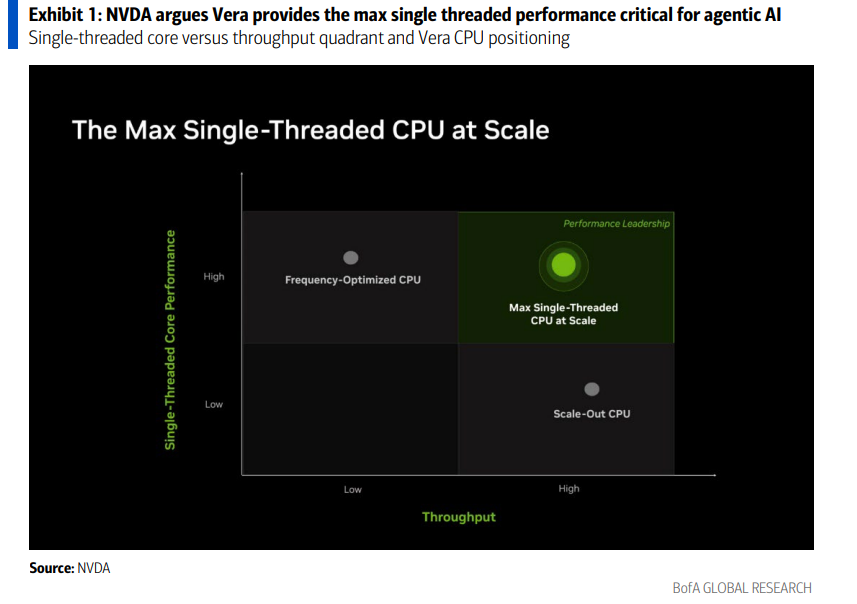
Nvidia recently disclosed the most detailed technical specifications of its Vera CPU architecture. This processor is equipped with 88 custom Olympus ARM architecture cores, a memory bandwidth of 1.2TB/s, and an on-chip interconnect bandwidth of 3.4TB/s. Nvidia's core argument is: the operational flow of AI Agents involves intensive CPU-GPU interactions—tool invocation, code execution, data retrieval, task orchestration—each step relies on the completion of the previous one, thus the single-core speed and latency of the CPU directly determine the overall response efficiency of the Agent.
On July 23, according to The Block Trader, Bank of America Securities analyst Vivek Arya stated in his latest report that the release of Vera introduces a new evaluation framework to the industry: "maximum single-threaded performance at scale." This is in direct contrast to AMD’s long-standing chiplet multi-core stacking approach. The bank characterizes this debate as: "Is the bottleneck for AI Agents the time it takes to complete a single task, or how many concurrent tasks can run on a single rack?" AMD will hold its AI 2026 Technology Day this Thursday, which will mark the company's first official response to this framework.
This debate arises at a time when the server CPU market is being reshaped by AI demand, with the market size expected to grow about fourfold from current levels to $170 billion by 2030. This is not a competition over an existing pie, but an incremental market in the making—whoever establishes the industry-accepted performance standard first, wins the pricing and narrative power.
Nvidia's logic: It’s more important for Agents to run fast than to run many concurrently
Nvidia’s description of the Agent workflow is very specific: during task completion, a significant amount of serialized interaction occurs between CPU and GPU, with each invocation waiting on the previous step before proceeding. This means any latency at any stage accumulates and magnifies, eventually slowing down the output efficiency of the entire AI factory.
Within this logic, single-core performance is not just a parameter on a spec sheet—it’s a critical variable that directly impacts GPU utilization—the faster the CPU, the less time the GPU spends waiting, resulting in higher resource utilization for the entire system. In other words, the faster the single-core, the faster the entire response chain.
There’s another design choice in Vera worth noting: Nvidia chose a monolithic die rather than a chiplet-based architecture, arguing that the former provides better "scalable consistency." This stands in direct opposition to AMD’s long-standing bet on chiplets, indicating that the two companies’ foundational philosophy on architecture has deeply diverged.
Moreover, Vera is not an isolated product, but a component of Nvidia's "co-designed" AI infrastructure ecosystem, working alongside the Rubin GPU, Groq LPX, Spectrum switches, and BlueField storage/NICs. This kind of system-level integration forms Nvidia’s true moat beyond just hardware comparisons.
AMD’s counter: In real AI production, it’s about concurrent capacity
AMD’s position is based on a different definition of the “real production environment.”
In AMD’s view, production-grade AI systems are not about a single Agent advancing tasks serially, but resemble a distributed software platform composed of databases, APIs, vector stores, orchestration engines, caches, and middleware. In this scenario, the bottleneck is not the speed to complete a single task, but rather how many workflows can be supported simultaneously within a fixed power budget.
AMD presented a concrete set of calculations: in a simulated 100-kilowatt rack deployment, EPYC 9965 (Turin) delivers about 2.4 times the rack-level throughput of Nvidia Vera; the next-generation EPYC 6 (Venice) is expected to reach 3.3 times.
AMD’s logic: higher throughput density means the same power consumption can serve more users and handle more requests—this, it argues, is the real cost function for cloud AI deployments.
AMD x86 or Nvidia ARM: Software ecosystem is the hidden battleground
The CPU architecture battle also extends to the instruction set level.
Nvidia’s choice of ARM architecture indicates its belief that if the microarchitecture is good enough, instruction set compatibility becomes secondary. However, AMD and Intel are likely to keep emphasizing the opposite after Thursday—AI is expanding from model inference into enterprise software workflows, while the software stack for enterprises (covering databases, middleware, security platforms, enterprise applications, etc.) has built up decades of optimization, validation, and compatibility on the x86 ecosystem.
This is not a simple technical discussion. As AI workloads are increasingly embedded into existing enterprise IT systems, the historic accumulation of the software ecosystem might be even harder to replace than hardware peak performance. Whether Nvidia can leverage Vera to penetrate these scenarios largely depends on how quickly the ARM software ecosystem matures.
The standards war: Who will define the next CPU KPI?
Two frameworks, two sets of KPIs—in essence, two companies are battling for control of the industry narrative.
Nvidia’s framework centers around latency, single-threaded progress, and GPU utilization. AMD’s framework focuses on concurrency, throughput, and service density.
The key question: Which metric will the market ultimately use to purchase server CPUs?
According to Bank of America, the focus of AMD’s event this Thursday is not to beat competitors with benchmark scores, but to persuade the industry to adopt its own evaluation system. Whichever company’s framework data center buyers adopt will hold pricing power in this $170 billion market.
Nvidia maintains a "Buy" rating on NVDA, with a target price of $350 (current price is $207.29).
Disclaimer: The content of this article solely reflects the author's opinion and does not represent the platform in any capacity. This article is not intended to serve as a reference for making investment decisions.
You may also like
Silver rallies 1.4% to $65 as bulls target $66 after US CPI data
PEPE Price Prediction: Bulls Eye a Fresh Rally as Momentum Builds

All Eyes on Walsh: Will the "Central Bank Super Week" See a G7 Rate Hike Wave Next Week?
Amid rising inflation, geopolitical conflicts, and oil prices surpassing $100, G7 central banks are entering a crucial rate-setting week. Driven by higher-than-expected core inflation, the Federal Reserve is expected to implement its first rate hike in three years; the Bank of Japan is likely to raise rates to 1.25%, marking a 30-year high; meanwhile, the Bank of England, the European Central Bank, and the Bank of Canada are also reinforcing their hawkish stances. Global monetary policy is undergoing a major turnaround towards collective tightening.
Uniswap processes $70.6 billion in 30-day DEX trades, outpacing rivals
Crypto prices
More


