
US-Iran Tensions Drive Safe-Haven Buying, Gold Continues to Rebound

Huitong Finance, July 23—— Gold prices continued their rebound during Asian trading on Thursday, with XAU/USD rising to around $4,120. Ongoing tensions in the Middle East are pushing safe-haven funds back into the precious metals market, while the market is also closely watching changes in US monetary policy. Although geopolitical risks are providing support for gold, elevated expectations for Federal Reserve rate hikes and rising inflationary pressures from higher energy prices may limit further upside for gold prices.
Spot gold prices continued to climb in early Asian trading on Thursday, with XAU/USD trading around $4,120 and extending its recent rebound. As global risk aversion heats up again, investors have increased their allocation to gold, providing short-term support for the precious metals market. The recent rise in gold has been mainly driven by ongoing tensions in the Middle East. The conflict between the US and Iran has entered its second week, and the market worries that related incidents could further affect the security of energy transportation and the performance of global risk assets. The US has stated that it would respond to any Iranian actions targeting shipping in the Strait of Hormuz with measures against relevant infrastructure; Iran, on the other hand, has warned that if the US takes further action, it will retaliate against relevant US infrastructure and regional energy facilities.
The market believes that the current geopolitical risks are once again reinforcing gold’s safe-haven attributes.
Meanwhile, the US continues to emphasize that diplomatic channels are still available while maintaining strong pressure, leading the market to remain cautious about future developments. US Secretary of State Marco Rubio previously stated that Iran lacks sufficient sincerity in reaching an agreement, but the US still remains committed to addressing regional issues through diplomatic means. Beyond geopolitical factors, the gold market is also affected by monetary policy expectations. Recently, the market has begun to adjust its expectations for the Federal Reserve’s policy path. According to market rate tools, investors see a much higher probability that the Fed will raise rates in the near term, with the chance of a hike this month rising to about 34%, up from about 10% a week ago. At the same time, the probability that the market expects at least a 25 basis point hike in September has increased to about 78%.
Changes in interest rate expectations typically put pressure on gold, as gold itself does not generate interest yield. When the market believes rates are likely to stay higher for longer, the opportunity cost of holding gold increases. Even so, at present, geopolitical risks remain the dominant factor, supporting gold’s resilience. According to TD Securities senior commodity strategist Ryan McKay, the recent rebound in gold has been mainly driven by flows, as some investors bought the dip after finding support around $4,000. However, he believes this does not necessarily mean gold has started a new long-term uptrend, as a rebound in energy prices could re-stoke inflationary pressures and limit room for further gains.
Energy price fluctuations are also an important variable for gold’s subsequent trend. If crude oil continues to rise due to ongoing supply risks, the market may once again worry about global inflation pressures, which would affect Federal Reserve policy expectations. On one hand, inflation worries could boost gold’s appeal as an inflation hedge; on the other hand, a higher interest rate environment could suppress gold’s valuation, meaning the market could be caught in a tug-of-war between these two forces.
Currently, investors are focusing on three core factors: first, whether Middle East tensions will continue to escalate; second, whether US interest rate expectations will shift further towards the hawkish side; third, the trend of the dollar index and US Treasury yields. If the dollar weakens while safe-haven demand remains, gold may continue to find upside momentum; but if rate hike expectations intensify, gold prices could face correction pressure.
Gold’s daily chart shows that after finding clear support around $4,000, XAU/USD rallied and is now retesting the $4,120 level. The short-term trend is gradually improving, moving averages are beginning to recover, and bullish sentiment is making a comeback. On the topside, resistance lies in the $4,150 to $4,180 range; if this is breached, it could further challenge the $4,200 round number. On the downside, watch support at $4,050 first, followed by the key psychological level at $4,000. The MACD shows bearish momentum weakening and bulls regaining strength, but it’s still necessary to be wary of risks from volatility at higher levels.
On the 4-hour chart, gold prices are maintaining a choppy rebound, with short-term moving averages providing upward support and the RSI rising into stronger territory, showing increased buying momentum. However, with prices now approaching previous resistance, if gold fails to break above the $4,150 area, a technical pullback may occur. If the price holds above $4,100, there is still upside potential in the short term; if it falls below $4,050, it could retest support around $4,000.
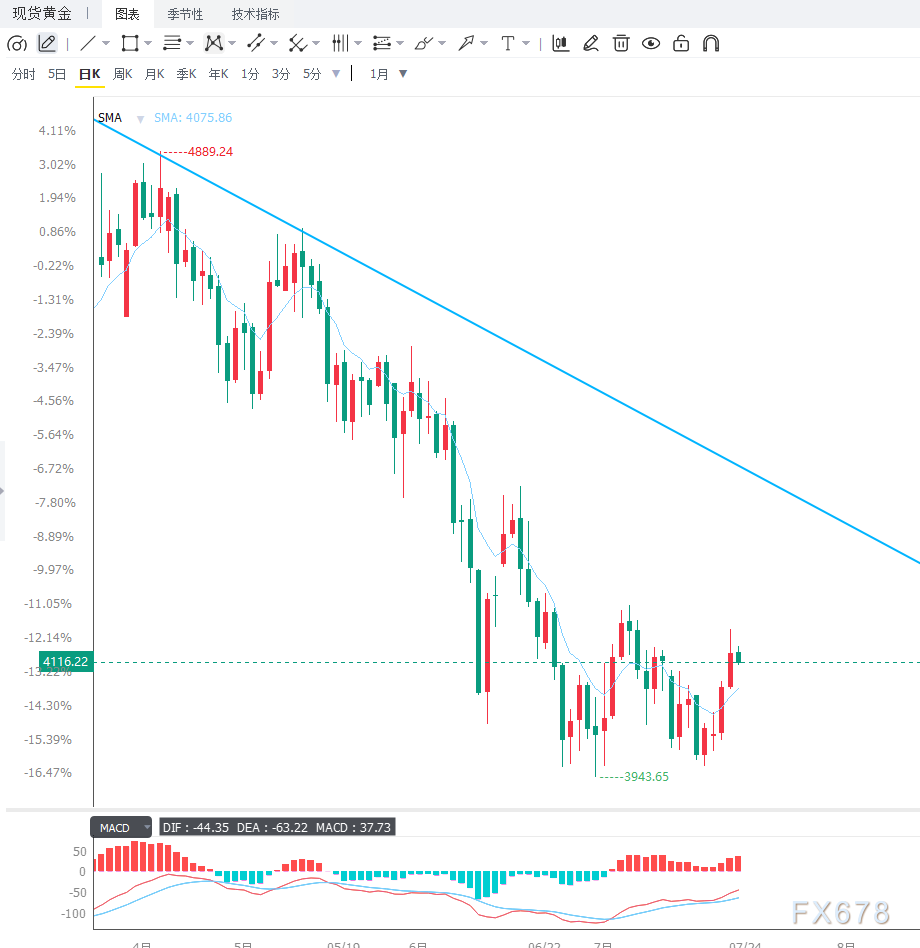
Gold’s recent rebound has been mainly driven by safe-haven demand, rather than a complete shift in fundamental trends. The ongoing escalation in the Middle East has brought capital back to focus on gold’s safe-haven value, pushing prices back above $4,100. At the same time, however, stronger expectations of rate hikes from the Federal Reserve and policy pressures from rising energy prices could still cap gold’s upside potential.
The future trend of gold will depend on the balance between risk events and monetary policy. If geopolitical risks continue to escalate, gold may challenge the $4,200 region; but if the market refocuses on the high interest rate environment, gold prices may enter a phase of range-bound consolidation. The gold market remains in a high-volatility state, so investors need to closely monitor safe-haven flows, the trend of the US dollar, and changes in Federal Reserve policy signals.
Disclaimer: The content of this article solely reflects the author's opinion and does not represent the platform in any capacity. This article is not intended to serve as a reference for making investment decisions.
You may also like
Silver rallies 1.4% to $65 as bulls target $66 after US CPI data
PEPE Price Prediction: Bulls Eye a Fresh Rally as Momentum Builds

All Eyes on Walsh: Will the "Central Bank Super Week" See a G7 Rate Hike Wave Next Week?
Amid rising inflation, geopolitical conflicts, and oil prices surpassing $100, G7 central banks are entering a crucial rate-setting week. Driven by higher-than-expected core inflation, the Federal Reserve is expected to implement its first rate hike in three years; the Bank of Japan is likely to raise rates to 1.25%, marking a 30-year high; meanwhile, the Bank of England, the European Central Bank, and the Bank of Canada are also reinforcing their hawkish stances. Global monetary policy is undergoing a major turnaround towards collective tightening.
Uniswap processes $70.6 billion in 30-day DEX trades, outpacing rivals
Crypto prices
More


