
Coffee and cocoa costs surge! Nestlé lowers profit margin forecast, share price plunges with largest drop since 2020

Soaring coffee and cocoa prices are eroding Nestlé's profitability.
The Swiss food giant lowered its profit margin outlook for the second half of the year on Thursday, and combined with sales growth falling short of some investors' expectations, the stock price plunged nearly 7% in a single day—marking the biggest one-day drop since 2020.
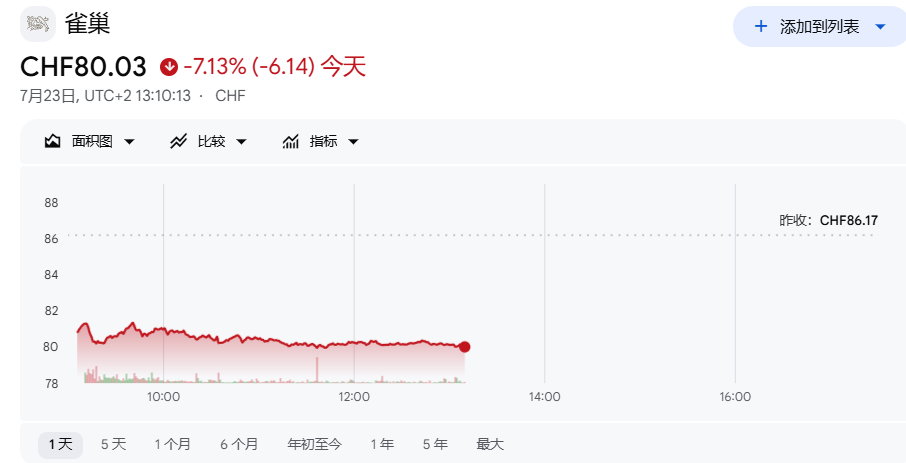
Nestlé stated that, dragged down by rising coffee and cocoa raw material costs, the company’s operating profit margin in the first half of this year slipped 0.1 percentage points year-on-year to 16.4%, and operating profit fell 2.8% to 7.1 billion Swiss francs (approximately $8.7 billion). The company subsequently revised its second-half profit margin outlook from "improving compared to the first half" to "roughly in line with the first half," disappointing market expectations.
This earnings hit comes at a crucial turning point as Nestlé’s new management is pushing for a comprehensive transformation. Newly appointed CEO Philipp Navratil and Chairman Pablo Isla—who previously led Inditex—are working on streamlining the group’s complex organizational structure and divesting certain businesses. Before the earnings release, the stock had risen due to market optimism, but the disappointing results erased all previous gains.
Sales Growth Falls Short of Expectations, Multiple Cost Pressures
Nestlé’s sales growth in Q2 was the main disappointment of this earnings report. The market had widely expected 2% sales growth; the actual figure was 1.8%. While this matched the consensus among analysts, it fell short of the higher expectations from some investors.
Barclays analyst Warren Ackerman said, "Given the previous rise in the stock price, this sales number isn't good enough."
In addition to raw material costs, Nestlé is also facing multiple additional pressures. The company pointed out that operating profit margins were also affected by increased marketing expenses, tariff impacts, and the recall of infant formula products earlier this year. This recall involved products potentially contaminated with cereulide—a toxin that can cause nausea and vomiting.
Revenue Exceeds Expectations, Price Increases Support Top-Line Growth
Despite margin pressures, Nestlé's Q2 revenue still outperformed expectations. During the period, sales grew by 3.7%, with price increases contributing 1.9 percentage points, partially offsetting the impact of rising costs.
However, analysts’ concerns over margin outlook overshadowed the revenue highlights. Bernstein analyst Callum Elliott said the revised lower margin guidance for the second half "tarnished what would otherwise have been a decent set of results from Nestlé."
Water Business Joint Venture Brings in Private Equity
Along with the earnings release, Nestlé announced a joint venture for its water business with private equity firm Platinum Equity, establishing a multi-billion-euro partnership which will bring Nestlé 3 billion euros in funding.
The new joint venture will be named Peranel, with both parties holding a 50% stake. The overall valuation is 4.9 billion euros, covering 30 brands sold in 120 countries, including San Pellegrino, Perrier, and Acqua Panna. The deal is regarded as part of Nestlé’s continued strategy of optimizing its asset portfolio and focusing on core business.
Disclaimer: The content of this article solely reflects the author's opinion and does not represent the platform in any capacity. This article is not intended to serve as a reference for making investment decisions.
You may also like
PEPE Price Prediction: Bulls Eye a Fresh Rally as Momentum Builds

All Eyes on Walsh: Will the "Central Bank Super Week" See a G7 Rate Hike Wave Next Week?
Amid rising inflation, geopolitical conflicts, and oil prices surpassing $100, G7 central banks are entering a crucial rate-setting week. Driven by higher-than-expected core inflation, the Federal Reserve is expected to implement its first rate hike in three years; the Bank of Japan is likely to raise rates to 1.25%, marking a 30-year high; meanwhile, the Bank of England, the European Central Bank, and the Bank of Canada are also reinforcing their hawkish stances. Global monetary policy is undergoing a major turnaround towards collective tightening.
Uniswap processes $70.6 billion in 30-day DEX trades, outpacing rivals
Morgan Stanley’s $50.6M BTC buying shields market – But rally to $82K has THIS hurdle
Crypto prices
More


