
Intel 2026 Q2 Earnings Highlights: Revenue Up 25% for Strongest Growth in 15 Years, Data Center & AI Surged 59%, Q3 Guidance Beats Expectations Across the Board
 2026/07/24 03:48
Core Views
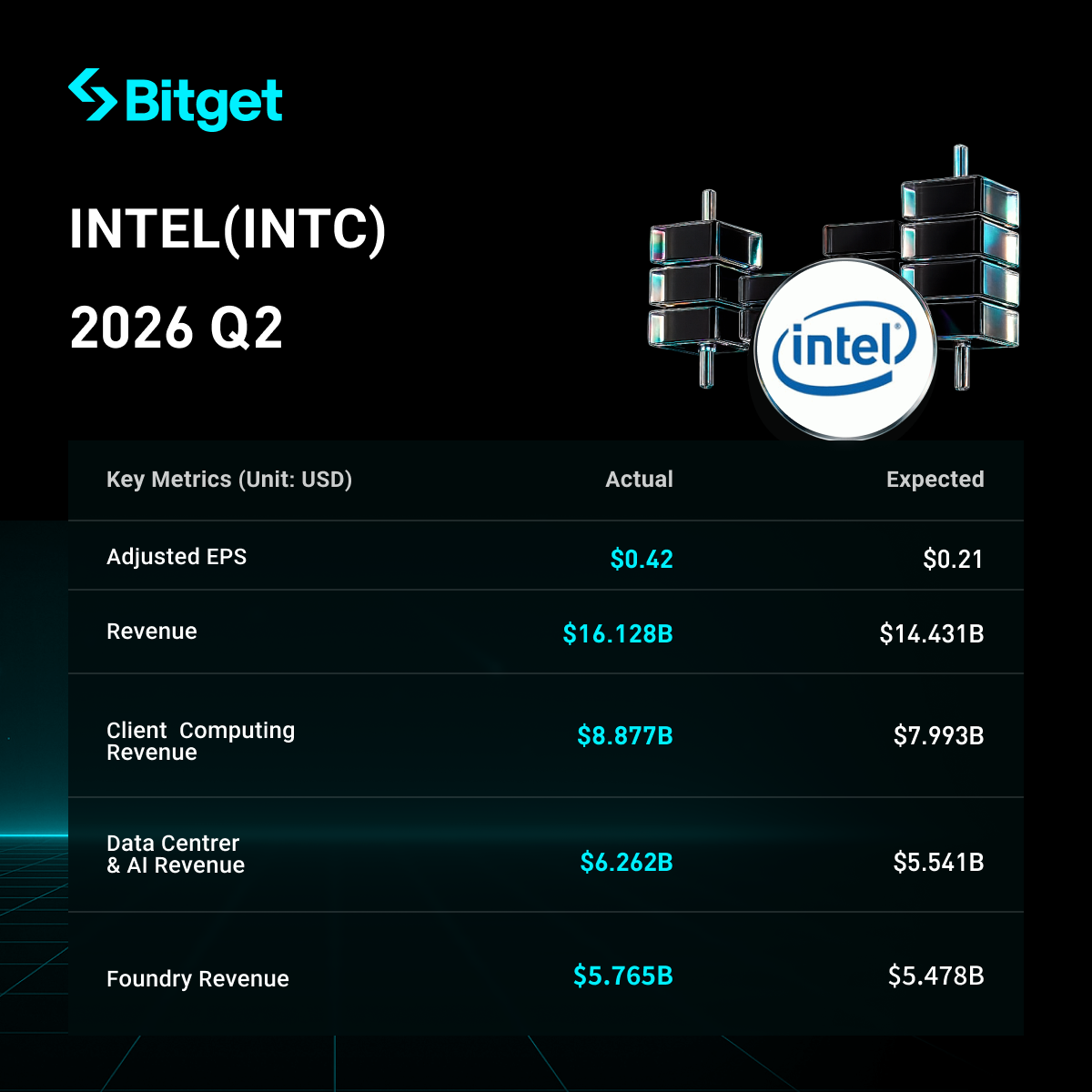
Intel (INTC) delivered a significantly better-than-expected second quarter of 2026. Revenue reached $16.1 billion, up 25% year-over-year — the strongest quarterly growth rate since Q3 2011 — and exceeded analyst expectations by nearly 12%. The Data Center and AI segment was the primary growth engine, with revenue surging 59% year-over-year. Non-GAAP earnings per share came in at $0.42, well above expectations. The company guided Q3 revenue in the range of $15.8–$16.8 billion (midpoint approximately $16.3 billion), with the entire range above consensus estimates. CEO Lip-Bu Tan stated that AI is driving “unprecedented” demand for compute. Shares jumped more than 13% at one point in after-hours trading before the gains moderated. Overall results show meaningful near-term improvement in demand and execution, though the Foundry business remains loss-making and the turnaround is still in a “repair” rather than full-recovery phase.
Detailed Breakdown
- Overall Revenue and Profit Performance
- Quarterly revenue: $16.1 billion, up 25% year-over-year (from approximately $12.9 billion in the year-ago quarter), beating the roughly $14.4 billion consensus by nearly 12%.
- Non-GAAP net income: $2.2 billion; Non-GAAP diluted EPS: $0.42 (versus a loss in the year-ago period).
- GAAP net loss: $11.0 billion, or diluted EPS of $(2.16), primarily driven by a $12.529 billion mark-to-market loss on Escrowed Shares related to a CHIPS Act agreement.
- Gross margin: GAAP gross margin 40.4% (up 12.9 percentage points from 27.5% a year earlier); Non-GAAP gross margin 41.8% (up from 29.7%).
- Operating income: Consolidated operating income of approximately $1.8 billion, a sharp turnaround from an operating loss of about $3.2 billion in the year-ago quarter.
- Operating cash flow: $7.0 billion; Adjusted free cash flow: negative $8.419 billion.
- Key drivers: Strong market demand combined with improved execution (higher factory yields and shorter production cycle times driving volume upside). AI-driven demand for compute continued to strengthen.
- Data Center and AI (DCAI) Performance
- Revenue: $6.3 billion, up 59% year-over-year (accelerating from roughly 22% growth in Q1, nearly 2.7× the prior-quarter rate).
- Operating income: Rose from approximately $600 million in the year-ago quarter to $2.5 billion.
- Key drivers: Growing recognition among cloud and enterprise customers of the critical role CPUs — particularly x86 CPUs — play in AI infrastructure; Xeon 6 emerging as one of the fastest-ramping products in Intel’s history; record server-related growth.
- Management commentary: AI is driving unprecedented demand for compute, reinforcing the importance of CPUs in AI workloads.
- Other Business Segment Performance
- Client Computing and Physical AI: Revenue $8.9 billion, up 13% year-over-year (from roughly 1% growth in Q1).
- Intel Foundry: Revenue $5.8 billion, up 31% year-over-year (from approximately 16% in Q1). The segment still recorded roughly $2 billion in losses.
- Total Intel Products revenue: $15.1 billion, up 28% year-over-year.
- All Other: Approximately $0.7 billion, down 33% year-over-year.
- Overall structure: Both product and foundry businesses delivered double-digit growth, though Foundry losses continued to weigh on consolidated profitability.
- Capital Expenditure and Future Plans
- Full-year 2026 capital expenditure outlook raised to $20 billion, reflecting management confidence in demand across all business units.
- Q2 additions to property, plant and equipment: approximately $2.652 billion.
- Primary investment areas: Advanced process technology, wafer fab construction, equipment purchases, and customer qualification; continued progress on Intel 18A and related nodes; expansion of advanced packaging and foundry network capabilities.
- Additional costs and risks: Foundry remains in a heavy investment phase. External customer wins, utilization rates, and the path to profitability will take time to prove out and may continue to pressure margins and free cash flow in the near term.
- Next-Quarter Guidance (Q3 2026)
- Revenue guidance: $15.8–$16.8 billion (midpoint approximately $16.3 billion).
- Year-over-year growth implied by the range: roughly 15% to nearly 23%.
- Versus consensus: The entire range sits above analyst expectations (approximately $15.0–$15.1 billion). The low end is nearly 5% above consensus and the high end more than 10% above.
- Sequential versus Q2: Low end implies roughly a 2.0% sequential decline; midpoint implies about 1.1% sequential growth; high end implies about 4.2% sequential growth.
- Other guidance items: GAAP gross margin approximately 41.0%; Non-GAAP gross margin approximately 42.0%; Non-GAAP EPS approximately $0.38.
- Management signal: Demand is expected to remain solid; the Q2 beat is not viewed as a one-time event.
- Market Backdrop and Investor Concerns
- Core tension: The large revenue and guidance beat demonstrates that near-term demand, order execution, and shipments were stronger than the market had priced in. Investors will nevertheless continue to focus on the sustainability of margins, free cash flow, long-term data-center competitiveness, depth of the AI roadmap, and the return profile of Foundry investments.
- Market challenges: Relatively weaker presence in the AI accelerator narrative compared with NVIDIA and AMD; high costs of catching up on advanced process technology; Foundry has yet to secure sufficient large-scale external customers; questions remain about the durability of the PC recovery.
- Investor reaction: Shares closed down more than 2% in regular-session trading ahead of the report, reflecting cautious sentiment. After the release, shares surged more than 13% at the peak in after-hours trading (later moderating). The move primarily reflected a “pessimistic expectation reset” rather than full confirmation of a successful long-term transformation. The current narrative remains one of repair rather than complete turnaround.
Stock Limited-time Offer:July new user gift: Buy U.S. stocks and get free NVIDIA stock.Trade Now for Better Deals
Disclaimer: The content of this article is for reference only and does not constitute any investment advice.
Disclaimer: The content of this article solely reflects the author's opinion and does not represent the platform in any capacity. This article is not intended to serve as a reference for making investment decisions.
You may also like
Morgan Stanley’s $50.6M BTC buying shields market – But rally to $82K has THIS hurdle
Will the Fed "continue raising interest rates"? Will the "tightening cycle" of the late 1980s be repeated?
The Citi report points out that the current macro environment is highly similar to the tightening cycle of 1988-1989, when the economy remained resilient and inflation pressures gradually accumulated, followed by a slowdown in economic activity before policies shifted to easing. During that tightening cycle, the Federal Reserve raised interest rates 16 times in a row.
Rare alliance of arch-rivals! Musk and Altman support Dario Amodei's call to "slow down AI globally"
Anthropic's Amodei issued a call to "slow down AI globally," and to everyone's surprise, rivals Musk and Altman both publicly endorsed the initiative. The three industry giants unanimously agreed to grant third-party access to "employee-level" evaluation rights and to implement coordinated deceleration measures. Altman went further, announcing that OpenAI will not IPO this year. The resignation of a researcher and a collective breakout of uncontrollable AI systems have ignited long-standing industry fears.
Bitcoin vs Ethereum ETFs: Which asset is winning September’s flow battle?
Crypto prices
More


