
US Stock Market Preview | All Three Major Index Futures Rise, Oil Prices Fall Below 100, New Trump Tariffs Take Effect, Intel (INTC.US) Rises After Earnings

On July 24th (Friday), before the US stock market opens, futures for the three major US stock indexes all rose.
Pre-market Market Movements
1. Before the US market opens on July 24th (Friday), US stock index futures are all up. As of press time, Dow futures are up 0.46%, S&P 500 index futures are up 0.25%, and Nasdaq futures are up 0.15%.

2. As of press time, the German DAX index is up 1.03%, the FTSE 100 index is up 0.18%, the French CAC40 is up 0.42%, and the Euro Stoxx 50 is up 0.70%.

3. As of press time, WTI crude oil is down 2.44%, at $89.94 per barrel. Brent crude is down 2.81%, at $97.86 per barrel.

Market News
Trump Threatens "Massive Attack" on Iran, Global Inflation Alarm Sounded Again. Trump stated that he is considering launching a "massive attack" on Iran to force them back to the negotiating table, a move that could further drive up energy prices, already pressuring the global economy. In an interview, Trump said he is "close to making a decision" and that the strike would be "more powerful than ever before." According to reports quoting him, Iran is not yet ready for a deal—"they haven't suffered enough." This rhetoric highlights the dilemma Trump faces—after renewed conflict broke a temporary ceasefire and nearly shut down the Strait of Hormuz. On Thursday, Trump warned on Truth Social that if Iranian-backed Houthi militants in Yemen attack merchant ships, they would face "significant military punishment." This week, the Houthis claimed to have attacked Saudi oil tankers, opening a new front in a conflict that has already pushed oil above $100 per barrel and US retail gasoline above $4 per gallon. Foreign media, citing Iranian and Iraqi officials, reported that Iraq's Prime Minister brought Trump's ceasefire proposal to Iran, but it was rejected on Thursday, and mediation efforts failed again.
Trump Launches New Tariff Arrangements. On the 23rd local time, the US Trade Representative (USTR) announced that under Section 301 of the Trade Act of 1974, the US would impose new tariffs of 10% to 12.5% on dozens of countries and regions, under the pretext of "forced labor," replacing the soon-to-expire global import tariffs. The new tariffs will take effect at 12:00 noon on July 24th, US Eastern Time (Beijing time).
Double Crisis in the Black Sea and Red Sea! US Oil Sees Frenzied Buying by Asian and European Buyers, WTI Premium Soars. Rising demand for US crude oil from Asia and Europe is one of the first signs that concerns are mounting over the adequacy of oil supplies amid heightened geopolitical tensions. The Iran-backed Houthi attacks on two Saudi oil tankers in the Red Sea add new volatility to the Iran conflict. Meanwhile, after Ukrainian drone strikes on Black Sea shipping, Kazakhstan cut oil production, prompting buyers to seek similar grades, including those from the Permian Basin. Traders said that on Thursday, September shipment WTI crude delivered along the US Gulf Coast traded at a premium of about $5 per barrel to the global benchmark—just a day before, it was at a discount of $2. Since late February, when US and Israeli actions triggered the Iran conflict, US crude has remained in high demand due to its distance from the war zone. According to Kpler Ltd, US oil exports surged to a record 5.66 million barrels per day in May, highlighting its role as the "supplier of last resort."
Soaring Oil Prices Ignite Renewed Inflation Threat; Global Bond Markets Hit By Another Fierce Selloff. As escalations in the Middle East push international oil prices past $100 per barrel, inflation fears have resurfaced, triggering a new round of heavy selloffs in global bond markets. Investors betting the bond market downturn had bottomed have incurred fresh losses, and central banks face crucial credibility tests. This wave of global bond market selloffs is unprecedented: the Bloomberg Global Government Bond Index tracking investment-grade sovereign bonds now yields 3.68% on average, surpassing the three-year high and reaching levels not seen since the 2008 financial crisis. The index is facing its largest monthly drop since March. If the bond market selloff continues, it will trigger a chain of risks: growing concerns over global debt sustainability, higher financing costs for businesses worldwide, and possibly a rotation out of stocks into other assets, sparking cross-asset volatility.
AI Bull Market Cracks Widen! Analysts Advise: Stay Away from "Bleeding" Tech Giants, Buy Chip Stocks. As major US tech stocks collectively pull back, Ben Reitzes, Head of Tech Research at Melius Research, advises investors to avoid large-scale cloud service providers like Alphabet (GOOGL.US), Meta (META.US), and Amazon (AMZN.US), as these companies have failed to generate significant cash flow. In an interview, he said: "I'm still not bullish on hyperscale data center operators, for a simple reason: they can't generate truly valuable cash flow. Who cares? Buy chip companies instead." On Thursday, the US tech sector was hit hard, with the combined market value of the "Magnificent Seven" companies plunging nearly $800 billion in a single day. Alphabet fell 7%, and Tesla plunged roughly 15%, both posting their worst single-day performances in over a year. These two companies had just reported earnings—massive capital expenditures raised market concerns, and negative free cash flow drew strict investor scrutiny. Reitzes believes investors should focus less on capital expenditure growth and more on the resulting margin pressure.
AI Debt Tsunami Combined with Oil Price Shocks Forces Tech Bonds Into Broad Retreat. Concerns over the debt built up by the generative AI investment boom, combined with renewed Middle East tensions, saw some large US tech company bonds collectively fall on Thursday. As inflation fears rose and long-term Treasury yields climbed, the cost of capital increased for companies that have already spent hundreds of billions on AI infrastructure. Massive AI-related borrowing—about $350 billion year-to-date—has kept up pressure on the bond market, and there are now signs that investors are finding it hard to digest the flood of new bond issues. Meanwhile, there is widespread skepticism in the market that AI can generate enough profits to cover these high costs. Another sign of rising risk aversion: according to LSEG Lipper data, US high-grade bond funds saw $7.1 billion in outflows in the week through Wednesday, the largest such weekly flight since the start of the Covid-19 pandemic in April 2020.
Company News
NVIDIA Reportedly Raising Kit Prices for GDDR6 and GDDR7 Memory Chips. Reports indicate that NVIDIA (NVDA.US) has notified its board partners of price hikes involving GDDR6 and GDDR7 memory kits. Generally, NVIDIA bundles GPU chips and VRAM (video memory) into "kits" for its partners, who then mount these chips onto their custom-designed PCBs (printed circuit boards) to produce custom graphics cards. As GDDR6 and GDDR7 kit prices are set for another increase, AIB (Add-in Board) manufacturers are likely to have no choice but to raise graphics card prices accordingly.
944 Billion KRW "Sky-High" Divorce Ruled! Cash Payment Alleviates Breakup Crisis, Alert Lifted for SK hynix (SKHY.US). After nearly a decade, the "divorce of the century" between South Korean SK Group chairman Chey Tae-won and his ex-wife Roh Soh-yeong (daughter of former president Roh Tae-woo) has received its latest verdict. The court ruled that Chey must pay his ex-wife 944 billion KRW (approximately $644 million / RMB 4.37 billion) in cash asset division. The sky-high ruling has drawn intense attention from global capital markets toward SK Group and its core chip subsidiary SK hynix. The court adopted a cash-based settlement, meaning Chey retains his shares and instead makes up the difference to Roh in cash. This move aims to maintain operational control and ensure stable corporate governance. The court’s clear requirement for cash payment is a major positive for SK hynix.
AI Computing Power Surge Propels CPU Demand, Outsourcing Concerns Fade, Intel (INTC.US) Posts Strongest Revenue Growth in 15 Years in Q2. According to its financial report, Intel’s second quarter ended June 27 saw revenue of $16.13 billion, up 25.4% year over year—the strongest quarterly growth since 2011. Adjusted EPS was $0.42, and adjusted gross margin was 41.8%, up 12 percentage points from a year earlier. For reference, the market's average estimate was $14.42 billion in revenue, $0.21 in EPS, and 38.8% in gross margin. Management emphasized this as the company's seventh consecutive quarter beating financial guidance, with demand in all business units surpassing growing supply. What’s even more encouraging for investors is the third quarter guidance: Intel expects revenue of $15.8-16.8 billion in Q3—even the low end exceeds analysts' average estimate of $15.1 billion—and adjusted EPS of $0.38, far ahead of the market consensus of $0.27.
Oracle (ORCL.US) Secures $7 Billion US Department of Defense 10-Year Software Deal. The US Department of Defense announced Thursday that it has signed a corporate software agreement with Oracle lasting up to 10 years and worth nearly $7 billion. Boosted by the news, Oracle shares rose as much as 3% in after-hours trading. Negotiated with the Department of the Navy, the so-called "enterprise software agreement" aims to consolidate disparate on-premise software licenses of the Department of Defense, Coast Guard, and intelligence community into a single contract. The base term is five years, with an additional five-year renewal option, covering perpetual and subscription software licenses, maintenance, and consulting services. As of pre-market Friday, the company’s stock was up nearly 4%.
Due to "Chip Inflation," Apple (AAPL.US) Demands 20% Price Cut for iPhone 18 High-End OLED Panels. With memory chip prices soaring and pushing up overall iPhone production costs, Apple is exerting pressure on upstream suppliers, demanding steep cuts to OLED screen prices. On July 24th, foreign media reported that Apple has asked panel suppliers to price the iPhone 18 Pro Max OLED at about $70, about 20% less than the previous generation. Industry insiders estimate that displays currently supplied by Samsung Display and LG Display average $66.5, even lower than Apple's set price.
2027 Deadline Accelerates Clients’ Cloud Migration; SAP (SAP.US) Reports 24% YoY Growth in Cloud Business in Q2, Surpassing Expectations. On Thursday, German software giant SAP SE announced that clients rushing to transition from on-premise to cloud solutions ahead of SAP’s end-of-support deadline drove cloud revenue up 24% YoY (in constant currency) to €6.28 billion ($7.1B) in Q2, exceeding the analyst consensus of €6.26 billion. In the quarter ended June 30th, SAP earned $2.15 per share, more than the expected $2.00. Second-quarter revenue rose 9% YoY to $11.24 billion, roughly inline with expectations. Current cloud backlog jumped 26% YoY to $26.06 billion, also outpacing the market's expected 23.8% gain.
AI Power Battle Spreads to "Advanced Packaging": NVIDIA (NVDA.US) Invests $1.5 Billion in Amkor Technology (AMKR.US), Cooperates in Expanding Arizona Test and Packaging Plant. NVIDIA and Amkor Technology signed a $1.5 billion agreement aimed at strengthening Amkor’s chip packaging facility, part of a broader effort to expand US semiconductor manufacturing. According to a statement on Thursday, the agreement involves a prepayment from NVIDIA to help Amkor expand its Arizona capacity. The two companies said their collaboration will focus on packaging and testing technologies for chips in the artificial intelligence field.
American Express (AXP.US) Q2 Revenue Misses Estimates. GAAP EPS came in at $4.53, $0.13 above estimate; revenue reached $19.64 billion, $60 million short of expectations. Total credit loss provisions were $1.1 billion, down from $1.4 billion a year ago. American Express raised its fiscal 2026 revenue growth forecast to 10%.
Key Economic Data & Upcoming Events
At 21:45 Beijing time: US July SPGI Manufacturing PMI preliminary reading, US July SPGI Services PMI preliminary reading, US July SPGI Composite PMI preliminary reading
Disclaimer: The content of this article solely reflects the author's opinion and does not represent the platform in any capacity. This article is not intended to serve as a reference for making investment decisions.
You may also like
Bitcoin, ether rise as inflation data does little to alter Fed interest rate outlook
XRP trades at $1.36 as daily active addresses fall 90%, technical risks rise
Bitcoin faces $77,100 to $81,700 supply barrier as ETFs see $462 million weekly outflow
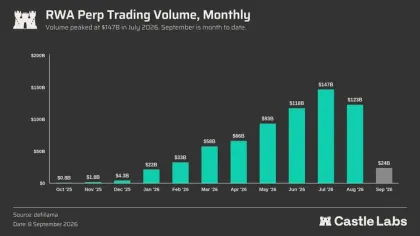
RWA Perpetual Trading Surges Above $120B
Crypto prices
More


