
BREAKINGVIEWS-Fed guidance retreat risks communication own goal
 Reuters2026/07/24 12:00
The author is a Reuters Breakingviews columnist. The opinions expressed are his own.
By Felix Martin
LONDON, July 23 (Reuters Breakingviews) - Kevin Warsh used his first press conference as chair of the Federal Reserve last month to pledge far-reaching reforms at the U.S. central bank, guided by five Task Forces for Advancing Monetary Policy, staffed by a roster of stellar experts. His first target is the Fed’s communications policy, and especially the vogue for transparency which has swept global central banking over the past two decades. The problem is that simply clamming up will not work.
Warsh’s primary bugbear is the practice of “forward guidance”, where policymakers supplement interest rate decisions by telegraphing where they expect policy to go over some additional future period. The Fed first inched towards such guidance in December 2008 when it stated that conditions were “likely to warrant exceptionally low levels of the federal funds rate for some time”, before explicitly committing in August 2011 to keep rates low “at least through mid-2013”. The following year, it added triggers including the unemployment and inflation rates to the mix.
Last month Warsh bid all that farewell. “We’ve dropped forward guidance,” he explained. He also expressed disdain for the Federal Open Market Committee’s (FOMC’s) practice of publishing forecasts of key economic variables in its Summary of Economic Projections (SEP) – and pointedly declined to contribute his own.
Warsh’s allergy to these practices rests on nostalgia for what might be called the “classical” view of monetary policymaking. On this view, profit-seeking investors position their portfolios based on their assessment of underlying economic fundamentals. By conditioning their decisions on the resulting asset prices, policymakers can thus leverage the power of markets to synthesise disparate private information as they seek to target inflation.
If central bankers offer explicit guidance regarding their own future decisions, the critique goes, they introduce a disastrous feedback loop. Rather than wasting time on assessing economic fundamentals, investors will now take the shortcut of simply pricing the central bank’s pre-announced path. The flow of information becomes circular and loses its link to underlying economic reality. “When all financial markets are doing is reflecting back at us what we've said,” Warsh explained in June, “then we're taking the most important source of information and we're being blind to it."
Warsh’s take has recent, painful evidence to back it up. When the Covid pandemic struck in early 2020, the Fed swiftly cut its main policy rate to between 0% and 0.25%. In September of that year, the central bank issued explicit guidance that it would not hike rates again until labour market conditions were consistent with full employment and inflation had topped its 2% target for some time. As a result, when core inflation – excluding food and energy costs - began to rise rapidly in early 2021, market expectations of future policy rates as measured by the yield on 2-year U.S. Treasury bonds remained rooted to the floor.
Only when the FOMC blinked and retired its characterisation of inflation as “transitory” in December 2021 did investors begin to price in the reality of an overheating economy. By that time, core inflation was heading above 5.5%. The FOMC itself, meanwhile, had interpreted the sanguine market for sovereign debt as independent confirmation that inflation would indeed quickly peter out. Its own lift-off was therefore even more delayed. Each side had assumed the other was monitoring the economic fundamentals. As it turned out, they had both just been ogling each other.
By ditching forward guidance, Warsh hopes to break this self-referential loop and force markets to price underlying risks again. That, he argues, will restore the informational value of asset prices and thus hand policymakers back their compass.
It is an attractive idea. Yet there are three reasons why it is not clear that Warsh’s classical view of monetary policymaking is realistic in the contemporary financial system – if indeed it ever was.
First, while the textbooks claim that financial markets price underlying economic fundamentals, investors know full well that they just as often reflect rank speculation as to what other market participants think. “We devote our intelligences to anticipating what average opinion expects the average opinion to be,” as the economist John Maynard Keynes put it; “And there are some, I believe, who practise the fourth, fifth, and higher degrees.”
Secondly, Keynes was writing when financial markets were the exclusive preserve of a professional elite. In the era of online trading apps like Robinhood Markets, zero-day-to-expiry options, prediction markets, and 24-hour trading, it is even harder to believe that today’s investing public are going to stop speculating how the central bank will react to economic events, regardless of whether it chooses to spell it out. Moreover, Keynes did not have to contend with the social media revolution which has made demands for instant accountability an unavoidable fact. When the U.S. president regularly addresses voters unfiltered via his smartphone, it is no longer viable to think that the country’s financial overlords can make policy without explaining themselves directly too.
Warsh’s plan also suffers from a final financial conundrum. The fixation of investors on policymakers’ intentions may indeed make it harder for central bankers to calibrate their policy accurately. Ironically, that obsession is also essential if policy is to have its desired effect. This is the paradox that then Bank of England Governor Mervyn King captured in his famous comparison of successful monetary policymaking to Argentinian football great Diego Maradona’s “goal of the century” against England at the 1986 soccer World Cup. Maradona dodged five defenders despite running in a straight line because his opponents expected him to deviate. King argued that only by luring investors into anticipating what it would do if circumstances demand that a central bank can achieve its objectives efficiently. “Not only do expectations about monetary policy matter,” as Michael Woodford, the guru of twenty-first century monetary economics, once summed it up, “at least under current conditions, very little else matters.” King’s views are likely to count: Warsh has appointed him to advise on the Fed’s communications.
Warsh is quite right to fear the descent of modern monetary policy into an unseemly postmodern morass. Yet in the digital age, the circular flow of information is the water in which we swim. The key to avoiding a communications breakdown is not silence but constructive ambiguity. As the soccer pundits say: don’t just shut up shop - keep your opponents guessing.
Follow @felixmwmartin on X
(Editing by Peter Thal Larsen; Production by Streisand Neto)
((For previous columns by the author, Reuters customers can click on MARTIN/))
Disclaimer: The content of this article solely reflects the author's opinion and does not represent the platform in any capacity. This article is not intended to serve as a reference for making investment decisions.
You may also like
Bitcoin, ether rise as inflation data does little to alter Fed interest rate outlook
XRP trades at $1.36 as daily active addresses fall 90%, technical risks rise
Bitcoin faces $77,100 to $81,700 supply barrier as ETFs see $462 million weekly outflow
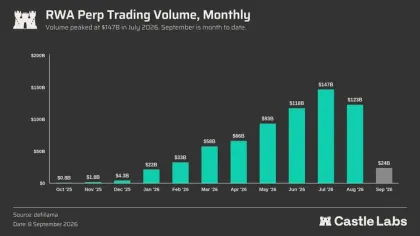
RWA Perpetual Trading Surges Above $120B
Crypto prices
More


