
Intel (INTC.US) posts impressive earnings, exceeds expectations, but Wall Street still concerned about foundry losses and "AI valuation cuts"

Intel's Q2 earnings exceeded expectations, leading to a rise in its stock price. Analysts are generally optimistic, but are considering valuation and foundry business concerns.
According to Zhitong Finance APP, as global demand for semiconductors and computing power continues to evolve, chip giant Intel (INTC.US) delivered a second quarter earnings report that far exceeded the market’s low expectations. Thanks to the Data Center and Artificial Intelligence business (DCAI) delivering the strongest year-over-year growth in nearly 15 years, along with a better-than-expected Q3 guidance, Intel’s share price jumped about 3% in pre-market trading on Friday. However, behind this apparently “huge success,” analysts from Seeking Alpha and several Wall Street investment banks have pointed out that the primary reason for the positive share price reaction was the lowered market expectations. Intel’s core foundry business (IFS) is still facing massive losses, and combined with tens of billions of dollars in mark-to-market (MTM) accounting adjustments relating to the CHIPS Act, Intel’s transformation remains fraught with valuation controversies and structural pains.
Key Data: Strongest Growth in Fifteen Years, Beats Forecast for Eighth Consecutive Time
This is Intel’s eighth consecutive quarter since Q3 2024 to deliver results exceeding expectations. Under Non-GAAP standards, gross margin was 41.8%, a sharp increase of 12.1 percentage points from 29.7% in the same period last year. Q3 guidance is also strong: expected revenue is between $15.8 billion and $16.8 billion, with the median of $16.3 billion far beating analyst expectations of $15.1 billion; Non-GAAP EPS guidance is $0.38, above the expected $0.27.
However, under GAAP, Intel recorded a net loss of $11 billion, or a loss of $2.16 per share. This massive loss stemmed from a $12.5 billion non-cash charge due to mark-to-market valuation of custodial shares related to the U.S. CHIPS Act Secure Enclave arrangement. The higher Intel’s stock price, the greater the value of government-held custodial shares, and the worse the GAAP loss looks—but this charge does not affect the company’s actual cash flow or operating performance.
Data Center and AI: CPU’s “Return of the King”
The brightest star in Intel’s Q2 report was the Data Center and AI Group (DCAI): revenue of $6.3 billion, surging 59% year-over-year, far surpassing analyst expectations of $5.6 billion. CEO Pat Gelsinger said plainly on the earnings call: “In the data center sector, CPU demand is taking off, and demand is exceeding our rapidly growing supply capabilities.”
The current explosion in CPU demand can be traced to the AI industry’s shift from “training” to “inference,” and from “centralized” to “distributed.” After several years dominated by GPU computing in AI, the value of CPUs in Agentic AI task execution is being rediscovered. Autonomous AI agents need massive general-purpose compute power for inference, scheduling, and coordination tasks—precisely the strength of x86 CPUs.
Foundry Business: Losses Narrow, First External Customer Revealed
Considered a key area for Intel’s transformation, the Intel Foundry Business (Intel Foundry) had Q2 revenue of $5.8 billion, up 31% year-over-year. Operating losses amounted to $2.1 billion, but thanks to better-than-expected Intel 18A yield improvements and expanded production capacity, the loss narrowed sequentially.
On the technology front, Pat Gelsinger revealed the 18A process production is 25% above expectations, with sequential growth of over 50% and a healthy trend in yield improvement. The more advanced 14A process is surpassing internal metrics, with risk production expected to begin in the second half of 2027 as planned. Even more significantly, Intel disclosed its first publicly named external foundry customer—cybersecurity firm Fortinet.
Client Business: AI PC Now Accounts for Two-Thirds
The Client Computing and Physical AI Group (CCPG) reported Q2 revenue of $8.9 billion, a 13% year-over-year increase. Among these, AI PC revenue grew 26% sequentially and now accounts for two-thirds of client revenue. The PC business is shifting from a “stock market” to an “AI upgrade market,” with Intel’s first-mover advantage in this field translating into tangible revenue growth.
Capital Expenditure: $20 Billion Is Just the Beginning
Confronted with surging demand for AI computing power, Intel is expanding capacity at an unprecedented rate. The company announced it will raise full-year 2026 capital expenditure expectations to over $20 billion and forecast significantly higher capital spending in 2027, with the vast majority allocated to US domestic manufacturing networks.
CFO David Zinsner revealed that from 2021 to 2026, Intel’s total capital expenditures on US equipment and factory space will approach $100 billion. This investment will be used to purchase equipment, accelerate clean room construction, and secure substrate and memory supply to support both foundry and proprietary product growth.
Wall Street Views: “Valuation Anxiety” Amid Divergent Opinions
Seeking Alpha analyst The Techie said: “As early as June, I downgraded Intel to a ‘sell’ as NVIDIA (NVDA.US) broke into the consumer PC processor market with the RTX Spark superchip. Part of my reasoning then was the stock was overvalued. Since, I’ve seen it correct and it’s dropped around 26% just in the past month. I believe this has led to across-the-board lower expectations, making this quarter’s report look outstanding. The numbers are solid, but I’ve seen companies with even stronger performance suffer share price drops this quarter. I think the market is looking for positives to digest about this report, because while the company’s results declined sequentially and margins lacked strong growth, its guidance is still better than expected.”
Seeking Alpha analyst Louis Gerard said: “Intel just delivered a relatively strong quarter, posting $16.1 billion in revenue, up 25% year over year, about 12% higher than expected. Non-GAAP EPS came in at $0.42, nearly double the forecast, mainly driven by the Data Center and Artificial Intelligence Group (DCAI) growing 59%.”
However, analysts pointed out that “the foundry business is still operating at a loss. Though its revenue reached $5.77 billion, up 31% YoY, it still posted an operating loss of $2.09 billion, and factoring in inter-segment offsets, total loss reached $5.48 billion. Thus, external foundry revenue was only $300 million. To be fair, Intel’s entire bull thesis depends on 18A external funding, which hasn’t yet appeared in earnings.”
Gerard added that the $11 billion GAAP loss was not an impairment, but a derivative of escrowed stock as a transitional measure—a $12.5 billion mark-to-market expense for shares held in trust for the Department of Commerce under the CHIPS Secure Enclave arrangement.
“While this does not impact overall operations, it’s worth noting that the more actively Intel trades, the greater the government’s claim, as the claim rises with higher share value,” Gerard noted.
Bank of America Reiterates “Buy” and $160 Price Target for Intel Stock
“Intel’s Q2 results beat expectations and upwardly revised guidance once again validates our Buy thesis supported by two pillars: 1) External equity foundry customer discussions have entered a more substantive phase, boosting capital expenditure growth (a positive for the semiconductor industry); 2) Intel’s core server CPU business is strongly participating in the current agent cycle, with data center sales up 59% YoY, the best growth in nearly 15 years. We reiterate our Buy rating and still view Intel’s leading US production capacity and strong support from the White House as long-term competitive advantages,” said analyst Vivek Arya’s team.
Analysts pointed out that from a risk perspective, any capital market actions to fund capital expenditure will need close attention, but they also mentioned Intel has other avenues, such as disposing of non-core assets and possible prepayments as alternatives.
Arya and his team added that external foundry customers will start cooperation this year and continue through 2027, with a significant jump in revenue expected in 2028-2030. This will mean several years of high capital outlays and low free cash flow (FCF).
Needham Maintains “Hold” on Intel, No Price Target Set
“Intel delivered results ahead of expectations across all divisions, with the data center AI segment standing out, despite supply constraints,” said the analyst team led by N. Quinn Bolton.
However, analysts noted, “While Intel is reversing its downward trend, we maintain our ‘Hold’ rating as we believe Intel’s market share in data center CPUs is declining, it lacks competitiveness in AI accelerators, and the stock remains overvalued.”
Wedbush Maintains “Neutral,” Raises Price Target from $60 to $98
“Intel easily surpassed previous guidance. Though the new projections are also above prior consensus estimates, given the strong fundamentals—especially higher CPU capacity utilization—these forecasts seem highly beatable. In short, we expect the largest global computing equipment producer to maintain a positive outlook. However, we still find it hard to justify Intel’s current valuation (especially compared with peers), so we’re not buying the stock for now,” said analyst Matt Bryson.
For AMD (AMD.US), Intel’s performance is a tailwind. Bryson said they expect AMD to better capture the benefits of rising average selling prices (ASP) and the shift to higher-margin server products. Analyst discussions indicate that in Q2, AMD outperformed Intel in incremental product supply.
The results also bode well for memory manufacturers. Analysts noted, the growing number of server CPUs means greater demand for registered dual inline memory modules (RDIMM) and other storage devices.
In addition, semiconductor equipment manufacturers are also seeing positive news. Bryson said Intel, TSMC (TSM.US), and Micron Technology (MU.US) have all increased their spending plans.
Goldman Sachs Cautiously Bullish
Goldman Sachs maintains a “Neutral” rating with a $150 price target. The report notes that while revenue reached $16.1 billion and gross margin of 41.8% handily beat its forecast of 39.3%, the manufacturing transition will still take time.
The significance of Intel’s report goes far beyond just “beating expectations.” It signals that AI computing demand is shifting from a solo act by GPUs, to a concerto of CPU+GPU+ASIC. CEO Pat Gelsinger summed it up: “With three strategically meaningful core assets—our x86 CPU line, advanced packaging technology, and our extensive foundry network—Intel is well-positioned to benefit from this sustained strong demand.”
Of course, challenges remain. The foundry business is still operating at a loss, expansion of external customers will be a long-term effort, and hefty capital outlays put pressure on free cash flow. But when a company once seen as “dead money” delivers its strongest quarterly growth since 2011, the market should at least acknowledge one fact—Intel’s “turnaround” is moving from “possibility” to “reality.”
Disclaimer: The content of this article solely reflects the author's opinion and does not represent the platform in any capacity. This article is not intended to serve as a reference for making investment decisions.
You may also like
Bitcoin, ether rise as inflation data does little to alter Fed interest rate outlook
XRP trades at $1.36 as daily active addresses fall 90%, technical risks rise
Bitcoin faces $77,100 to $81,700 supply barrier as ETFs see $462 million weekly outflow
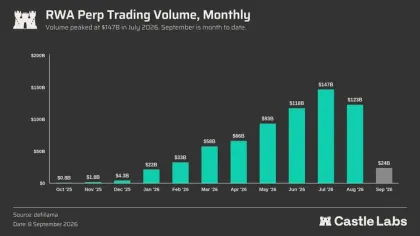
RWA Perpetual Trading Surges Above $120B
Crypto prices
More


