
High-momentum trades face sharp corrections; retail "buy the rally" strategy fails; Wall Street suggests bottom-fishing strategies

After experiencing a significant pullback, several Wall Street institutions are advising investors to buy the dip, believing that U.S. high-momentum stocks are gradually showing allocation value.
According to Zhitong Finance APP, since July, high-momentum trading in the U.S. stock market has experienced a rapid pullback, dealing a heavy blow to retail investors who have long chased popular themes. However, after the significant correction, several Wall Street institutions have begun to advise investors to buy on dips, believing that U.S. high-momentum stocks are gradually showing allocation value.
Data shows that a basket of stocks popular among retail investors, including Robinhood (HOOD.US) and Marvell Technology (MRVL.US), has fallen by 13% cumulatively in July, on track to post its worst monthly performance since 2022. Meanwhile, a group of stocks with the highest retail participation in the Russell 1000 Index compiled by Jefferies has dropped by over 25% since June.
Retail investors have long been enthusiastic about chasing the market’s hottest investment themes. Such “YOLO” (You Only Live Once) trading strategies have suffered notable setbacks in the latest high-momentum stock adjustment.
Among the eleven categories of quant investment factors tracked by Bloomberg, the momentum strategy—buying stocks with the highest recent gains and selling the worst performers—has been the worst-performing quant strategy since July.
According to Vanda Research global macro strategist Viraj Patel, the semiconductor and AI hardware sectors have been the main driving forces for momentum trading, and are core holdings in retail investor portfolios.
Market participants believe the latest correction in momentum stocks is mainly driven by multiple factors. First, the market has begun to worry about the return on continued AI capital expenditures by tech giants, prompting hedge funds to cut their tech stock positions at record speed. At the same time, escalating tensions in the Middle East and uncertainty about the Federal Reserve’s future interest rate path have further dampened appetite for crowded trades.
As high-momentum trading cools, overall trading enthusiasm among retail investors has also clearly waned.
According to Vanda Research, the rolling weekly net purchases by U.S. retail investors have fallen to their lowest levels since the pandemic. Data from J.P. Morgan shows that in the week ending this Wednesday, retail net inflows into U.S. stocks reached about $5.7 billion, below the 12-month average of $6.8 billion per week.

From an industry perspective, technology ETFs have generally seen outflows. In particular, Direxion Daily Semiconductor Bull 3X Shares (SOXL.US) and VanEck Semiconductor ETF (SMH.US) have seen the most pronounced outflows among semiconductor ETFs, with selling pressure for both funds about 1.6 standard deviations above historical averages.
J.P. Morgan strategist Arun Jain said the decline in retail participation is consistent with the cautious market sentiment triggered by the recent sharp pullback of momentum strategies.
However, data shows that retail investors are not completely exiting the stock market, but are becoming more selective and cautious in their investments.
According to J.P. Morgan, Microsoft (MSFT.US) and NVIDIA (NVDA.US) continue to attract retail inflows, while Apple (AAPL.US) and Tesla (TSLA.US) have become some of the stocks facing the highest retail selling pressure.
Patel pointed out that compared to last year’s “buy anything AI” investing style, retail flows are now more dispersed and stock selection more cautious.
Despite increased short-term volatility, some Wall Street institutions believe that this round of correction has released much of the speculative bubble, making high-momentum stocks attractive once again.
UBS Securities strategist Michael Romano indicated that the recent decline has likely digested much of the previously accumulated market speculation, providing a foundation of support for stock prices.
Bank of America’s trading division has also advised clients to buy U.S. high-momentum stocks on dips, arguing that after the recent profit-taking, the sector has entered an attractive allocation range.
Data shows that the high-momentum stock portfolio tracked by Bank of America rose a cumulative 8.9% over three consecutive trading days as of Thursday, marking the largest three-day gain since November 2024; over the same period, the UBS Momentum Index rose 11%, the biggest three-day gain since 2022, indicating capital is starting to flow back into the high-momentum sector.
Patel said that high-momentum trading and retail investors have recently experienced a “roller-coaster” ride, but as selling pressure gradually eases and buying returns, the market is increasingly primed for a significant rebound.
Disclaimer: The content of this article solely reflects the author's opinion and does not represent the platform in any capacity. This article is not intended to serve as a reference for making investment decisions.
You may also like
XRP trades at $1.36 as daily active addresses fall 90%, technical risks rise
Bitcoin faces $77,100 to $81,700 supply barrier as ETFs see $462 million weekly outflow
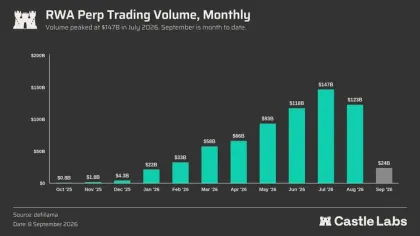
RWA Perpetual Trading Surges Above $120B
Why Ripple (XRP)? 21Shares Highlights 4 Reasons Investors Should Take Notice
Crypto prices
More


