
Ripple CEO’s Major Statement About XRP and SWIFT Resurfaced

Crypto researcher SMQKE (@SMQKEDQG) has resurfaced a transcript from a 2019 Economic Club of New York appearance by Ripple CEO Brad Garlinghouse. The document puts a sharp spotlight on XRP’s speed advantage over traditional SWIFT transactions, and the volatility math behind it.
SWIFT recently announced its blockchain-based shared ledger, with 17 banks preparing to pilot tokenized cross-border payments on its infrastructure.
SWIFT positions this as an evolution of its existing network. The ledger enables 24/7 payment processing, settling through existing systems after transactions complete.
‼️BRAD GARLINGHOUSE: XRP CARRIES LESS RISK THAN A TRADITIONAL SWIFT TRANSACTION‼️
“When you do a SWIFT transaction, the average transaction, let's just say is three days. That's 270,000 seconds, trust me I did the math on that. If you multiply 270,000 seconds in a low volatility…
— SMQKE (@SMQKEDQG) July 23, 2026
Ripple CEO Made the Case in 2019
Back in October 2019, Garlinghouse was already addressing the volatility objection that banks raise against crypto. His response was built on simple arithmetic. “When you do a SWIFT transaction, the average transaction, let’s just say, is three days. That’s 270,000 seconds,” he told the audience.
He then compared that exposure window to an XRP transaction completing in 3-4 seconds. Multiply 270,000 seconds of exposure in a low-volatility asset against 3 seconds in a high-volatility one, and XRP produces less total volatility risk.
The Hedging Factor
With a traditional fiat transaction settling over two to three days, a counterparty absorbs and prices that currency risk on your behalf. XRP removes that equation entirely.
“With XRP, it’s happening so fast you don’t really need to hedge it because you’re in and out of it in a few seconds,” Garlinghouse said; No multi-day exposure window. The transaction completes before volatility becomes a meaningful variable.
What the Post Highlights
SMQKE’s post puts this argument in focus at a moment when SWIFT is actively building blockchain infrastructure. SWIFT’s new ledger reduces settlement time compared to traditional rails, operating through tokenized deposits and allowing banks to move funds outside business hours before finalising through existing systems.
The distinction SMQKE highlights is settlement speed. SWIFT’s ledger improves on the traditional model, but XRP was engineered around a 3- to 4-second transaction window that Garlinghouse described in 2019.
The Argument Has Been on Record
Garlinghouse made this case publicly seven years ago. The math has not changed. A transaction completing in seconds carries a fundamentally different risk profile than one settling over days, regardless of the asset’s daily volatility. Garlinghouse laid it out plainly in 2019, and the argument remains very relevant today.
Disclaimer: The content of this article solely reflects the author's opinion and does not represent the platform in any capacity. This article is not intended to serve as a reference for making investment decisions.
You may also like
Bitcoin, ether rise as inflation data does little to alter Fed interest rate outlook
XRP trades at $1.36 as daily active addresses fall 90%, technical risks rise
Bitcoin faces $77,100 to $81,700 supply barrier as ETFs see $462 million weekly outflow
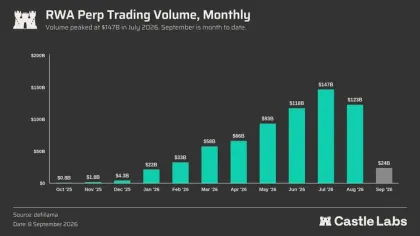
RWA Perpetual Trading Surges Above $120B
Crypto prices
More


