
Trump's New Round of Global Tariffs Sued by Small Businesses, U.S. Trade War Faces New Legal Disputes

The Supreme Court previously ruled that imposing global tariffs under the IEEPA is illegal. The Trump administration then invoked Section 301 of the Trade Act of 1974, imposing tariffs of 10%-12.5% on more than 60 economies on the grounds of "forced labor." Several small businesses subsequently sued, accusing the government of replicating the overturned tariff system under the new provision without conducting legally required targeted investigations.
The Trump administration’s latest round of global tariffs has just been implemented, only to face new legal challenges.
Several U.S. small businesses have filed lawsuits with the U.S. Court of International Trade, alleging that the Trump administration is illegally using Section 301 of the Trade Act of 1974 to impose new tariffs, attempting to circumvent the global tariff policy previously struck down by the Supreme Court.
This means that the Trump administration’s plan to rebuild a “tariff wall” once again faces judicial uncertainty. Previously, the Supreme Court had ruled that global tariffs imposed by Trump under the International Emergency Economic Powers Act (IEEPA) were illegal, forcing the administration to seek new legal grounds.
The core dispute in this lawsuit centers around whether the Trump administration can utilize Section 301 to impose broad tariffs on many trading partners on the grounds of issues such as “forced labor.”
Trump Announces New Tariffs, Most Major Trading Partners Face 10%-12.5% Rates
The Trump administration announced on Thursday that the U.S. will impose tariffs of 10% to 12.5% on imports from most major trading partners.
The Office of the United States Trade Representative stated that this measure is based on Section 301 of the Trade Act of 1974 and stems from an investigation into forced labor issues within global supply chains. The U.S. government asserts that about 60 economies have failed to effectively prevent forced labor in supply chains, harming the interests of American workers.
Section 301 authorizes the U.S. Trade Representative, under presidential direction, to take action—including imposing tariffs—against foreign trade practices deemed harmful to U.S. businesses or violating international trade rules.
However, small businesses argue that the Trump administration’s actions did not meet the investigative standards required by Section 301.
Small Businesses Sue: The Government Cannot Recreate Struck Down IEEPA Tariffs Using Section 301
The lawsuit was initiated by two companies: spice importer Burlap and Barrel Inc. and watch retailer Collective Horology LLC.
According to the complaint, the new tariffs did not involve concrete investigations into individual countries, but instead adopted a sweeping “across-the-board” increase.
The complaint states that Section 301 is not an infinitely broad authorization, and the government cannot use this provision “to replicate the previously invalidated IEEPA tariff system” by imposing taxes on nearly all trading partners and a vast range of imported goods.
These companies also seek to expand the case into a class action, representing all importers affected by the new tariffs.
Another lawsuit was also filed on Friday, involving seven companies, including educational toy manufacturers Learning Resources Inc. and hand2mind Inc. Both companies were also involved in previous legal actions challenging Trump’s IEEPA tariffs.
Focus of the Dispute: Did the Trump Administration Conduct “Country-Specific” Trade Investigations?
The primary legal argument for these companies is that Section 301 generally requires the U.S. Trade Representative to investigate the trade practices of specific countries and demonstrate how these practices harm U.S. commercial interests.
However, the plaintiffs argue that the current U.S. government investigation relied more on “general statements” regarding global forced labor issues, without specifying: which countries engaged in actual violations; how these violations impacted U.S. businesses; or why tariffs on all imports from these countries are necessary.
Liberty Justice Center CEO Sarah Albrecht stated:
“Forced labor is morally unacceptable, but a significant goal does not empower the government to ignore the law.”
After IEEPA Tariffs Were Struck Down, U.S. Government Faces $166 Billion in Refund Pressure
This legal challenge also brings renewed attention to how the Trump administration handled the fallout after the IEEPA tariffs were struck down.
In February of this year, the U.S. Supreme Court ruled that Trump’s global tariffs under the International Emergency Economic Powers Act were illegal. Since then, U.S. Customs has faced massive refund claims from affected companies.
Reports indicate that the U.S. had previously collected about $166 billion in tariffs related to these measures.
So far, the U.S. government has already issued billions of dollars in refunds, but the Department of Justice is still seeking to limit the scope of the refunds.
The Trump administration is appealing a court ruling that requires the government to recalculate duties for all importers who paid IEEPA tariffs. The government argues that such court orders should apply only to companies involved in the lawsuits, not to all importers.
If New Tariffs Are Challenged, The Government May Face Greater Implementation Pressure
Analysts believe that this lawsuit against the Section 301 tariffs could become the new legal battleground for Trump’s trade policy.
If the courts ultimately restrict the government’s use of Section 301 to impose broad tariffs, the Trump administration’s efforts to promote global trade protectionism could be significantly hindered.
At the same time, if large numbers of companies continue to challenge the legality of the tariffs, the U.S. Court of International Trade, customs authorities, and importing businesses could again be drawn into prolonged legal and administrative proceedings.
Currently, the two cases—Burlap and Barrel Inc. v. Greer and Learning Resources Inc. v. United States—have both been filed with the U.S. Court of International Trade in New York.
Disclaimer: The content of this article solely reflects the author's opinion and does not represent the platform in any capacity. This article is not intended to serve as a reference for making investment decisions.
You may also like
XRP trades at $1.36 as daily active addresses fall 90%, technical risks rise
Bitcoin faces $77,100 to $81,700 supply barrier as ETFs see $462 million weekly outflow
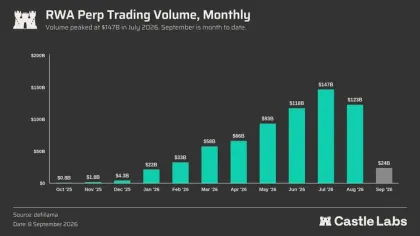
RWA Perpetual Trading Surges Above $120B
Why Ripple (XRP)? 21Shares Highlights 4 Reasons Investors Should Take Notice
Crypto prices
More


