
US Stock Market Super Big Week Arrives! Earnings Reports from Four Tech Giants, Federal Reserve Interest Rate Decision to Shake the Market; Eased US-Iran Tensions Send Oil Prices Plunging

A new week will see the most information-dense trading window of this quarter: the four major tech giants will release earnings reports, and the Federal Reserve will hold its interest rate decision meeting. In addition, geopolitical tensions in the Middle East have eased, causing international oil prices to fall sharply from the $100 mark.
According to Zhitong Finance APP, US stocks have just wrapped up a turbulent week, with all three major indices ending the week down. The coming week ushers in the most information-dense trading window of the quarter: four tech giants will release their earnings reports and the Federal Reserve will hold its FOMC meeting. In addition, easing geopolitical tensions in the Middle East have led to a significant pullback in international oil prices from the $100 mark.
The S&P 500 closed up 0.05% last Friday but fell 0.6% for the week; the Dow closed up 0.46% yet was down 0.4% for the week; the Nasdaq Composite Index closed down 0.64% on Friday, with a weekly loss of 2.1%.
Four Big Techs Announce Earnings—AI Capex Becomes Key Question
This week marks the climax of US stock earnings season, with four of the “Magnificent Seven” tech giants taking center stage: Microsoft (MSFT.US) and Meta (META.US) will release their reports on Wednesday; Apple (AAPL.US) and Amazon (AMZN.US) will report on Thursday.
Just as with last week's earnings from Alphabet (GOOGL.US, GOOG.US) and Tesla (TSLA.US), the market's core focus remains on whether massive AI capital expenditures can translate into real returns.
Alphabet’s Q2 results were actually solid: both revenue and net profit beat expectations, Google Cloud achieved a year-on-year growth rate as high as 82%, and search business stayed resilient despite competition from ChatGPT, Claude and others.
However, Alphabet raised its 2026 capex guidance from the previous $180–190 billion range to $195–205 billion and expects capex to rise further in 2027. At the same time, Alphabet's quarterly free cash flow turned negative for the first time since going public.
Tesla’s report also revealed negative free cash flow and a sharp increase in capital expenditures. After earnings were released, both companies saw share prices plunge last Thursday, collectively wiping about $500 billion from their market value, also dragging down the tech sector.
Apollo Global Management Chief Economist Torsten Slok bluntly stated that the market is no longer satisfied with companies merely announcing “increased AI investment” and that investors demand a clear answer: Can such massive capex drive profits and accelerate returns?
Deutsche Bank’s outlook on Microsoft highlights three bear arguments: continued rising prices for upstream components like memory and chips require ongoing investment for AI deployment; uncertain long-term returns on huge AI platform investment, with free cash flow continuously eroded by capex; high dependence on OpenAI increasing order concentration risk.
Deutsche Bank predicts that Microsoft will raise its 2026 capex guidance from the previous $215 billion to $238 billion, with full-year free cash flow barely holding steady.
Analysts believe market scrutiny of massive investments is “understandable,” especially since just a few years ago Microsoft's free cash flow was over $70 billion. But, for Microsoft and the entire “Magnificent Seven,” such concerns may be overstated.
Deutsche Bank analysts state: “The idea that Microsoft will have almost no way to offset these losses in the coming quarters is, in our view, overly pessimistic.”
Heavyweight Earnings, Economic Data to Flood In
Besides the four tech giants, leading stocks across industries will release earnings this week, spanning semiconductors, consumer, aviation, pharma, and energy:
AstraZeneca (AZN.US) will report on Monday, with Coca-Cola (KO.US) and Boeing (BA.US) on Tuesday; Lam Research (LRCX.US), Qualcomm (QCOM.US), and Starbucks (SBUX.US) will report on Wednesday; Mastercard (MA.US), Shell (SHEL.US), and AB InBev (BUD.US) on Thursday. On Friday, US energy giants ExxonMobil (XOM.US) and Chevron (CVX.US), pharmaceutical giant AbbVie (ABBV.US), and power major Eaton (ETN.US) will conclude this busy earnings week.
Of particular note, SK Hynix(SKHY.US) is set to release its first earnings report since listing on US markets. According to reports, South Korean presidential advisor Kim Yong-bum said on Saturday that Samsung Electronics and SK Hynix will enter into memory chip supply deals worth up to $950 billion with large US tech firms, including Nvidia. SK Hynix will supply US firms with $750 billion in long-term memory chips, while Samsung will provide Broadcom with $200 billion worth. Meanwhile, Nvidia and SK Group announced an AI infrastructure plan valued at over $500 billion.
In addition, US Q2 GDP and June PCE price index figures will be released on Thursday. The market expects annualized GDP growth for Q2 at 2.1%, bolstered by consumer and business investment. Another report is expected to show that June’s key PCE inflation indicator slowed due to falling gasoline prices, though prices have since rebounded.
Fed Interest Rate Decision Looms—Markets Prepare for Both Outcomes
The Federal Reserve will hold its FOMC meeting from July 28–29. Investors widely expect the central bank to hold rates steady, but the risk of a surprise hike cannot be ignored. In addition, the Bank of England and the Bank of Japan will also announce rate decisions.
Capital.com analyst Daniela Hathorn commented that the US labor market appears robust, with monthly jobs reports showing growth above the benchmark and initial jobless claims last week at their lowest since 1969. On inflation, recent CPI and PPI prints have fallen month-on-month, though annual increases remain well above target levels.
However, renewed conflict in the Middle East pushing up oil prices, Trump's administration announcing a new round of global tariffs, and continued AI investment-driven demand have complicated the Federal Reserve’s policy outlook. Fed funds futures show the probability of a 25 bps hike this week has risen to about 36%, up from just 10% two weeks ago when June CPI was released.
Hathorn said the labor market strength gives the Fed flexibility to raise rates if needed. She added, “The data suggests markets may be too optimistic about a rapid turn to looser monetary policy.”
Recent comments from Cleveland Fed President Loretta Mester provoked market debate. She stated: “For the first time in my tenure, I am hearing from business leaders that they believe action is needed to curb inflation; at the same time, I also hear from consumers who are growing increasingly desperate as their expenses outstrip their incomes. From these conversations I understand inflation has no single cause but is multifaceted.”
Additionally, Dallas Fed President Lorie Logan earlier this month called for a small rate hike, arguing that inflation will not sustainably return to the Fed’s 2% target. Both officials have votes in this week’s rate decision, and if other policymakers opt to hold rates steady, they are likely to dissent. Citi expects that if there are more than two dissenting votes, markets will read this as a stronger hawkish signal.
The Fed Likely to Hold Rates This Week, But Surprise Hike Risk Remains
CME data shows a 63.7% probability the Fed will keep rates unchanged in July, with a 36.3% chance of a 25 bps hike. Market expectations for a September hike are stronger—odds have climbed to about 80%.

However, some Wall Street analysts point out that rate hikes may arrive much sooner than anticipated.
Neil Dutta, Chief Economist at Renaissance Macro Research, believes markets may encounter a surprise Fed rate hike at this week's meeting. He argues that action now allows the Fed to avoid being forced into a reactive stance in months ahead.
Joseph Lavorgna, former Treasury official under Trump and now Chief US Economist at SMBC Nikko Securities America, also pointed out that a hike this month could be less politically costly than hiking closer to the November midterms. If the first hike is delayed to September or even October, “what then? Better to act now.”
Policy uncertainty is producing rare “two-sided hedging” in the financial system. Pradeep Bhatia, CEO of Derivative Path Inc., explained: “Among the banks we work with, about a third are preparing for further rate hikes, while the rest are hedging against the risk of cuts. This divergence suggests the market has stopped trying to predict the Fed’s move and is instead preparing for both outcomes.”
Additionally, the Bank of England will release its rate decision, meeting minutes, and monetary policy report on Thursday. Following weaker-than-expected June inflation data, the market now broadly anticipates the BoE holding rates steady this week.
The Bank of Japan will announce its rate decision and economic outlook report on Friday. Markets generally expect the BoJ to stay on hold this week, with officials inclined to first assess the impact of their last hike. However, with the yen hitting its lowest versus the US dollar in nearly 40 years, some analysts expect the BoJ could give off a stronger hawkish signal.
Signs of Easing Tensions in the Middle East, Oil Prices Pull Back Sharply from $100 Mark
Early Asian trading Monday saw US stock index futures, precious metals, and the cryptocurrency market all surge, while international oil prices plunged. On the news front, signs of easing tensions in the Middle East boosted market risk appetite. Iranian sources stated they would stop military actions as long as the US halts its strikes, though they remain “skeptical” of US intentions.
It was previously reported that US President Trump instructed the military on the 24th not to strike Iran, ending 13 consecutive days of US airstrikes. Trump said at the White House that afternoon that the US and Iran are still in dialogue, adding that “this time Iran means business.” He simultaneously warned that the US could resume strikes if necessary and is “fully prepared to act at any time.”
Meanwhile, the latest news on US-Iran talks emerged on July 26. US ambassador to the UN Michael Waltz said President Trump has paused military action against Iran to allow more time for diplomacy. Iranian Foreign Ministry spokesperson Baghaei stated that information exchange between Iran and the US is continuing, and mediators continue their efforts.
Baghaei emphasized that the US-Iran memorandum of understanding is not a lengthy, complex document, but a brief MoU with just 14 clauses. The international community originally hoped the US would “at least this time” fulfill its commitments, but US actions have flagrantly violated multiple MoU terms, causing diplomatic efforts to “fail for the third time.”
As of writing, WTI crude futures have plunged 4.56% to $85.24/barrel; Brent crude futures are down 4% at $88.01/barrel.

Disclaimer: The content of this article solely reflects the author's opinion and does not represent the platform in any capacity. This article is not intended to serve as a reference for making investment decisions.
You may also like
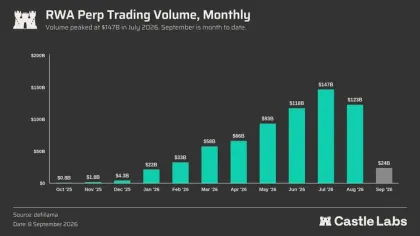
RWA Perpetual Trading Surges Above $120B
Why Ripple (XRP)? 21Shares Highlights 4 Reasons Investors Should Take Notice
XRP must hold $1.38–$1.40 above 100-EMA to avoid dip, analyst warns
Chainlink: Grayscale & Bitwise scoop 1.4M tokens, yet LINK slips
Crypto prices
More


