
Federal Reserve policy decision shifts from "chairman-led" to "committee game," making consensus much harder to achieve

Source: Jinse Finance
The U.S. Treasury market is sending a clear message to Federal Reserve Chairman Walsh: tough talk alone against inflation may not be enough to stabilize market expectations.
Since July, renewed escalation in the U.S.-Iran conflict has briefly pushed international oil prices above $100 per barrel, sparking another round of sell-offs in the U.S. Treasury market. As the core of global financial market pricing, the yield on the 10-year U.S. Treasury rose more than 30 basis points compared to the end of June, reaching 4.678% last Friday—close to a ten-year high. Bond prices move inversely to yields; a rising yield means the market is demanding higher risk compensation.
"The market is sending the Fed a message: uncertainty is building up, and investors want more compensation," said Paul Christopher, Head of Global Investment Strategy at Wells Fargo Investment Institute.
The market's main concern is that rising oil prices may reignite inflation, while under Walsh, the Fed is reducing explicit forward guidance on future policy. Compared to former Chairman Powell's use of forward guidance to stabilize expectations, Walsh prefers letting economic data dictate policy directions.
As of last Friday, CME Group's FedWatch data showed a roughly 62% probability that the Fed will keep rates unchanged at the July meeting, but the chance of a rate hike has risen to 38%, significantly higher than the roughly 13% from a week earlier.
"This shows the market is very concerned about inflation and watching to see if the Fed will take concrete action to prove its anti-inflation stance," said Gennadiy Goldberg, Head of U.S. Rates Strategy at TD Securities.
With only four days remaining before the Fed's rate decision meeting, market judgment on the central bank’s next move has entered a level of uncertainty rarely seen in years. This "uncertainty" precisely reflects the policy shift being promoted by new Fed Chairman Walsh.
"We're seeing the mark left by the new chairman in market pricing," said former Minneapolis Fed President Narayana Kocherlakota, now an economics professor at the University of Rochester.
He believes Walsh wants to establish a new Fed model: the market no longer knows in advance what the central bank will do, while the Fed can freely choose to hold rates steady or hike them based on the latest data. This has also led the market to focus more on the positions of different Fed officials.
Jim Bianco, President and Chief Macro Strategist of Bianco Research, notes that investors now need to pay attention to the attitudes of the Fed’s 12 voting members, not just the chair. "Walsh is no longer the only driver; the Fed has 12 independent voters, and the chairman is just one among them," Bianco said.
Widening Divide Between Hawks and Doves
Some Fed officials have already made clear their desire to further tighten policy. Dallas Fed President Logan and Cleveland Fed President Harker have for months stressed the need to consider rate hikes to ensure inflation continues to fall.
However, other officials think the Fed can wait for more data. New York Fed President Williams believes policymakers can observe future inflation changes before deciding whether to adjust rates.
"Watching the Fed now has become like tracking votes—one needs to understand each voter’s stance," Bianco said.
He believes currently about 5 votes inside the Fed support a rate hike, still short of the 7 needed for a majority.
However, Neil Dutta, Head of Economic Research at Renaissance Macro Research, notes that although rate hike supporters are not the majority, their "stance is very firm" and could prompt some hesitant members to join the tightening camp.
Derek Tang, co-founder of LH Meyer/Monetary Policy Analytics, says this meeting could be the first under Walsh where the Fed sees a visible internal split. There were no dissenting votes at Walsh’s June meeting, partly because other officials gave the new chair a "honeymoon period," but this may not last.
Whether Walsh Supports a Rate Hike Remains the Biggest Uncertainty
The main issue now is what Walsh himself thinks about the rate path. Since becoming Fed Chair, Walsh has not clearly revealed his views on the economy, inflation, or interest rate trends.
Gregory Daco, Chief Economist at EY-Parthenon, said that Walsh’s remarks at previous Congressional hearings have been at most "implicit," not making clear whether he expects inflation to keep falling, nor revealing his view on whether investment in artificial intelligence could add inflation pressure.
"These are the questions a Fed Chair should answer, but Walsh seems to—to some extent—rely on the collective decision of the committee," Daco said.
Bianco believes if Walsh ultimately supports a rate hike, the Fed’s monetary policy vote could be 10 to 2.
But Dutta thinks Walsh may push for the committee to keep rates unchanged in July. Still, strategically, if pressured to hike in coming months by internal committee dynamics, Walsh might prefer to act early.
Meanwhile, some economists believe Walsh is not inclined to hike immediately. They point out that during his campaign for Fed Chair, Walsh showed a tendency to support rate cuts, while the U.S. government has also been pressing for lower rates.
U.S. President Trump recently admitted in an interview that the Fed Chair is just one vote on the committee. "I respect him greatly, but don’t forget, he has a committee," Trump said.
Tim Duy, Chief U.S. Economist at SGH Macro Advisors, believes this statement actually weakens Walsh’s influence as chair because the market will pay more attention to the internal balance of power within the committee.
Walsh Needs to Win Committee Support
Another challenge for Walsh is that he does not automatically get support from other Fed officials.
Kocherlakota said that historically, Fed chairs usually could coordinate the committee to form consensus, but that didn’t mean other committee members would unconditionally support the chair.
"The Fed Chair does not naturally get seven votes just by holding the position; he must convince colleagues that a given policy is in the economy’s best interest," he said.
Kocherlakota served as a Fed official with Walsh from 2009 to 2010. He said Walsh has excellent analytical skills, but will need to turn his personal judgments into policy arguments that can influence the committee.
At present, former Fed Chair Powell remains on the Federal Reserve Board, adding to the uncertainty of policy discussions.
Bianco noted that if severe divisions arise within the Fed, Powell could become a key voter.
Kocherlakota believes that given recent cooling in inflation data, the Fed still has grounds to hold rates steady in July. But in the next two or three meetings, the Fed may still need to hike to maintain its anti-inflation credibility and policy independence.
The real challenge facing Walsh is just beginning: how to build sufficient influence and lead a Fed with growing internal divisions to the next stage of policy, while providing less market guidance.
Disclaimer: The content of this article solely reflects the author's opinion and does not represent the platform in any capacity. This article is not intended to serve as a reference for making investment decisions.
You may also like
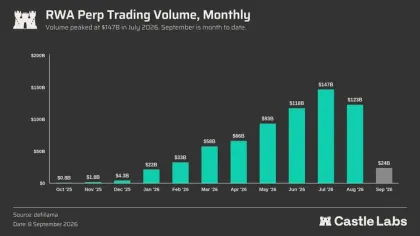
RWA Perpetual Trading Surges Above $120B
Why Ripple (XRP)? 21Shares Highlights 4 Reasons Investors Should Take Notice
XRP must hold $1.38–$1.40 above 100-EMA to avoid dip, analyst warns
Chainlink: Grayscale & Bitwise scoop 1.4M tokens, yet LINK slips
Crypto prices
More


