
British Pound consolidates against Japanese Yen ahead of central bank decisions

GBP/JPY extends its subdued price action on Wednesday, forming a series of small-bodied candlesticks after briefly climbing above 219.00 earlier this month, its highest level since December 2007. At the time of writing, the cross trades around 217.50.
The loss of upside momentum reflects weakening sentiment toward the British Pound (GBP) rather than any meaningful recovery in the Japanese Yen (JPY). Initial optimism following the appointment of the United Kingdom’s new prime minister has faded, with fiscal concerns returning as a near-term headwind for Sterling.
However, the downside for GBP/JPY appears limited, as the Yen remains broadly weak due to Japan’s wide interest-rate gap with other major economies. The latest energy shock also weighs on the currency, given the country’s heavy reliance on imported Oil.
Meanwhile, traders are also avoiding aggressive directional positions, with the Bank of England (BoE) and Bank of Japan (BoJ) monetary policy announcements among the key risk events on tap later this week.
Both central banks are widely expected to leave interest rates unchanged, shifting attention to their policy statements and officials’ remarks for clues about the future path of interest rates and how policymakers intend to respond to energy-driven inflation risks.
Technical Analysis
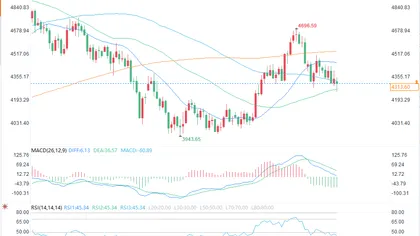
On the daily chart, GBP/JPY holds a constructive near-term bias as it sits marginally above the 21-day Simple Moving Average (SMA) at 217.48 and well above the 50-, 100- and 200-day SMAs.
Momentum is mixed, with the Relative Strength Index (RSI) around 54 after easing from overbought territory, while the Moving Average Convergence Divergence (MACD) indicator has slipped just below zero, suggesting that upside momentum is fading rather than collapsing.
On the upside, initial resistance is seen at 218.50, followed by the yearly high of 219.61. On the downside, initial support emerges at the 21-day SMA near 217.48, with the 50-day SMA at 215.60 and the 100-day SMA at 214.43 offering additional layers of demand if a deeper pullback develops.
A more decisive deterioration would expose the broader bullish structure around the 200-day SMA at 211.56, where buyers would be expected to defend the longer-term trend.
Disclaimer: The content of this article solely reflects the author's opinion and does not represent the platform in any capacity. This article is not intended to serve as a reference for making investment decisions.
You may also like
BTC, ETH, XRP, ZEC consolidate near highs as breakout levels approach
As chip stocks plummet, "cybersecurity software" surges across the board, CrowdStrike and Palo Alto Networks hit new highs
CrowdStrike surged 13.8% in a single day to a record high, while Palo Alto Networks soared 13%. The software ETF outperformed the semiconductor ETF by more than 10 percentage points in a single day, marking the largest gap in history. Analysts believe that regardless of the pace of AI development, security demand will only continue to rise. Capital is accelerating its rotation from computing hardware to security software, with segments such as identity management and data governance expected to benefit first.
Altman can afford to wait, but Masayoshi Son can't: OpenAI will not go public this year, exposing a $20 billion gap and a credit weakness for SoftBank.
OpenAI has postponed its public listing, putting its largest external shareholder, SoftBank, in a liquidity crisis. This week, SoftBank is conducting a roadshow in New York, seeking to issue $10-20 billion in bonds to repay the $40 billion bridge loan previously borrowed to increase its investment in OpenAI. According to Bloomberg estimates, SoftBank faces a funding gap of at least $20 billion, and the yield on its existing U.S. dollar bonds has already exceeded 8.5%, with pricing approaching junk status.
Meeting postponed, gold price drops rapidly
Crypto prices
More


