
Both pouring money into AI, why is the market only rewarding Microsoft today?

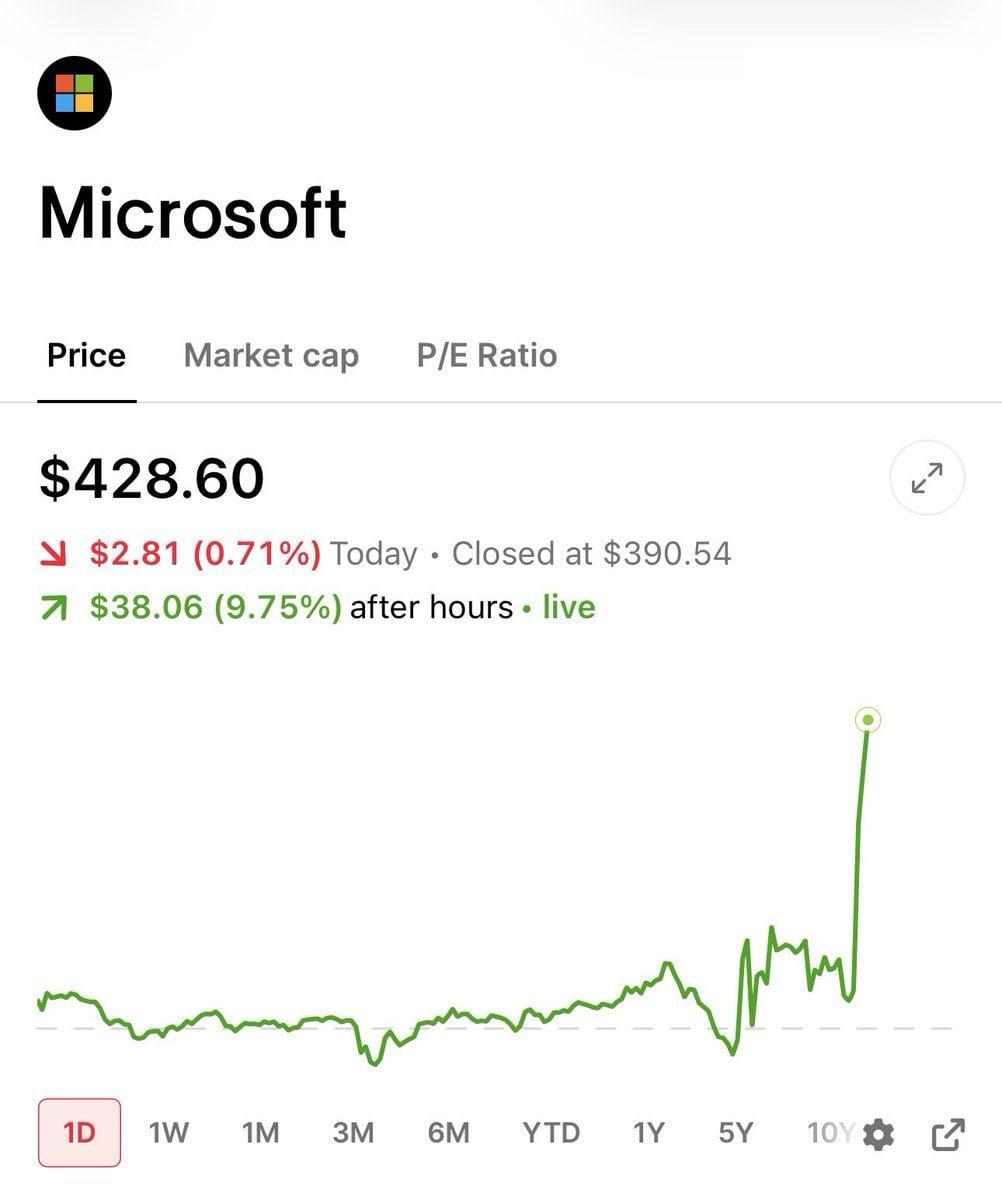
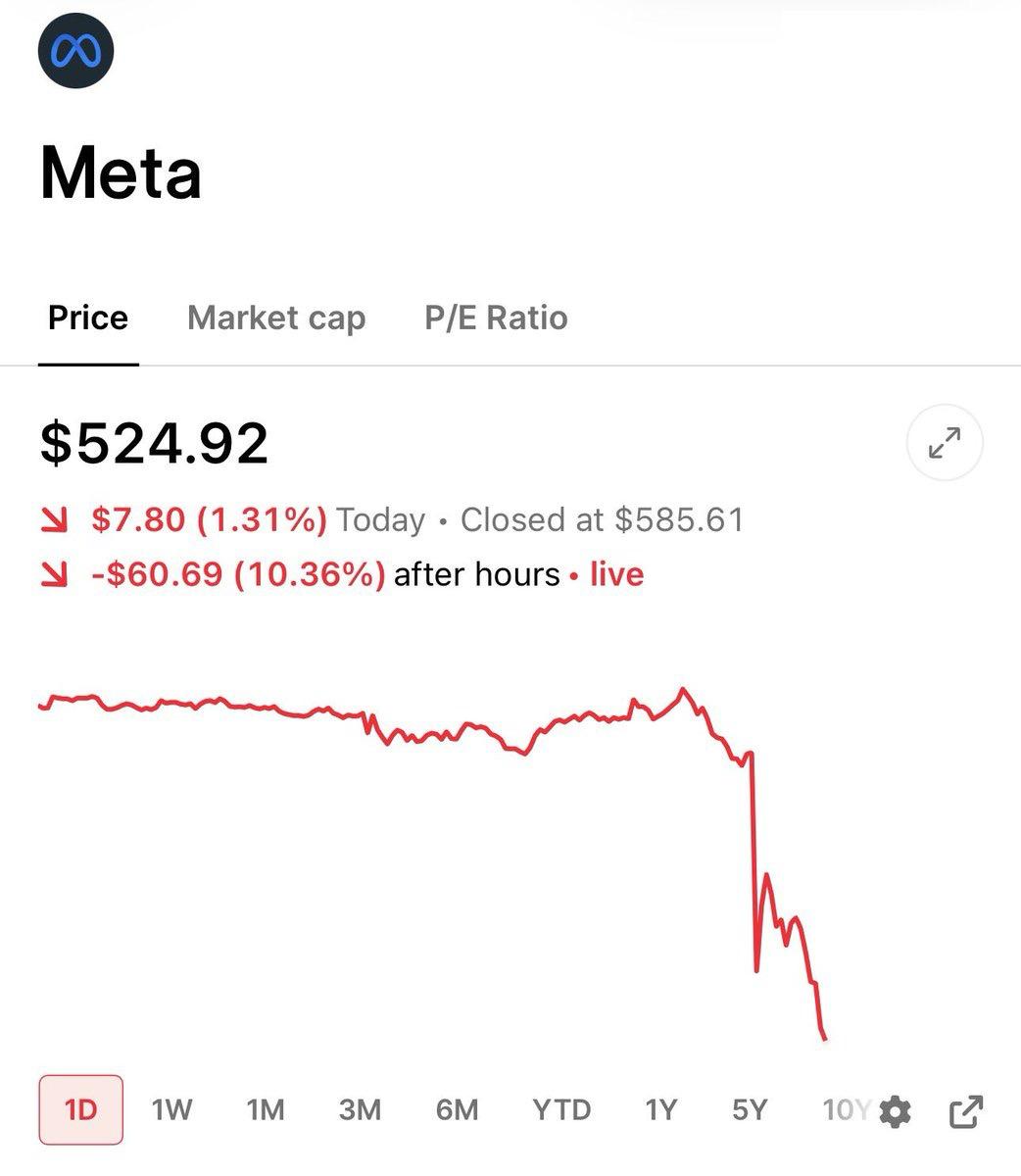
After-hours, Microsoft surged nearly 10% while Meta dropped almost 1%. Both companies are aggressively spending on AI, yet Wall Street is showing completely opposite reactions.
The reason is quite straightforward: the market no longer pays for “who dares to spend money”, but only rewards companies who can prove that throwing money at a problem immediately generates revenue.
Let’s look at Microsoft first
On the surface, Microsoft’s big rally was due to Azure’s 43% quarterly growth beating expectations, but the real driver came from the earnings call—management guided for about 45% growth next quarter, stressing that demand is still constrained by compute supply, and new capacity is absorbed by clients as soon as it goes online.
This statement is critical for the market: Microsoft isn’t building data centers in advance and waiting for clients, but has clients already queuing up, and every chunk of compute that comes online immediately converts to Azure revenue. Demand brought by open source models and multi-model deployment continues to soak up cloud compute.
As for the annual CapEx being lowered from $190 billion to $175 billion, don’t be misled by accounting standards.It’s just a change in financial treatment—money previously recorded as “asset purchases” is now partially reported as “long-term rent”, so the cash outlay for the year appears lower, but future rent commitments actually rose from about $197 billion to $329 billion.
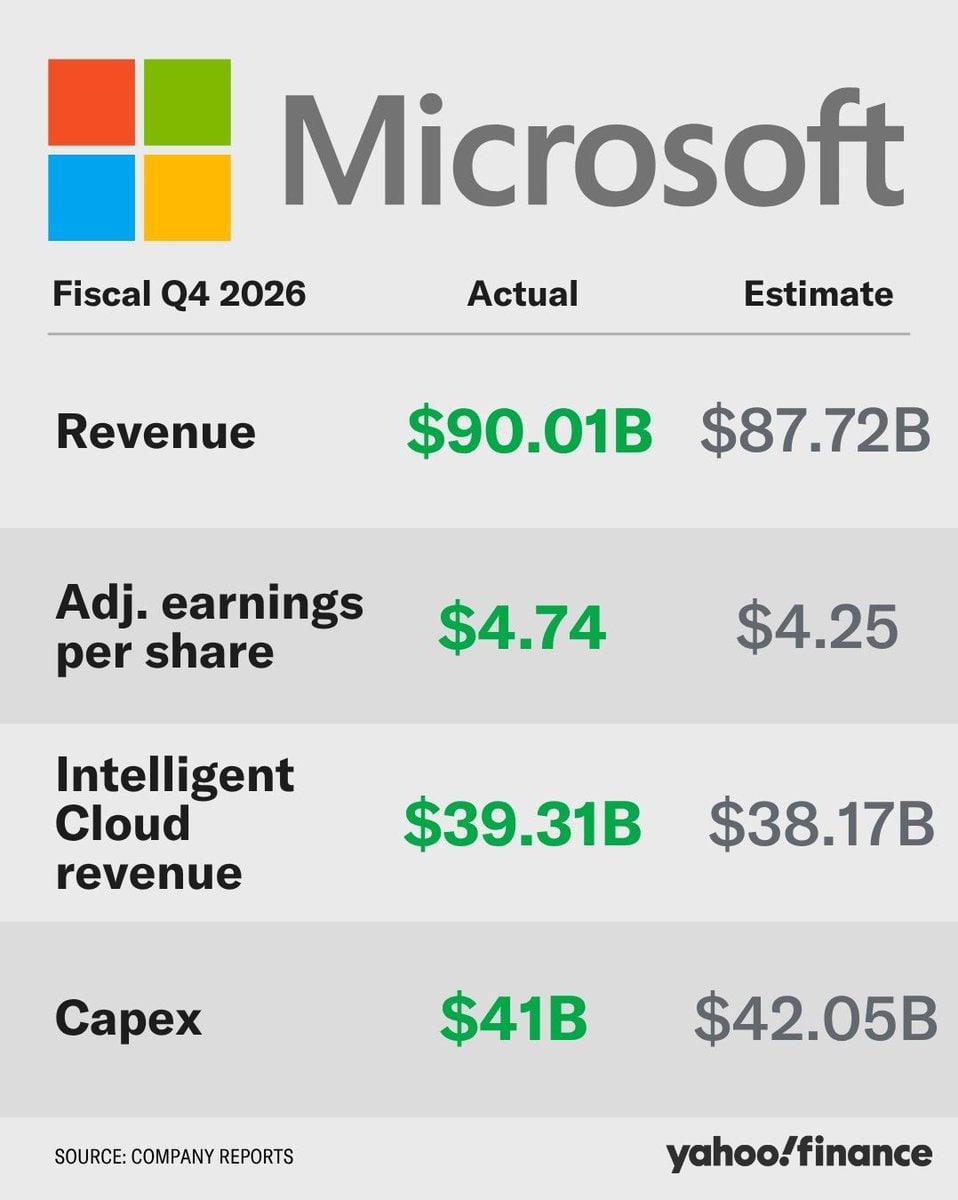
What really impressed the market is: CapEx hasn’t seen any new runaway increases, Azure has accelerated from 43% to 45%, and management emphasized that FY27 free cash flow will remain positive.
This closed loop of investment—capacity—revenue—cash flow is working seamlessly.
Now take a look at Meta
Meta’s problem isn’t that CapEx is higher than Microsoft, but that this investment has yet to demonstrate a clear path to returns.
This quarter, revenue grew 28%, which doesn’t seem bad, but costs and expenses grew 55%, operating profit dropped 8%, and EPS fell 13%.
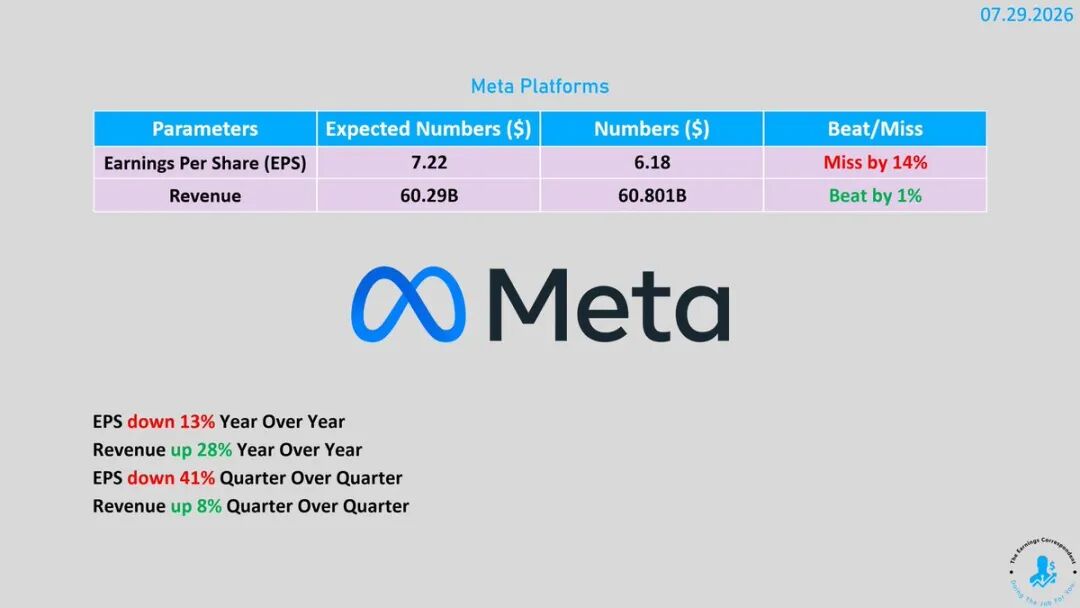
Even starker: capital expenditures this quarter reached $31.1 billion, with free cash flow left at only $784 million.
To illustrate: a $1.5 trillion giant, after a busy quarter, is left with just over $700 million cash on hand. It’s as if you boast of having $10,000, but after turning your pockets inside out, you only find $5—it's not that you don’t have assets, they’re all tied up in houses and cars, so spendable cash is almost nonexistent.
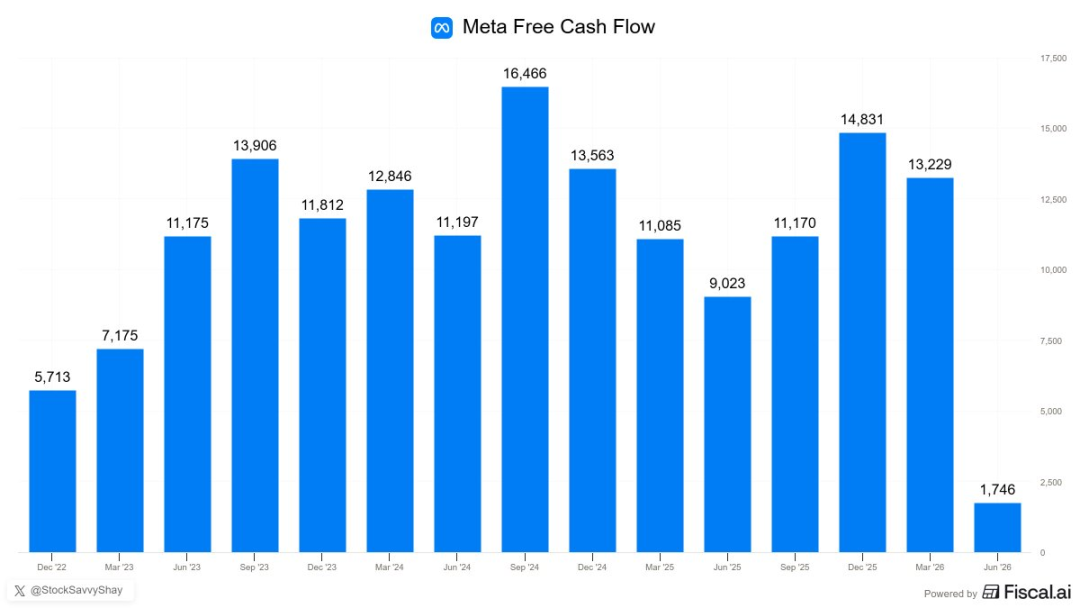
The full-year CapEx guidance just narrowed from $125-145 billion to $130-145 billion, so there’s no market-feared runaway increase, but the Q3 revenue guidance also didn’t provide any real upside surprise.
And that’s why the market isn’t buying it: Meta is telling everyone “I need to keep investing,” yet it doesn’t present an external metric like Microsoft’s 45% Azure revenue growth to prove that new compute is quickly monetized.
Meta’s AI does improve recommendations and ad efficiency, but those benefits are overshadowed by even faster-growing depreciation, infrastructure, and headcount costs—investment is rising, but returns aren’t clear.
Looking back at Google
Google Cloud’s revenue this quarter grew 82% to $24.8 billion, operating profit rose from $2.8 billion to $8.8 billion, and demand for AI cloud is indeed strong.
But this quarter, capital expenditures hit $44.9 billion, exceeding operating cash flow of $39 billion, turning free cash flow to a negative $5.9 billion. Then Google raised its full-year CapEx forecast, and after-hours share price slid by nearly 7%.
Google’s issue is typical: it’s not the lack of AI returns, but that returns and cash burn are both surging.
The market is willing to recognize Cloud acceleration, but can’t ignore free cash flow being eaten away.
Looking ahead to Amazon
AWS will release its earnings after market close on Thursday. Last quarter, AWS grew 28%, the fastest pace in 15 quarters, but free cash flow plummeted from $25.9 billion to $1.2 billion in the past year, mainly because AI-related equipment investment increased $5.93 billion year-on-year.
With these Microsoft, Meta, and Google earnings as context, Amazon surely knows what the market is afraid of.
It’s highly unlikely they’ll be foolish enough to say in a headline, “capital expenditures keep soaring”. Even if CapEx needs to increase, management will likely phrase it more gently—for example, stressing the cost advantage of self-developed chips, highlighting client orders in backlog, or mitigating the accounting impact through long-term lease commitments.
But changing the phrasing doesn’t change market evaluation criteria. Wall Street will only care about three things: Can AWS keep accelerating? Can free cash flow stop declining? Is every piece of new compute capacity instantly generating revenue as it comes online?


Disclaimer: The content of this article solely reflects the author's opinion and does not represent the platform in any capacity. This article is not intended to serve as a reference for making investment decisions.
You may also like
Pushing Forward Against the "AI Slowdown" Trend? Reports Suggest Kioxia Plans U.S. IPO to Raise at Least $10 Billion
Kioxia is reportedly considering raising $10 billion through a listing in the United States.

3 Altcoins Poised to Pump Soon: LTC, TRX, ADA

AI Computing Power Construction Shifts from "Lack of Electricity" to "Lack of Talent": Modularization Rises, Schneider, Vertiv, Eaton Embrace New Opportunities
Bernstein recently released a research report stating that, amid the rapid expansion of AI computing power, the main constraint affecting the development of data centers is undergoing a shift.

Zcash slides from $1,300, risk of $850 pullback before new rally
Crypto prices
More


