
Microsoft FY2026 Q4 Earnings Highlights: Azure Revenue Growth Exceeds 40% and Surpasses $100 Billion for the First Time, Cloud Business Beats Expectations Across the Board, Capital Expenditures Below Forecast
 2026/07/30 03:59
Core Views
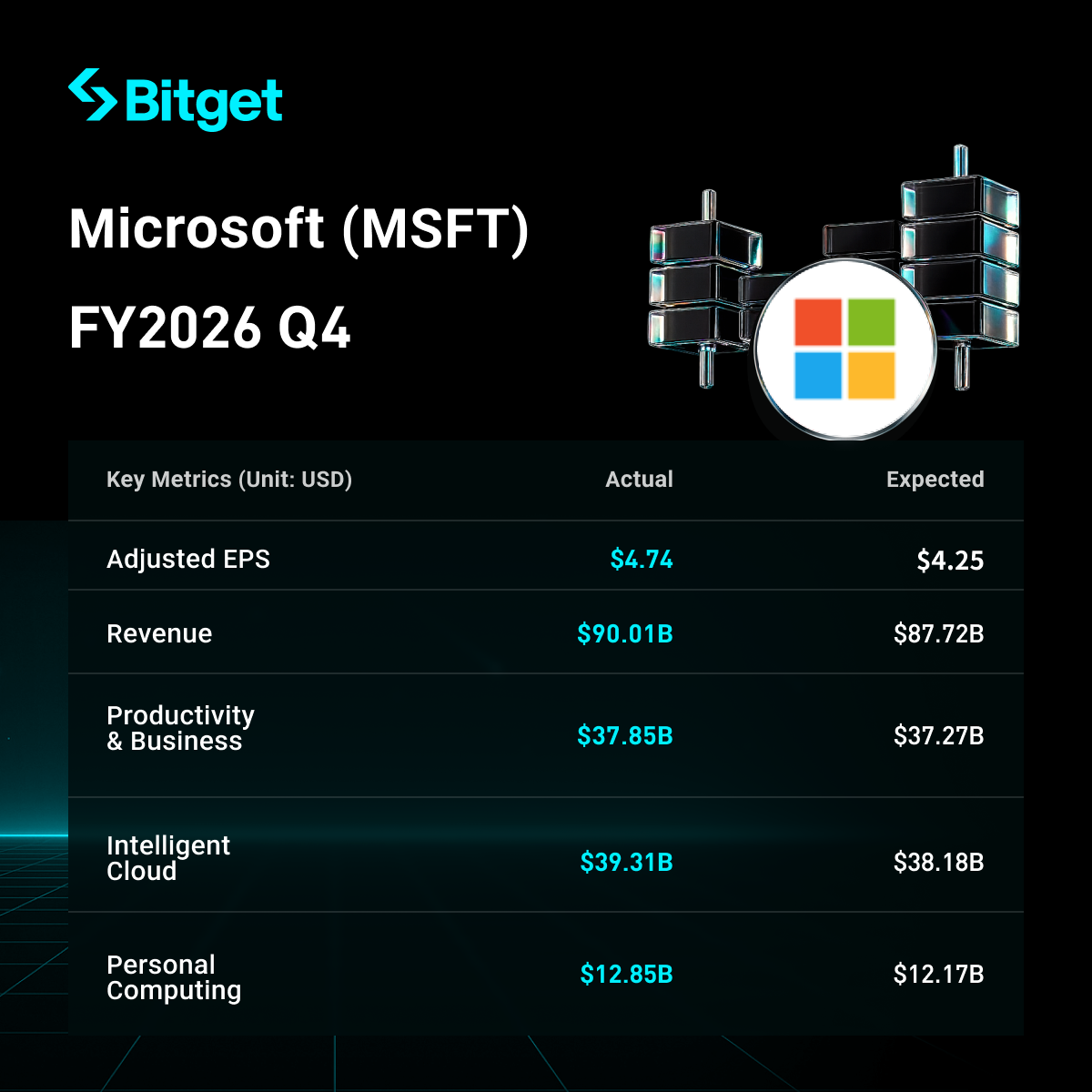
Microsoft delivered a comprehensive beat against Wall Street expectations in its fiscal fourth quarter of 2026 (ended June 30, 2026). Total revenue reached $90.0 billion, up 18% year-over-year. Non-GAAP adjusted earnings per share (EPS) came in at $4.74, up 23% year-over-year. Operating income was $40.6 billion, up 18% year-over-year. The most closely watched cloud business performed strongly, with Microsoft Cloud revenue at $59.3 billion, up 27% year-over-year. Azure and other cloud services revenue grew 43% year-over-year, significantly ahead of the market expectation of approximately 39.6%–40%. Azure full-year revenue surpassed $100 billion for the first time, and Microsoft 365 Copilot paid seats exceeded 30 million. Although capital expenditures increased substantially, total capital expenditures for the quarter of $41.0 billion came in below expectations, and the company maintained its previously announced capital expenditure guidance (approximately $175 billion after accounting adjustments). After the results were released, the stock rose as much as nearly 5%–10% in after-hours trading, reflecting the market’s positive reaction to AI investments beginning to convert into cloud revenue growth, while still weighing the pressure of elevated capital spending on free cash flow.
Detailed Breakdown
- Overall Revenue and Profit Performance
- Total revenue: $90.0 billion, up 18% year-over-year (up 17% in constant currency), approximately 2.6% above analyst expectations.
- Non-GAAP adjusted earnings per share (EPS): $4.74, up 23% year-over-year, approximately 11.5% above expectations.
- Operating income: $40.6 billion, up 18% year-over-year, approximately 4% above market expectations.
- Operating cash flow: $55.44 billion, up 30% year-over-year.
- Cash remaining after property and equipment expenditures: approximately $19.64 billion, lower than the prior-year period of approximately $25.57 billion, primarily due to AI-related capital expenditures compressing free cash flow.
- The investment in Anthropic contributed approximately $3.2 billion in income in the quarter; this factor should be distinguished when assessing sustainable profitability.
- Cloud Business (Azure and Intelligent Cloud) Performance
- Microsoft Cloud revenue: $59.3 billion, up 27% year-over-year, approximately 1% above market expectations.
- Azure and other cloud services revenue: up 43% year-over-year, clearly ahead of the expected approximately 39.6%.
- Intelligent Cloud segment revenue: $39.31 billion, up approximately 32% year-over-year, approximately 3% above market expectations.
- Key milestones: Azure full-year revenue exceeded $100 billion for the first time; Microsoft 365 Copilot paid seats surpassed 30 million.
- CEO Satya Nadella emphasized progress on the “cost-to-outcome curve,” ensuring every customer can turn tokens into actual business results.
- Commercial remaining performance obligation (RPO) grew 84% to $678 billion, indicating strong future revenue visibility.
- Other Business Segment Performance
- Productivity and Business Processes: revenue of $37.8 billion, up 14% year-over-year. Microsoft 365 Commercial Cloud grew approximately 14%–16% (adjusted); Consumer Cloud grew 24%; LinkedIn grew 12%; Dynamics 365 grew 13%.
- More Personal Computing: revenue of $12.9 billion, down 4% year-over-year. Windows OEM and Devices revenue declined 7%; Xbox content and services revenue declined 10%; Search advertising revenue (excluding traffic acquisition costs) grew 10%.
- Overall, the cloud business remained the core growth driver, while the office software and enterprise collaboration ecosystem expanded steadily, with AI features accelerating commercialization through existing channels.
- Capital Expenditure Plans
- Fourth-quarter property and equipment expenditures: $35.8 billion, up approximately 110% year-over-year (more than double the year-ago period).
- Total capital expenditures supporting cloud and AI demand: $41.0 billion, up 70% year-over-year, approximately 3.5% below analyst expectations.
- Full-year property and equipment expenditures: approximately $115.95 billion, up nearly 80% from $64.55 billion in the prior fiscal year.
- Calendar year 2026 capital expenditure guidance remains broadly in line with the previously announced approximately $190 billion (approximately $175 billion after finance-lease accounting adjustments); the company did not raise the guidance further.
- New data center lease commitments that have not yet commenced execution exceeded $130 billion in the fourth quarter; the total commitment grew 67.4% sequentially to approximately $329.1 billion, indicating that AI compute capacity expansion continues to accelerate. Roughly two-thirds of capital expenditures were directed toward short-lived assets (primarily CPUs and GPUs).
- Next-Quarter and Full-Year Guidance Related
- On the earnings call, the company maintained its capital expenditure guidance unchanged, becoming one of the first major technology companies not to raise spending guidance.
- Management emphasized strong demand signals and ongoing capacity constraints, with Azure growth expected to potentially accelerate further.
- Commercial remaining performance obligation has reached a level approximately twice annual revenue, providing high visibility into future revenue.
- Precise next-quarter revenue and operating income guidance was discussed further on the call, with the overall direction pointing to double-digit growth.
- Market Context and Investor Concerns
- Core tension: whether the massive AI infrastructure investments are being made too quickly and whether returns are arriving in a timely manner. This quarter’s Azure growth rate exceeding expectations provided an initial signal that enterprise AI demand is converting into cloud revenue, easing investor concerns about return on investment.
- Market challenges: persistently elevated capital expenditures continue to compress free cash flow, putting pressure on margins and valuation; if cloud growth slows in the future while spending remains high, pressure could re-intensify.
- Investor reaction: the stock declined modestly ahead of the results; after the release it rapidly reversed higher in after-hours trading and at times rose sharply, reflecting the ongoing market weighing of “cloud growth exceeding expectations” against “AI spending remaining elevated.” If capital expenditures do not continue to expand while cloud revenue keeps growing strongly, that would be the signal investors hope to see.
Disclaimer The content of this article is for reference only and does not constitute any investment advice.
Disclaimer: The content of this article solely reflects the author's opinion and does not represent the platform in any capacity. This article is not intended to serve as a reference for making investment decisions.
You may also like
All Eyes on Walsh: Will the "Central Bank Super Week" See a G7 Rate Hike Wave Next Week?
Amid rising inflation, geopolitical conflicts, and oil prices surpassing $100, G7 central banks are entering a crucial rate-setting week. Driven by higher-than-expected core inflation, the Federal Reserve is expected to implement its first rate hike in three years; the Bank of Japan is likely to raise rates to 1.25%, marking a 30-year high; meanwhile, the Bank of England, the European Central Bank, and the Bank of Canada are also reinforcing their hawkish stances. Global monetary policy is undergoing a major turnaround towards collective tightening.
Uniswap processes $70.6 billion in 30-day DEX trades, outpacing rivals
Morgan Stanley’s $50.6M BTC buying shields market – But rally to $82K has THIS hurdle
Will the Fed "continue raising interest rates"? Will the "tightening cycle" of the late 1980s be repeated?
The Citi report points out that the current macro environment is highly similar to the tightening cycle of 1988-1989, when the economy remained resilient and inflation pressures gradually accumulated, followed by a slowdown in economic activity before policies shifted to easing. During that tightening cycle, the Federal Reserve raised interest rates 16 times in a row.
Crypto prices
More


