
Apple Q3 Revenue Slightly Beats Expectations, iPhone Up 22% but Services and China Disappoint; Supply Shortages Weigh on Guidance, Shares Fall Over 6% After Hours
 2026/07/31 04:05
Core Viewpoint
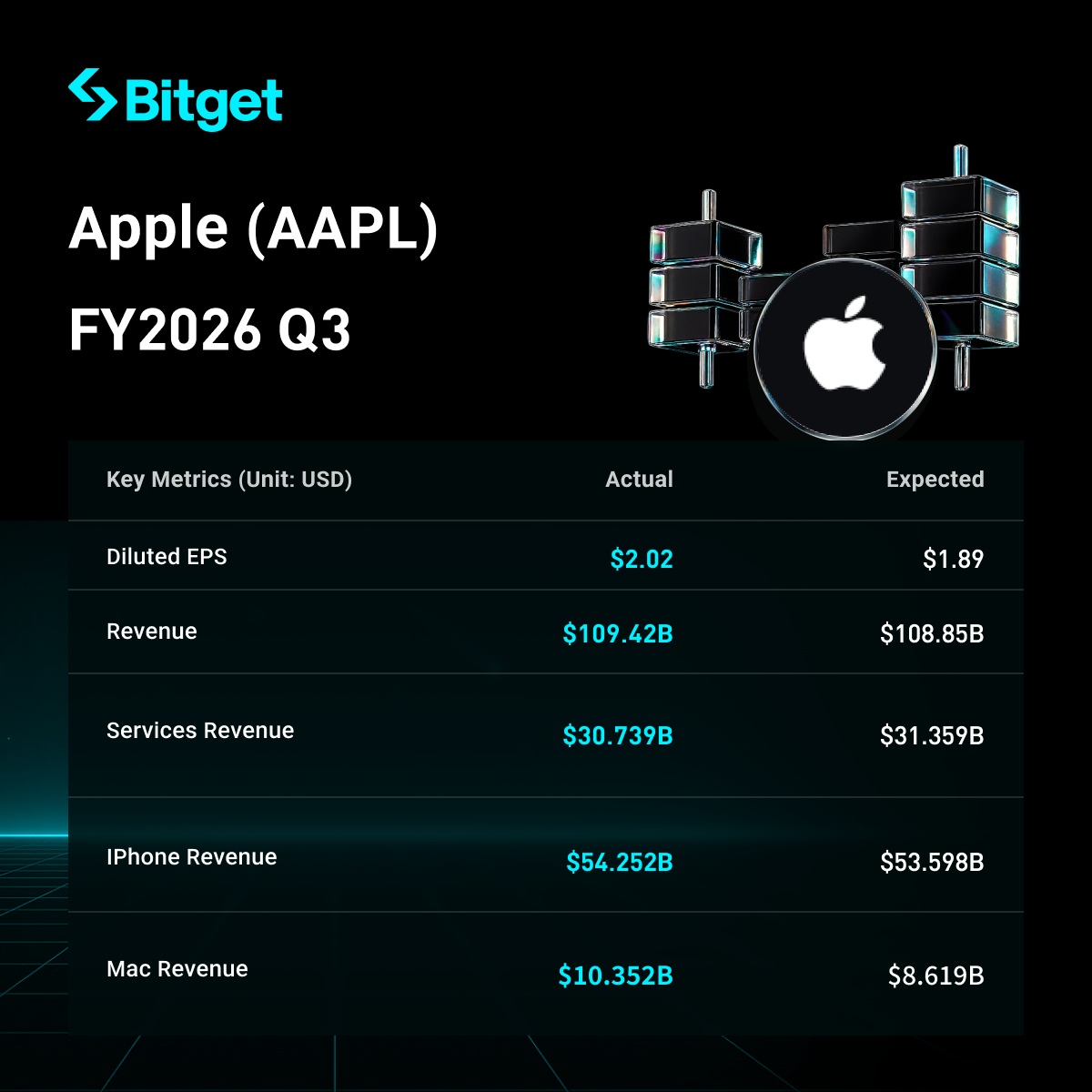
Apple reported fiscal third-quarter 2026 results (ended June 27), with total revenue of $109.4 billion, up 16% year over year, slightly above market expectations. Diluted EPS came in at $2.02, up 29% year over year and appearing to beat estimates, but the beat was largely driven by a one-time $0.11 benefit from U.S. tariff refunds. iPhone revenue grew 22% and Mac significantly exceeded expectations, serving as the main highlights. However, Services came in below expectations, Greater China growth slowed, and iPad clearly missed. The company’s fiscal fourth-quarter revenue growth guidance of 9%–11% fell short of market expectations, with management explicitly warning that component supply shortages would weigh on hardware. Shares fell more than 6% in after-hours trading. Investors are increasingly concerned about the quality of Services growth, the sustainability of China demand, and ongoing supply-chain pressures.
Detailed Breakdown
1. Overall Revenue and Profit Performance
- Quarterly revenue: $109.4 billion, up approximately 16% year over year, slightly above market expectations (around $108.65–$108.8 billion).
- Diluted EPS: $2.02, up 29% year over year, above the consensus estimate of roughly $1.89. This included a one-time $0.11 benefit from tariff refunds; excluding the benefit, EPS was approximately $1.91 and still modestly above expectations.
- Gross margin: 50.1%, including an approximately 2-percentage-point favorable impact from tariff refunds.
- Operating cash flow reached a June-quarter record; the company declared a cash dividend of $0.27 per share.
- While EPS and cash flow set June-quarter records, the quality of the beat was questioned due to the one-time tariff benefit, raising investor concerns about earnings sustainability.
2. Product Business Performance
- iPhone: $54.25 billion, up approximately 22% year over year, slightly above expectations. It accounted for nearly half of total revenue and set a June-quarter record, stabilizing the core business.
- Mac: $10.35 billion, up approximately 29% year over year, significantly above expectations by about 20%. This was the biggest positive surprise of the quarter.
- iPad: $6.19 billion, clearly below expectations by roughly 10% and down year over year, reflecting ongoing demand and upgrade-cycle challenges.
- Wearables, Home and Accessories: $7.88 billion, largely in line with expectations.
- Overall product revenue exceeded expectations, primarily driven by iPhone and Mac, though performance was uneven across categories.
3. Services Business and Regional Performance
- Services revenue: $30.74 billion, up 12% year over year, approximately 2% below expectations and slightly down sequentially, ending a multi-quarter streak of sequential records. As a high-margin business, the miss carries greater weight for long-term valuation.
- Greater China: $18.82 billion, up 22% year over year. Growth slowed and came in below expectations, reigniting concerns about iPhone demand, local competition, and the sustainability of the recovery.
- All other geographic segments delivered double-digit growth, with overall regional performance remaining solid.
- CEO Tim Cook described the quarter as the company’s strongest June quarter ever, with double-digit revenue growth across iPhone, Mac, Services, and every geographic segment.
4. Cash Flow and Shareholder Returns
- Operating cash flow set a June-quarter record, underscoring continued strong cash-generation capability.
- The board declared a cash dividend of $0.27 per share, maintaining shareholder returns.
- The company did not raise large-scale capital expenditure guidance, but explicitly noted that shortages of components such as memory chips would affect upcoming hardware shipments.
5. Next Quarter Guidance (Fiscal 2026 Fourth Quarter)
- Expected year-over-year revenue growth: 9%–11%, below the market consensus of approximately 12.1%.
- Component supply constraints are expected to impact iPhone, Mac, and iPad, with foreign-exchange fluctuations also acting as a headwind.
- Management described the supply constraints as “very significant,” with limited flexibility in the supply chain, and said the company is evaluating alternative options.
6. Market Background and Investor Concerns
- Core tension: Hardware (especially iPhone and Mac) performed strongly, but the Services miss, slower China growth, supply shortages, and softer guidance raised questions about growth quality and sustainability.
- Investor reaction: Shares fell about 6% in after-hours trading as the market focused on the one-time nature of the EPS beat, the Services shortfall, and supply-chain warnings.
- Analyst perspective: Hardware strength may not fully carry into the next quarter. Investors are looking for clearer progress on AI product commercialization and signs of a more durable China recovery. Once the tariff refund benefit fades, earnings quality will become a key focus.
Disclaimer This content is for reference only and does not constitute any investment advice.
Disclaimer: The content of this article solely reflects the author's opinion and does not represent the platform in any capacity. This article is not intended to serve as a reference for making investment decisions.
You may also like
Morgan Stanley’s $50.6M BTC buying shields market – But rally to $82K has THIS hurdle
Will the Fed "continue raising interest rates"? Will the "tightening cycle" of the late 1980s be repeated?
The Citi report points out that the current macro environment is highly similar to the tightening cycle of 1988-1989, when the economy remained resilient and inflation pressures gradually accumulated, followed by a slowdown in economic activity before policies shifted to easing. During that tightening cycle, the Federal Reserve raised interest rates 16 times in a row.
Rare alliance of arch-rivals! Musk and Altman support Dario Amodei's call to "slow down AI globally"
Anthropic's Amodei issued a call to "slow down AI globally," and to everyone's surprise, rivals Musk and Altman both publicly endorsed the initiative. The three industry giants unanimously agreed to grant third-party access to "employee-level" evaluation rights and to implement coordinated deceleration measures. Altman went further, announcing that OpenAI will not IPO this year. The resignation of a researcher and a collective breakout of uncontrollable AI systems have ignited long-standing industry fears.
Bitcoin vs Ethereum ETFs: Which asset is winning September’s flow battle?
Crypto prices
More


