
AMD Q2 2026 Earnings Highlights: Revenue and Profits Both Beat Expectations, Data Center Revenue Doubles with 107% Growth, Q3 Guidance Falls Short of Some Aggressive Expectations Leading to Sharp Stock Drop
 2026/08/05 03:21
Core View
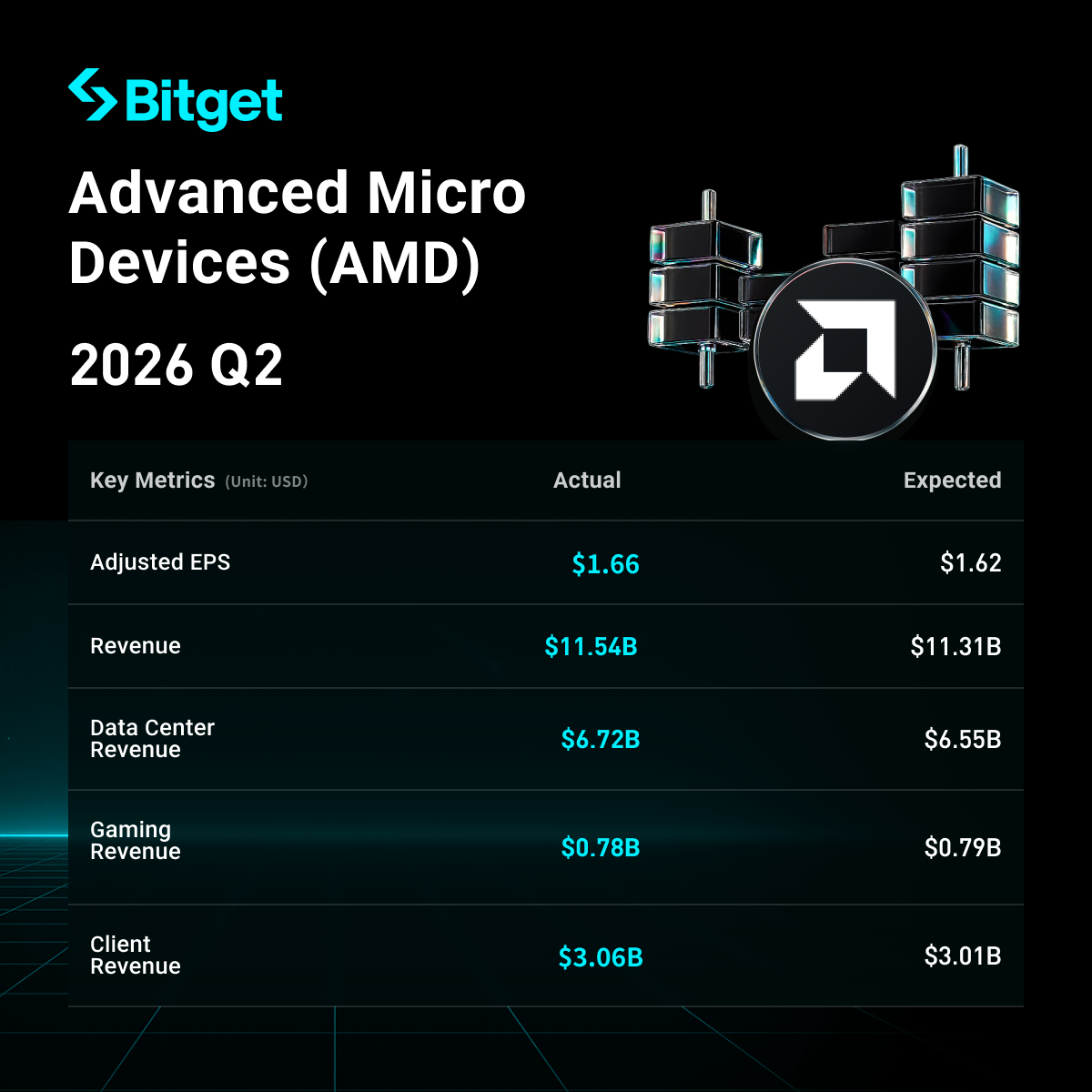
AMD reported its second-quarter 2026 results with revenue of $11.536 billion, up 50% year-over-year to a record high and beating market expectations of approximately $11.3 billion. Non-GAAP earnings per share came in at $1.66, surpassing the consensus of $1.62. Data Center segment revenue reached $6.718 billion, surging 107% year-over-year and accounting for about 58% of total revenue, serving as the primary growth engine. GAAP gross margin rose to 54% (up 14 percentage points year-over-year), while non-GAAP gross margin stood at 56%. Despite the broad beat, the Q3 revenue guidance of approximately $13 billion (±$300 million) exceeded the Wall Street average expectation of about $12.5 billion but fell short of more aggressive investor hopes. Combined with the stock’s year-to-date gain of over 100% and valuations that already fully priced in AI growth, shares dropped roughly 8.8%–9% in after-hours and overnight trading. The market narrative has shifted from “whether AMD can benefit from AI” to “whether AMD can match the growth pace of AI leaders.”
Detailed Breakdown
- Overall Revenue and Profit Performance
- Revenue: $11.536 billion, up 50% year-over-year (from $7.685 billion in the year-ago quarter) and up 13% sequentially (from $10.253 billion in the prior quarter), beating expectations of approximately $11.3 billion / $11.28 billion.
- GAAP gross margin: 54%, up 14 percentage points year-over-year; non-GAAP gross margin: 56%.
- GAAP operating income: $1.990 billion (versus a loss of $134 million in the year-ago period); non-GAAP operating income: approximately $3.1 billion.
- GAAP net income: $2.297 billion; non-GAAP net income: approximately $2.8 billion.
- GAAP diluted EPS: $1.38; non-GAAP diluted EPS: $1.66 (beating expectations of $1.62 / $1.61).
- Cash and short-term investments: approximately $13.111 billion; total debt: approximately $3.226 billion.
- Key drivers: Strong Data Center demand (EPYC server CPUs and Instinct AI GPUs) more than offset the decline in the Gaming business.
- Data Center Segment Performance
- Revenue: $6.718 billion (approximately $6.7 billion), up 107% year-over-year, representing about 58% of total company revenue (versus roughly 42% a year earlier).
- Operating income: $2.103 billion (versus a loss in the year-ago period).
- Key drivers: Robust demand for EPYC server processors and Instinct GPUs, with strong growth from both cloud and enterprise customers. Management indicated that Data Center sales are expected to accelerate further in the second half of 2026.
- Strategic progress: Launch of the Helios AI server rack solution; partnership with Anthropic to deploy up to 2 GW of MI450-series GPUs; expanded collaboration with Microsoft for Helios deployments on Azure; introduction of the Instinct MI400 series (including the MI455X) for large-scale AI training and inference. AMD is shifting from selling discrete chips toward offering complete AI system solutions in an effort to challenge Nvidia.
- Other Business Segment Performance
- Client: Revenue of approximately $3.062–$3.1 billion, up 23% year-over-year, primarily driven by strong demand for Ryzen processors.
- Gaming: Revenue of $779 million, down 31% year-over-year due to lower semi-custom chip revenue.
- Client & Gaming combined: Approximately $3.841 billion, up 6% year-over-year.
- Embedded: Revenue of $977 million, up 19% year-over-year.
- Overall, growth in Client and Embedded partially offset the decline in Gaming.
- Capital Expenditure and Future Plans
- Capital expenditures in the quarter totaled approximately $808 million.
- The company is focused on AI infrastructure: accelerating Instinct GPU deployments, ramping the Helios rack solution, and emphasizing a “chip + system + software ecosystem” model modeled after Nvidia.
- Management noted that AI is driving a significant expansion in compute demand across all markets, and that AMD’s product portfolio and growing customer visibility position it well to capture this opportunity.
- Next-Quarter Guidance (Q3 2026)
- Revenue expected to be approximately $13 billion (±$300 million). At the midpoint, this implies year-over-year growth of about 41% and sequential growth of about 13%.
- The guidance exceeds the Wall Street average expectation of roughly $12.5 billion but falls short of some more aggressive analyst forecasts (some had hoped for as high as $14 billion).
- Non-GAAP gross margin expected to be approximately 56%.
- Management anticipates that Data Center strength will accelerate in the second half of the year, driving further overall revenue and earnings expansion.
- Market Backdrop and Investor Concerns
- Stock reaction: Shares fell approximately 8.8%–9% in after-hours and overnight trading following the release (prior close around $518.58). The stock had already gained more than 100% year-to-date, with AI growth expectations largely priced in, reducing tolerance for anything less than spectacular guidance.
- Core tension: Results and guidance both beat consensus, yet were viewed as “not spectacular enough.” Market focus has moved from questioning whether AMD can benefit from AI to whether it can capture share at a pace competitive with Nvidia’s dominance in AI accelerators.
- Competition and risks: Nvidia continues to hold a dominant position in the AI accelerator market. AMD must still prove performance competitiveness and long-term adoption by developers, cloud providers, and enterprises. Gaming remains under pressure; semiconductor cyclicality and the trajectory of AI capital spending remain key variables.
- Industry impact: Shares of peers such as Intel and Arm declined in after-hours/overnight trading. AI infrastructure build-out remains the core growth driver, but future performance will hinge on GPU market share gains, expansion of the cloud customer base, and progress in building a competitive ecosystem.
Stock Limited-time Offer:August new user gift: Buy U.S. stocks and get free NVIDIA stock.Trade Now for Better Deals
Disclaimer This content is for reference only and does not constitute any investment advice.
Disclaimer: The content of this article solely reflects the author's opinion and does not represent the platform in any capacity. This article is not intended to serve as a reference for making investment decisions.
You may also like
Tonight, a "dovish rate hike"?
The Federal Reserve is almost certain to raise interest rates tonight, but the key issue is "what will be said after the hike." Citi characterizes this move as a "fine-tuning" adjustment, suggesting there is no inevitable future rate hike, yet warns that if Chairman Powell does not provide clear forward guidance, it will trigger significant market volatility. Goldman Sachs bluntly stated that there is insufficient economic foundation for this rate hike, with inflation being merely a one-off factor, and expects this to be a "signal-less rate hike."
JPMorgan: "Open source disruption" and "AI safety" are not issues, there is still room for capital expenditure in the next two years, semiconductor equipment will become the "new bottleneck"
JPMorgan believes that open-source models are not a threat, regulatory disruptions are only short-term, and cloud vendors’ leverage remains low—the fundamentals of computing power investment have not changed. It forecasts that the capital expenditure of the seven major tech giants will soar from $443 billion in 2025 to $1.577 trillion in 2027, with semiconductor equipment becoming the core bottleneck of the supply chain and a new round of price increases expected in wafer foundry and advanced packaging.
Micron executive: Storage determines AI limits, substantial new capacity will come after 2028
Micron executive Sumit Sadana stated that memory bandwidth and capacity have become the core factors determining the performance ceiling of AI systems. In the face of structural imbalances between supply and demand, Micron expects to increase capital expenditure to over $45 billion in fiscal year 2027, but due to process complexity, substantive new capacity will not be released until 2028. Additionally, long-term supply agreements are reshaping the industry's business model, and humanoid robots will trigger the next wave of massive demand.
Goldman Sachs warns top clients: AI momentum trading shows unprecedented cracks, recommends hedging
Goldman Sachs has issued a rare warning to top clients: deep structural cracks are emerging in AI momentum. The AI-themed basket has dropped nearly 45% from its peak, with the one-day performance gap between short-term and long-term momentum reaching a five-year high. Capital is accelerating its shift from semiconductors to software. Goldman Sachs explicitly recommends that investors with AI exposure start hedging.
Crypto prices
More


