
After the liquidation, capital instead rushes toward "AI stock gods"

A large number of Silicon Valley investors have proactively contacted the fund, expressing their intention to increase their investment. Sequoia Capital partner Pat Grady publicly stated, "He will be an important figure in Silicon Valley for the long term," noting that setbacks have further strengthened his 'hero persona.' Venture capitalist Elad Gil announced that he has applied to invest in the fund for the first time. Meanwhile, Wall Street regards this as a classic lesson in over-leverage, emphasizing capital preservation and strict risk control management.
Leopold Aschenbrenner's hedge fund Situational Awareness “blew up”, but instead of scaring off investors, this crisis has ignited a new wave of enthusiasm in Silicon Valley.
According to a Bloomberg report on August 8, sources revealed that just days after the fund imploded, a large number of Silicon Valley investors proactively reached out to Situational Awareness to express their interest in adding new investment. Sequoia Capital partner Pat Grady publicly stated that Aschenbrenner will remain a significant figure in Silicon Valley for the long term.
Wall Street News previously wrote that Aschenbrenner himself acknowledged his error in a letter to investors, announced the removal of all leverage, and described the crisis as a “costly but invaluable lesson.” Previously, when confronted with a margin call from its lenders, Situational Awareness urgently sold off most of its stock holdings to Citadel, owned by Ken Griffin, with discounts exceeding 10%. The fund’s remaining asset portfolio (including private investments) is currently worth about $10 billion. Despite the major setback, the fund has still recorded approximately 80% positive returns this year.
This storm exposed the deep divisions between Silicon Valley and Wall Street. Wall Street sees this as a classic case where an AI star pays the price for excessive leverage; Silicon Valley’s reaction is quite the opposite—with many investors viewing it as a “buy the dip” opportunity and continuing to back the former OpenAI researcher-turned-investor. Currently, Situational Awareness has informed investors it is not accepting new capital for now, but enthusiasm from outsiders has not waned.
Silicon Valley Supports: Hero Narrative Outshines Risk Warnings
Far from a stain, the fund's blow-up has only strengthened Aschenbrenner’s “hero persona” in Silicon Valley.
Redpoint Ventures managing director Logan Bartlett put it bluntly: "There’s a kind of hero archetype here. Leopold took a punch, but it brought everyone together." Veteran venture investor Elad Gil went further, publicly announcing his first investment application into Aschenbrenner’s fund.
Sequoia Capital Partner Pat Grady, asked about the turbulence at Situational Awareness during a Bloomberg TV interview on Thursday, said:
"Our view is that he's going to be an important figure in Silicon Valley for a long time to come."
New York University Stern School of Business adjunct professor and Focus Investment Group managing director Gygmy Gonnot offered a structural explanation for the divide:
"Silicon Valley rewards those who get it right on transformational technologies, while Wall Street rewards those who generate substantial risk-adjusted returns while preserving capital."
Wall Street's Doubts: The Old Story of Leverage and Concentration
To Wall Street, the near-collapse of Situational Awareness is no surprise—it’s a recurring tale in the hedge fund industry.
From the collapse of Long-Term Capital Management (LTCM) in the late 1990s to the blow-up of Archegos Capital Management, excessive borrowing is a recurring feature of every disaster.
According to reports, S3 Partners founder Bob Sloan made it clear on Bloomberg TV on Tuesday:
"Let’s be clear—these were super concentrated positions, super crowded positions, and also super high-leverage positions."
From the beginning, some Wall Street institutions have been cautious about Aschenbrenner’s fund. Unlike similar funds, major capital for Situational Awareness comes from affluent individuals and family offices in the San Francisco Bay Area, not from pension funds and sovereign wealth funds that traditionally invest in mature funds.
According to a previous report by Bloomberg, just weeks before the fund blew up, Barclays’ prime brokerage unit refused to take Situational Awareness as a client, citing overly concentrated exposure to a single sector.
It’s further reported that, according to sources, Morgan Stanley also refused to offer prime brokerage services at the launch of the fund on the grounds of Aschenbrenner’s lack of experience. However, these sources noted that Morgan Stanley has since reversed course and now plans to add the fund as a prime brokerage client in the coming weeks.
Goldman Sachs, JPMorgan Chase, and Bank of America have provided leverage to Aschenbrenner’s fund.
AI Track: High Volatility and High Returns
The AI-focused hedge fund track where Situational Awareness operates is one characterized by both high volatility and high returns.
Rivals like the team at Value Aligned Research Advisors include veterans from BlackRock and Hudson River Trading, managing over $26 billion in assets as of the end of June. According to an investor document seen by Bloomberg, the company’s AI fund achieved around 194% returns through June this year—vastly outperforming the S&P 500’s near 10% gain over the same period.
Last month’s wave of AI stock sell-offs was broad, and not even the largest hedge funds were spared. According to Bloomberg, multistrategy giant Millennium Management fell 2.1% in July, Point72 Asset Management dropped 3.3%, and Altimeter Capital Management's relatively concentrated hedge fund tumbled 11% last month.
Notably, some funds with similar positions to Situational Awareness spotted the risks in advance. According to reports, one such fund began hedging early, worried that Aschenbrenner’s fund would be forced to dump positions.
After Deleveraging: Still Relying on Wall Street to Rebuild
After the crisis, Aschenbrenner faces the core challenge of finding balance between two radically different worlds.
In his letter to investors, he stated that he has removed all leverage from the fund and is not currently using bank prime brokerage to amplify bets—at least for now. He wrote:
"These are costly scars, but I am committed to making sure they are invaluable lessons for our firm and myself as we move forward."
However, if he wants to replicate this year’s earlier high returns, Aschenbrenner will ultimately need to convince Wall Street to provide leverage again. That means finding a sustainable path between explosive support from Silicon Valley and Wall Street’s strict demands for risk management.
Disclaimer: The content of this article solely reflects the author's opinion and does not represent the platform in any capacity. This article is not intended to serve as a reference for making investment decisions.
You may also like
"The Most Unsexy Investment Strategy" is Timely! As Bonds Collapse and Stocks Soar, Investors Face a Great Opportunity for Rebalancing
Financial advisors indicate that, amid global bond sell-offs, stock markets hovering near historic highs, and investors facing geopolitical uncertainties, now may be an especially suitable time to consider portfolio rebalancing.

They boosted the Yen but failed to hold U.S. Treasury bonds! Is Basent a "weak teammate" for U.S. stocks?
This week, Besant made high-profile calls to suppress yen short positions and raised the US Treasury repo limit to $6 billion. As a result, the yen strengthened, but US Treasuries declined—10-year yields hit their highest level since October 2023, and 30-year yields approached a twenty-year peak. Analysts noted that the combination of a stronger yen and rising US Treasury yields is simultaneously impacting carry trades and stock valuations, posing a dual threat to the US stock market bull run. This is described as "the greatest risk facing the bull market."
SK hynix US stocks surge to new highs, storage sector strengthens across the board! Goldman Sachs declares: The worst days are over
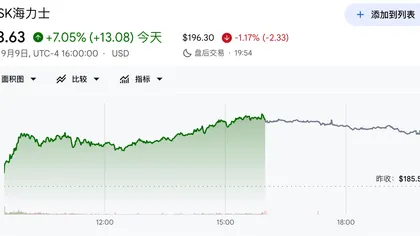
A Goldman Sachs research report ignited the storage sector, with SK Hynix soaring 7% on the US stock market in a single day to a record high. Micron and SanDisk also rose in tandem, outperforming the broader market. Goldman Sachs pointed out that a technical breakout in the storage sector, combined with low hedge fund positions, has shifted the "pain trade" direction upward. However, on the same day, the CEO of Kioxia poured cold water on the rally, stating bluntly that NAND "prices have risen enough." Amid this tug-of-war between bulls and bears, Micron's September 30 earnings report will be a key deciding factor.
Crypto prices
More


