
Rocket Lab Q2 2026 Earnings Highlights: Record Revenue of $234 Million, Up 62% YoY; Backlog Reaches Record $2.36 Billion; Strong Q3 Guidance
 2026/08/11 04:14
Core View
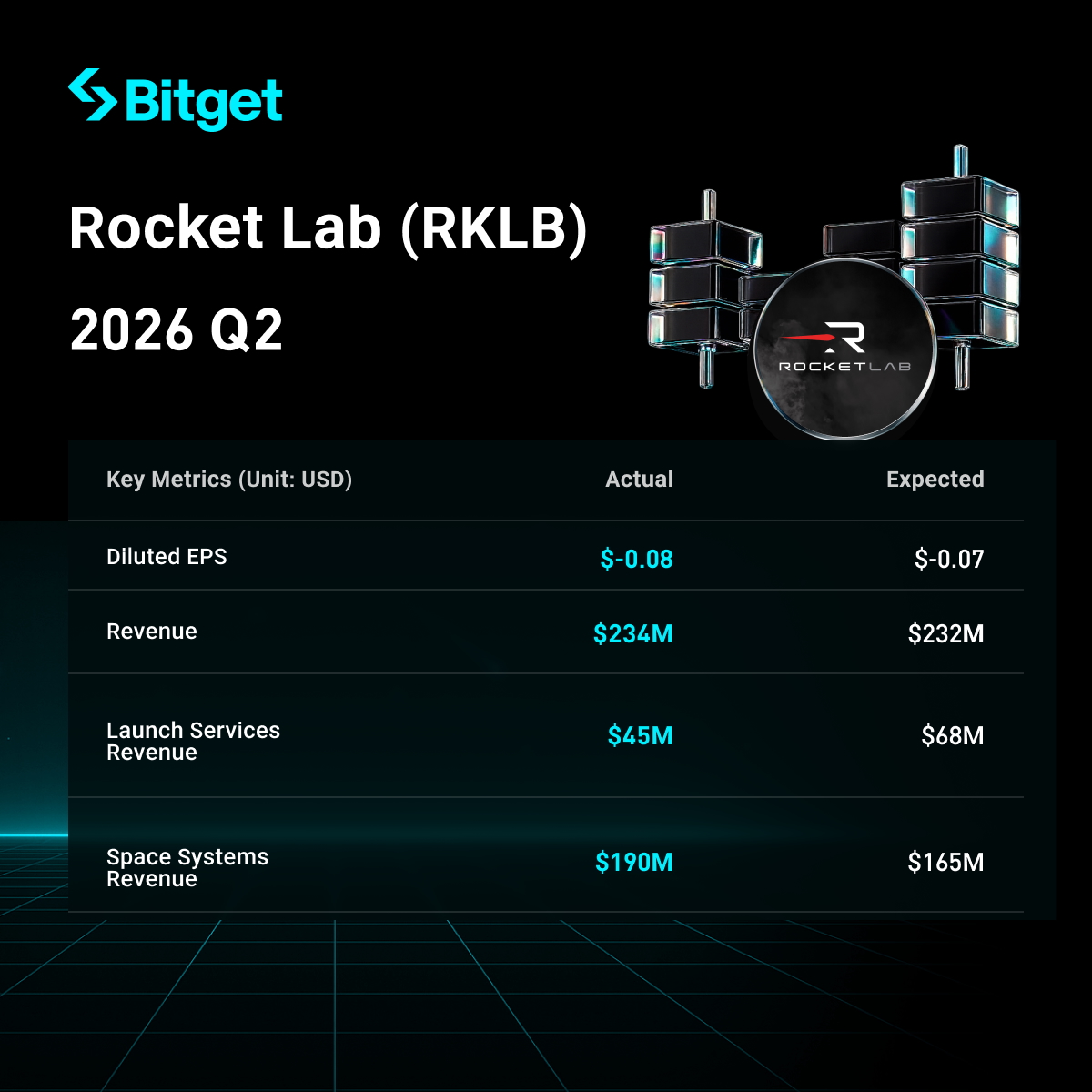
Rocket Lab (RKLB) reported its second-quarter 2026 results, with revenue reaching a record $234 million, up 62% year-over-year and beating market expectations. Net loss narrowed to approximately $49.26 million, or a diluted loss per share of $0.08. Backlog hit a record $2.36 billion, up 137% year-over-year. Growth was primarily driven by the Space Systems segment (accounting for about 81% of revenue), while Launch Services revenue fluctuated due to revenue recognition timing. The company guided Q3 revenue of $250–265 million (above Wall Street estimates), but gross margin guidance came in below expectations, reflecting margin pressure from the expansion of lower-margin satellite platforms. Shares declined after the report.
Detailed Breakdown
- Overall Revenue and Profit Performance
- Quarterly revenue of $234 million (approximately $234.066 million), up 62% year-over-year (from $144.5 million), and up about 16.8% sequentially, exceeding the prior quarter’s record by $34 million and beating analyst estimates (around $231.4–232 million).
- Net loss of approximately $49.26 million, narrowed from $66.41 million in the year-ago period; diluted loss per share of $0.08 (versus $0.13 a year earlier), slightly wider than some estimates of a $0.06–0.07 loss.
- Product revenue approximately $181.3 million; service revenue approximately $52.7 million. Overall gross margin around 36%, improved year-over-year.
- First-half 2026 revenue of $434.4 million, up about 63% year-over-year; first-half net loss of approximately $94.28 million, improved from the prior year.
- Space Systems Performance
- Revenue of $189.5 million, up approximately 94% year-over-year and 38.6% sequentially, representing the largest revenue contributor (about 81% of Q2 total revenue).
- Growth driven primarily by expansion in satellite manufacturing and initial contribution from the Mynaric acquisition.
- Key contracts secured: approximately $397 million award to deliver multiple Flatellite spacecraft for the U.S. Space Force’s SB-AMTI program (to be launched on Neutron); more than $160 million across two contracts to build three geostationary satellites, including a prime contract with the U.S. Space Force’s Space Systems Command to build and operate two space domain awareness satellites.
- Formally established Rocket Lab Germany GmbH to support scaling of satellite and component manufacturing in Germany and to provide commercial and sovereign space capabilities to European customers.
- Launch Services and Other Business Performance
- Launch Services revenue of $44.6 million, down approximately 4% year-over-year and 30% sequentially (despite a similar number of launches), primarily due to the mix of point-in-time Electron revenue recognition versus over-time HASTE recognition.
- More than $437 million in new launch contracts secured across Electron, HASTE, and Neutron during Q2 and post-quarter, expanding the total launch backlog to a record of more than 90 missions.
- Overall backlog of $2.36 billion (roughly 40% Launch Services / 60% Space Systems), up 137% year-over-year.
- Introduced the GHOST globally deployable launch system; first site (Launch Complex 4) at the Pacific Spaceport Complex in Kodiak, Alaska, with planned suborbital debut in 2027.
- Future Plans and Strategic Initiatives
- Neutron medium-lift reusable rocket: Progress on assembly, integration, and first-flight hardware testing; Stage 1 tank production remains on track for delivery to the launch pad in Q4 2026 (with some adjustment to earlier inaugural flight expectations).
- Closed the acquisitions of Mynaric and Motiv; announced a landmark agreement to acquire Iridium Communications Inc. to create a fully vertically integrated space company capable of designing, building, launching, and operating its own satellite constellations.
- Continued investment in launch infrastructure, production capacity, and Neutron development; additional Neutron launch contracts signed (including with Kepler Communications).
- Q3 2026 Guidance
- Revenue: $250 million to $265 million (midpoint approximately $257.5 million, above Wall Street estimates of around $238.5 million).
- GAAP gross margin: 29% to 31% (below analyst average estimate of approximately 37.6%); non-GAAP gross margin: 35% to 37%.
- GAAP operating expenses: $143 million to $149 million; non-GAAP operating expenses: $121 million to $127 million.
- Net interest income: $21 million.
- Adjusted EBITDA loss: $17 million to $23 million.
- Basic weighted-average shares outstanding: approximately 641 million (including about 41 million Series A convertible preferred shares).
- The company noted that more than $1 billion in new launch and space systems contracts have already been signed in Q3 to date, supporting the strong growth outlook.
- Market Context and Investor Concerns
- The core tension is strong top-line growth and record backlog (driven by surging demand) versus near-term margin pressure: the rising mix of lower-margin satellite platforms is weighing on profitability, leading to Q3 gross margin guidance below expectations.
- Investor attention is also focused on Neutron development progress and the adjusted timeline for first flight, alongside ongoing high spending on R&D and infrastructure.
- Market reaction: Shares closed down approximately 3.37%, with further pressure in after-hours trading (reports of declines exceeding 7–8%), reflecting caution on short-term profitability.
- Positive factors include growing defense and government contracts, the vertical integration strategy via the proposed Iridium transaction, and expansion of the launch backlog, which support longer-term competitive differentiation.
Stock Limited-time Offer:August new user gift: Buy U.S. stocks and get free NVIDIA stock.Trade Now for Better Deals
Disclaimer This content is for reference only and does not constitute any investment advice.
Disclaimer: The content of this article solely reflects the author's opinion and does not represent the platform in any capacity. This article is not intended to serve as a reference for making investment decisions.
You may also like
The ultimate bottleneck for AI is not just electricity, but also the electricity bill! As data centers become a focus in the US elections, AI infrastructure investment faces a "ballot stress test"
In 2026, data center spending, as the backbone of the artificial intelligence industry, will reach a record high. However, alongside the boom in infrastructure construction, opposition to data centers has risen sharply this year. What started as a localized issue has quickly evolved into a key topic for the November midterm elections.

Eurozone Bond Yields Rise as Brent Touches $100; 10-Year Bund Yield Hits 15-Year High -- Update
From AI to gold and U.S. Treasury bonds: almost everything is surging to new highs, the market welcomes “Everything High”
AI capital expenditure and corporate earnings expectations continue to rise, while energy, gold, US Treasury yields, and market positions are also climbing. On the surface, this suggests a comprehensive increase in growth and risk appetite; however, when inflation, interest rates, and crowded trades are all at high levels, the market's tolerance for the sustainability of the AI boom is also narrowing.
Trump pushes Fed to cut rates, but Waller may go the opposite way: Next week’s meeting faces a “three-way choice”
Bloomberg columnist Claudia Sahm believes that as Trump continues to pressure for rate cuts while inflation remains well above the 2% target, raising rates is becoming an option again, leaving Waller facing a tough decision next week. The Federal Reserve has three paths: raising rates without Waller’s support, which could trigger rare internal divisions; holding steady, which may invite criticism of political interference; or Waller leading a rate hike, which could withstand White House pressure and defend policy independence.
Crypto prices
More


