
Gold consolidates around $4,400, awaiting guidance from US CPI data

FX168 Finance, September 8th—— U.S. August employment data significantly outperformed market expectations, with non-farm payrolls increasing by 162,000 and the unemployment rate holding at 4.1%. This has pushed the market to raise bets on a rate hike in September, putting gold under pressure and pulling it back to around $4,400. With U.S. PPI and CPI set to be released this week, gold will continue to be influenced in the short term by fluctuations in the U.S. dollar and Treasury yields. However, rising energy prices, inflation risks, and long-term portfolio demand for gold continue to provide some support for the price of gold.
Gold started this week continuing its weak trend, with spot gold retreating to

After the release of the employment data, the rate market quickly adjusted its expectations. Currently, the probability of a 25 basis point rate hike at the September 16th Federal Reserve meeting has risen to
However, judging the medium-term trend of gold based solely on employment data remains limited. What the market truly needs to confirm is whether U.S. economic resilience will further feed into inflation. If employment remains strong and rising energy prices push cost pressures higher, U.S. rates could stay elevated for longer, putting more short-term valuation pressure on gold. On the other hand, if the soon-to-be-released inflation data does not show further overheating, the hawkish impact from the employment data may gradually wane.
The market's focus this week has shifted from the labor market to inflation indicators. The U.S. August Producer Price Index will be released on
The market is currently paying close attention to the pass-through of energy costs to end-user inflation. If PPI and CPI exceed expectations, the market is likely to raise bets on further rate hikes, with both the dollar and Treasury yields having room to move higher, and gold may retest $4,400 or even lower. Conversely, if core inflation is mild, the tighter policy expectations brought by the employment data may recede, and a weaker dollar would provide a rebound window for gold. The market currently expects August PPI year-on-year growth of about
It is worth noting that this pullback in gold does not mean the long-term bullish logic has fundamentally changed. Gold prices have previously risen sharply, and the structure of market participants has shifted. Besides short-term speculative funds, long-term allocation demand, the physical market, and funds in the derivatives market still provide important support. Therefore, it is more important to pay attention to the strength of support after gold's pullback from highs, rather than simply interpreting short-term declines as a trend reversal.
From a global asset allocation perspective, gold remains in a complex macro environment. On the one hand, higher U.S. rate expectations, rising Treasury yields, and a temporarily stronger dollar will directly weigh on gold's valuation; on the other hand, inflation risks from rising energy prices, divergence in global rate paths, and safe-haven demand may increase gold's allocation value. This means that in the near future, gold could exhibit a pattern of
On a daily chart level, spot gold is currently in a clear correction phase, with prices retreating to around $4,410, close to a key support area from earlier. Current market momentum is weak, but clear signs of a medium-term trend reversal have yet to form. If $4,400 can be effectively defended, gold could still see an upward correction; primary resistance above is first at
On the 4-hour chart, gold is still in a weak short-term consolidation. The rapid decline after the non-farm data has left short-term moving averages under pressure and momentum has yet to fully recover, with the market tending to wait for inflation data to confirm a direction. If gold can form a base above $4,400 and break back above $4,465, further short-term rebound space could be opened up; if rebound attempts are consistently blocked at around $4,465, the bears still hold the short-term initiative. If $4,400 is decisively broken, the market may further test the $4,350 area and seek buyers at even lower supports.
Overall, gold is currently facing a classic
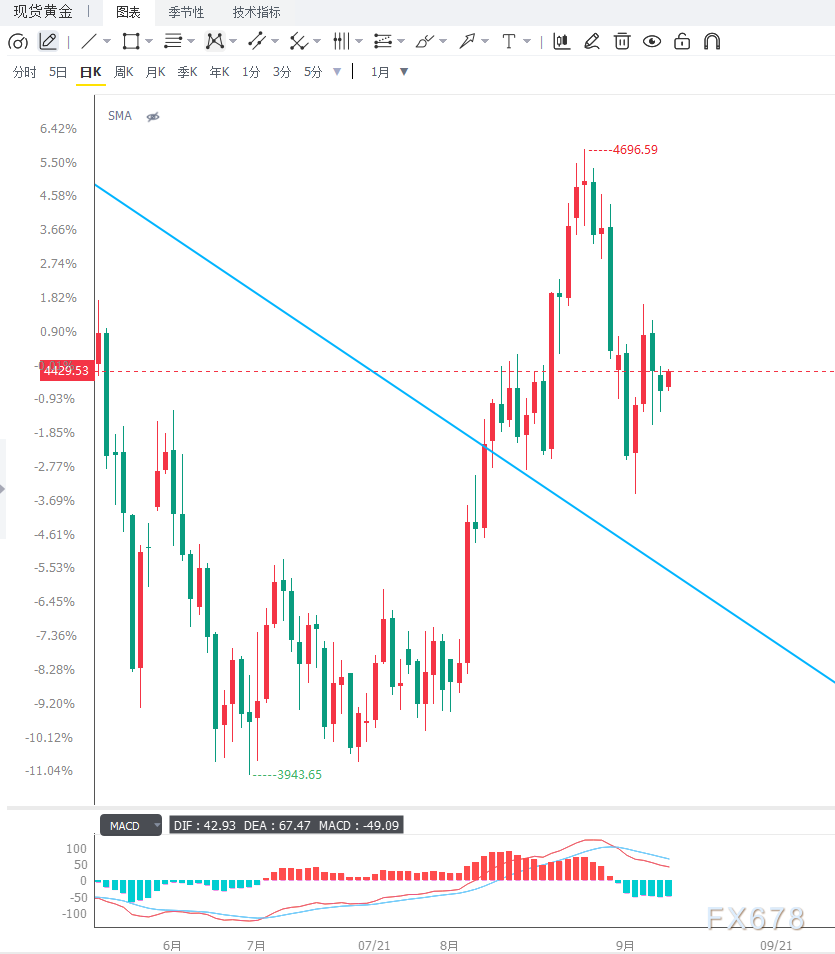
The U.S. August non-farm data exceeded expectations, making the greatest short-term pressure for gold return to
Disclaimer: The content of this article solely reflects the author's opinion and does not represent the platform in any capacity. This article is not intended to serve as a reference for making investment decisions.
You may also like
SpaceX's rising weight triggers $12.4 billion in passive buying; is the test of 2.3 billion unlocked shares still to come?
According to estimates by JPMorgan, the Nasdaq 100 index rebalancing on September 21 will increase SpaceX's weighting from 1.25% to about 1.51%, triggering approximately $12.4 billion in passive net buying. The driver for this weighting jump is the unlocking of restricted shares, and the scale of unlocks will continue to expand in the future: by mid-November, more than 2.3 billion shares will gradually become tradable. The interplay between restricted share unlocks and passive buying may dominate SpaceX's pricing in the fourth quarter.
VeChain VET price analysis: will the third resistance test finally break?

Bitmine buys 28,086 ETH, closing in on 5% of total supply target
Strategy repurchases $176 million of STRC shares, makes no bitcoin purchases or sales
Crypto prices
More


