
Gold Surges to $15,000: Fantasy, Prediction, or Warning?

When predicting the price of gold, the market tends to seek answers from gold itself: how supply and demand are changing, whether investment demand can increase, and how much higher the price of gold can go.
However, this line of thinking may overlook a more crucial issue.
Gold itself does not suddenly become more productive. An ounce of gold is still an ounce of gold—it neither generates interest nor pays dividends. What actually changes is the amount of currency required to purchase that ounce of gold and the market's assessment of the value of that currency.
Therefore, instead of asking why gold could reach $15,000 per ounce, it may be more insightful to ask: What needs to change in the value of the currency for one ounce of gold to be worth $15,000?
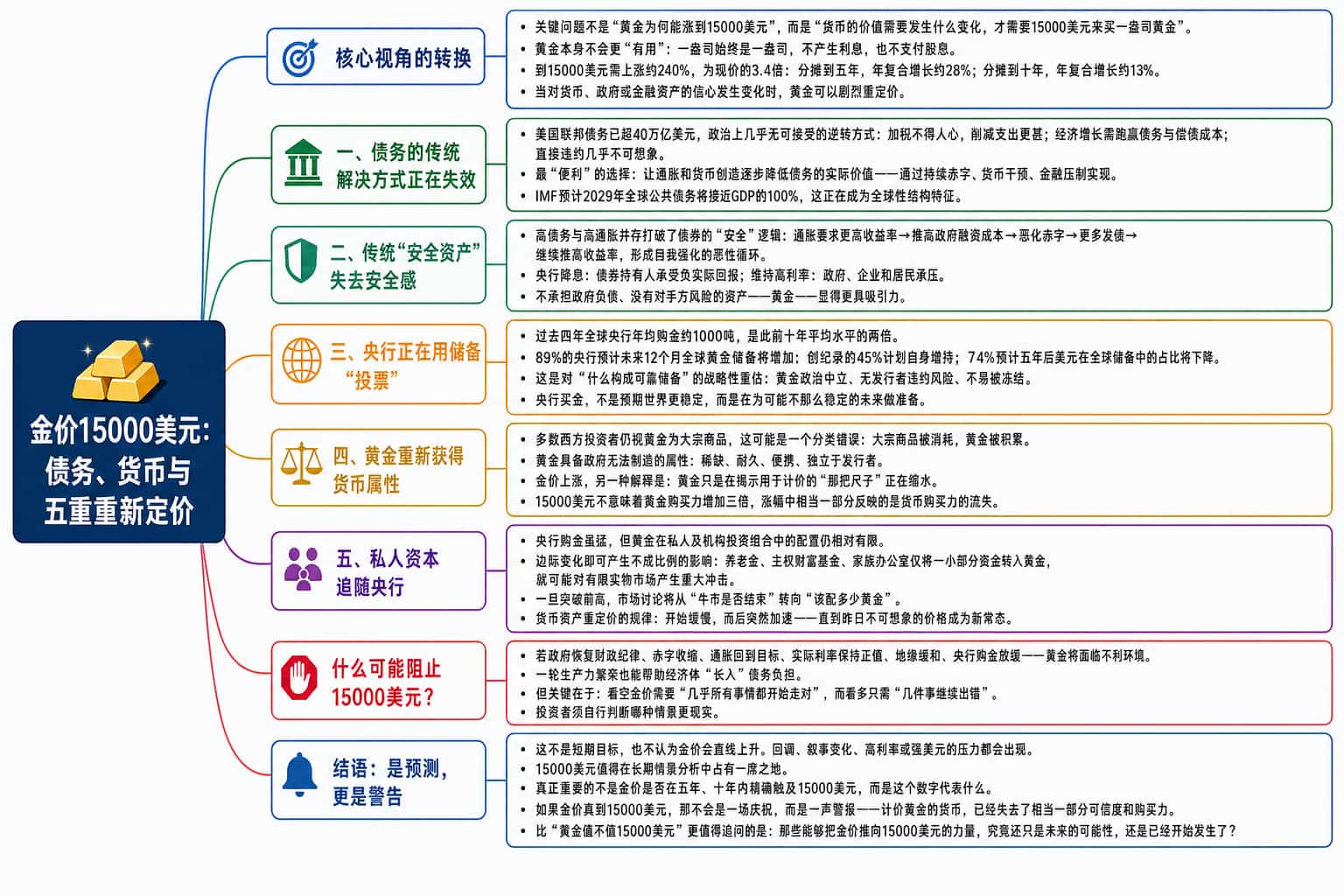
Based on the current price of about $4,400, for gold to reach $15,000 implies a rise of about 240%, or around 3.4 times the current price.
This increase is extreme, indeed. However, if it occurs over five years, the compound annual growth rate is around 28%; extended over ten years, the required annual return is about 13%.
These numbers are high, but not entirely unimaginable. History has already shown that when confidence in currency, government, or financial assets changes, gold can experience dramatic repricing.
What is truly worth discussing is the conditions under which such repricing would take place.
First Scenario: Debt is Becoming Increasingly Difficult to Solve by Traditional Means
U.S. federal debt has now surpassed $40 trillion. The real challenge is not just the magnitude of the debt, but also the lack of politically acceptable ways to reverse the situation.
In theory, a government can reduce its debt burden by raising taxes, cutting expenditures, growing the economy, defaulting, or eroding debt by inflation.
However, tax hikes lack political appeal, large spending cuts are even harder, and while economic growth can help, it must outpace the constantly accumulating debt and rising debt servicing costs.
For issuers of major reserve currencies, direct default is almost unimaginable.
Under these circumstances, a politically more convenient option is to gradually reduce the real value of the existing debt through inflation and currency creation.
This does not require the government to formally announce such a policy—it can be achieved via ongoing fiscal deficits, monetary interventions, financial repression, and inflation consistently running above cash returns.
The IMF’s Fiscal Monitor report released in April 2026 estimates that by 2029, global public debt will approach 100% of GDP.
Therefore, this is not a uniquely American problem, but is becoming a structural feature of the global financial system.
If governments are unable to repay their debts with today's purchasing power, then doing so in the future with a currency of lower purchasing power becomes a tempting choice.
Gold does not need to wait for governments to default before rallying. As long as investors start to doubt how much purchasing power the currency used to service future debt will still have, gold may gain a valid reason for repricing.
Second Scenario: Traditional “Safe Assets” Start to Become Unsafe
For decades, government bonds have been at the core of the financial system. They provide both yield and liquidity, and are considered safe-haven assets in times of market stress.
But when high debt and high inflation coexist, this relationship becomes more complicated.
Rising inflation calls for higher bond yields, while higher yields increase government financing costs. Rising financing costs worsen deficits, leading to more debt issuance; increased bond supply may require still higher yields to attract buyers.
This creates a troubling cycle: more debt leads to higher interest outlays; higher outlays require more debt.
If central banks cut rates or intervene in the market to lower government financing costs while inflation remains high, investors holding cash and bonds may suffer negative real returns.
If central banks stick to high rates, governments, businesses, real estate markets, and the banking system all come under greater strain.
Neither scenario is painless. Instead, it may enhance the appeal of an asset that does not carry government liabilities or traditional counterparty risk.
Gold is often doubted for “not generating returns.” But when the real returns of traditional safe assets turn negative, or when “safety” itself is questioned, the lack of yield may become less important while the absence of default risk becomes more valuable.
For the gold price to rise sharply, investors need not abandon bonds altogether.
If gold captures even a relatively small portion of the capital seeking alternative assets, it could have a disproportionate effect on the relatively limited physical gold market.
Third Scenario: Central Banks Are Voting With Their Reserves
Private investors often still see gold as an obsolete asset, but the behavior of global central banks does not support this view.
According to the World Gold Council's Central Bank Gold Reserves Survey 2026, over the past four years, global central banks have added about 1,000 tons of gold to their reserves annually, twice the average of the previous decade.
The survey also shows 89% of respondent central banks expect global official gold reserves to increase in the next 12 months, and a record 45% expect their own institution to boost gold holdings.
Meanwhile, 74% of respondent central banks expect the dollar’s share in global reserves to fall over the next five years.
This is not just a bet on rising gold prices, but reflects that central banks globally are reassessing what constitutes a reliable reserve asset.
Gold does not depend on issuance by other governments, cannot be created by another central bank, and does not entail issuer default risk in the traditional sense. When held domestically, gold is also less vulnerable to foreign government asset freezes.
Continued central bank gold buying does not mean they expect the future world to be more stable.
On the contrary, this behavior means they are preparing reserve assets for a world with decreasing stability.
As long as the official sector maintains current levels of gold purchases, central bank demand may continue to provide structural support to the gold market.
Once private capital begins to adopt similar asset allocation logic, this support may translate further into upward price momentum.
Fourth Scenario: Gold Regains Its “Monetary Character”
Many Western investors still regard gold as a commodity, lumping it together with oil, copper, and wheat. But this classification increasingly fails to capture gold’s actual function.
Most commodities are eventually consumed, whereas gold is more often mined, refined, and stored.
This logic has held for thousands of years: gold is scarce, durable, portable, and does not rely on government issuance.
Thus, the distinction between gold and fiat currency is once again becoming important.
Fiat currency is the unit of account for government spending, borrowing, and taxation, while gold can be viewed as an asset measuring the value of those currencies.
When the gold price rises, people usually say gold is getting more expensive. But another explanation is that gold is simply revealing that the “measuring stick”—the currency used for pricing—is shrinking.
If gold reaches $15,000, it does not mean the real purchasing power of gold has tripled. A significant part of this increase may instead reflect that fiat money is losing purchasing power relative to an asset that is scarce, limited, and has long-term store of value properties.
The final numerical result may look astonishing, but the process that leads to it may be anything but unfamiliar.
Fifth Scenario: Private Capital Begins to Follow Central Banks
Currently, central banks have become important buyers in the gold market, but gold’s allocation in most private and institutional portfolios is still relatively limited.
This means the gold price does not require all investors to pivot toward gold at once. As long as there are marginal shifts in allocation, the market can change.
If pension funds, sovereign wealth funds, family offices, and private investors allocate even a small portion of their portfolios to gold, it could have a significant impact on the relatively limited physical market.
Such a shift may not occur smoothly.
The gold price might first retest previous highs. If there is a decisive breakout, market debate could shift from “Is the gold bull market over?” to “How much gold should investors allocate?”
The higher the price, the more pronounced the psychological tug-of-war investors face: fear of chasing the top on the one hand, and fear of having no gold exposure on the other.
The repricing of monetary assets often unfolds like this—starting slowly, then accelerating, until the once-unimaginable prices of yesterday become tomorrow’s new normal.
$15,000 May Never Happen
Any serious long-term scenario analysis must also consider the opposite outcome.
If governments restore fiscal discipline, cut deficits, inflation returns to target levels for an extended period, real rates remain materially positive, geopolitical tensions ease, and central bank gold buying slows or even reverses, gold would face a much less favorable environment.
A period of robust productivity growth could likewise help economies absorb the debt burden without relying on persistent inflation or financial repression.
None of these outcomes are impossible.
But this means that a bearish view on gold assumes governments will make politically painful fiscal decisions, central banks will be able to control inflation without destabilizing heavily indebted economies, international relations will improve, and the market will regain trust in sovereign debt.
In other words, a long-term undervaluation of gold would require many things to go right at the same time. In contrast, the path to $15,000 only requires several existing trends to persist and reinforce each other.
What investors really need to judge is which scenario mix is more realistic.
$15,000: Forecast or Warning?
$15,000 should not be interpreted as a short-term target for gold, nor does it suggest that the gold price will climb in a straight line toward that level.
We may still see sharp pullbacks ahead, and market narratives will continue to evolve. Higher rates and a stronger dollar could put considerable pressure on gold; no specific price target is ever guaranteed.
However, from a long-term scenario analysis perspective, $15,000 deserves a place in the discussion.
Today’s gold price already reflects changing market expectations about currency, debt, and monetary policy. Persistent fiscal deficits, inflation, central bank gold purchasing, and geopolitical fragmentation could all further drive repricing.
What really matters is not whether gold price exactly hits $15,000 in 5 or 10 years.
The key is what it would mean if that price is actually reached.
$15,000 gold would not be a celebration—more likely, it would be an alarm: the currency used to price gold would have lost a significant portion of its credibility and purchasing power.
Therefore, the more important question is not “Is gold worth $15,000” but: Are the forces that could push gold to $15,000 still just future possibilities, or are they already unfolding?
Disclaimer: The content of this article solely reflects the author's opinion and does not represent the platform in any capacity. This article is not intended to serve as a reference for making investment decisions.
You may also like
AI Researchers Fear AI Could Destroy Humanity: Why Is Wall Street Betting Big on It?
Bitcoin eyes $82,000 resistance as golden cross forms, targets $85,000 breakout
Goldman Sachs: Initiates Arista Networks (ANET.US) with a "Buy" rating and a target price of $225
Goldman Sachs pointed out that Arista Networks reaffirmed its revenue and profit margin guidance for 2026, mainly supported by improved supply chain visibility and strong demand in its two strategic focus areas: AI infrastructure and enterprise campus deployments.

Paramount Skydance stock holds bullish trend, stalls at $10.95 resistance
Crypto prices
More


