
Starbucks: Fleeing China in Disarray, Can the Coffee King Make a Comeback in the US?


In the previous article, we explained what kind of company Starbucks is: a brand that relies on high gross margins of nearly 70% from its strong brand and "third place" concept, is able to absorb stored-value float like a bank, and has long been a cash cow that buys itself into negative equity through constant buybacks and dividends. But a great company doesn't necessarily mean great growth or a great asset.
In this article, Dolphin will answer another question: against the backdrop of recent negative comps in the U.S., market "loss" in China, and sluggish growth, how much is this cash cow really worth now?
1. What is the future growth potential of Starbucks?
Before discussing growth, we must first clarify a core premise: where exactly should we look for future growth?
In reality, following the completion of Starbucks' sale of its China business in April (selling 60% equity to Baring, and converting nearly 8,000 stores to a licensing model, moving them off the books), Starbucks' growth map has been completely restructured. The China market, formerly Starbucks' second growth curve under consolidated reporting, is now reduced to investment income from a 40% equity stake plus royalty income based on revenue proportion—a high-gross-margin but low-ceiling cash flow asset.
Other international markets also mainly adopt the franchise model, contributing stable but inflexible "brand fees." In other words, the determining factor for Starbucks' growth and valuation flexibility now rests on a single main battlefield—the North American market, which still contributes about three-quarters of revenue and operates mainly as a self-run heavy-asset business.
Growth in North America, in turn, depends on store expansion and same-store sales recovery. Below, Dolphin will break this down step by step:
Growth Logic 1: Small Store Formats Open Up U.S. Store Expansion Room
Historically, Starbucks stores have typically been over 200 square meters, with high construction and site-selection barriers: dense on the coasts, relatively sparse in the middle of the country.
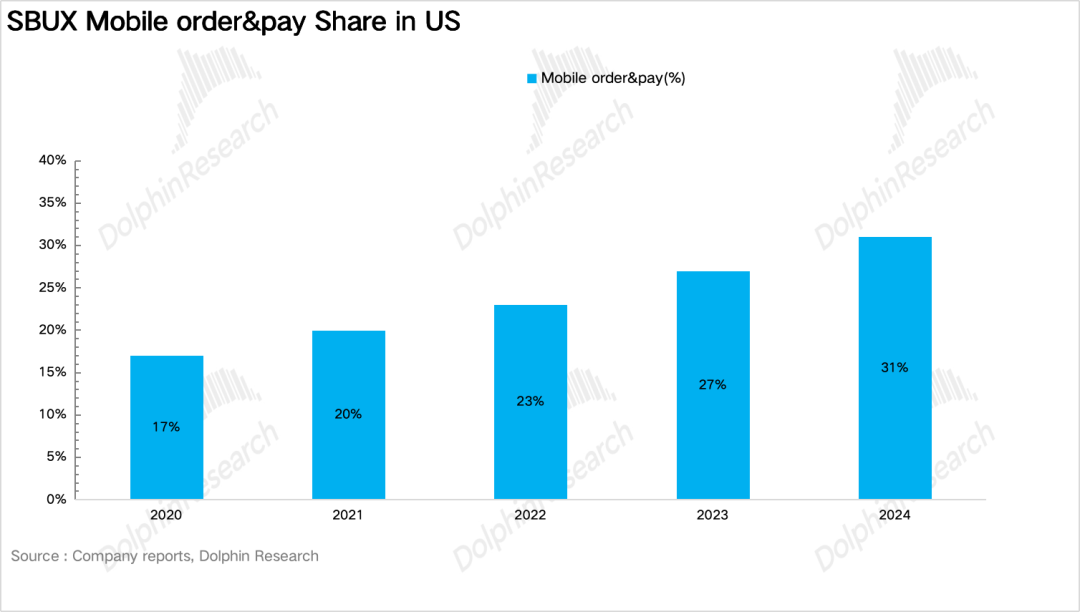
However, North American consumer behavior has changed significantly in recent years: as seen in the chart below, mobile orders have almost doubled in five years from 17% to 31%.
This has made the traditional 200‑300㎡ standard large store format obviously redundant for the speed-oriented consumer scenes of today.
In this context, Starbucks chose a dual-track growth path of "optimizing existing stores for experience, and incremental stores for efficiency":
For existing stores, as a core action of the “Back to Starbucks” strategy, the company launched the Coffeehouse Uplift plan to revamp 1,500 North American stores by the end of 2026, adding sofa seating, extra power outlets, and strengthening the “third place” ambiance to counter the monotony of the consumption scene and solidify the core loyal customer base.
For new stores, Starbucks launched two light formats that fit the heavy non-dine-in order scenario: Starbucks Pickup (order-only stores designed for App mobile ordering with no seating, located in high-density urban commercial and transit hubs like New York and Chicago), and Double Drive-Thru (compact, double-lane drive-thru stores in suburbs and highways for vehicle throughput). Online orders get a dedicated pickup window for maximized efficiency.
Take the newly disclosed prototype at Starbucks' investor day (32 seats, drive-thru, about 125㎡): the construction cost is 20-30% lower than a traditional big store; individual store investment payback is shortened from 4 years to 3. This means many previously unviable site models in smaller Midwest towns now have store-opening feasibility.
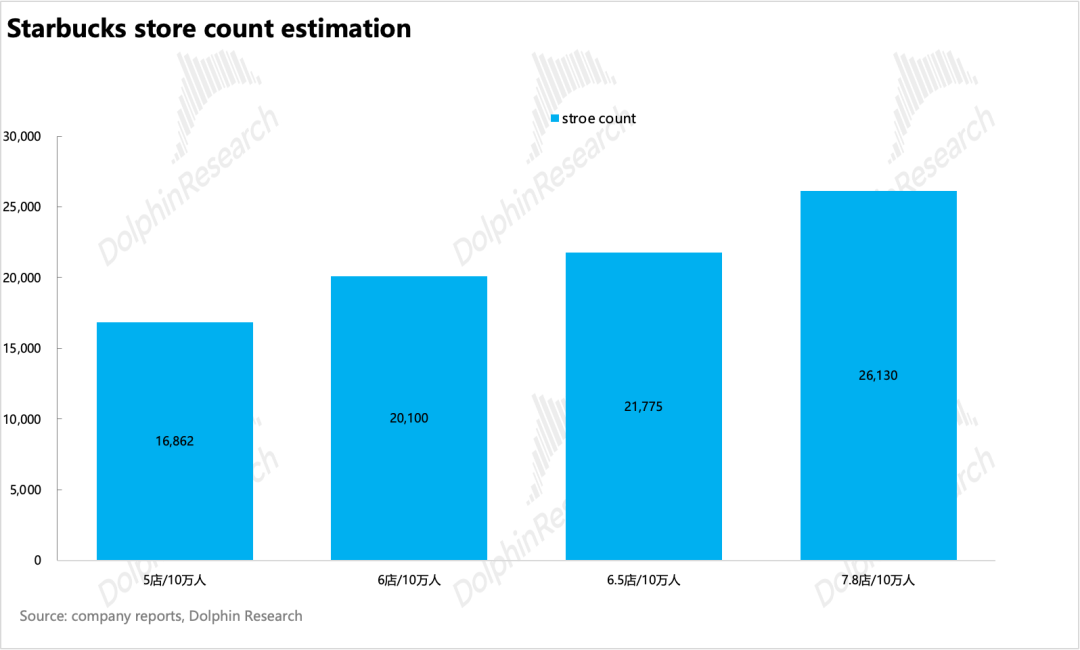
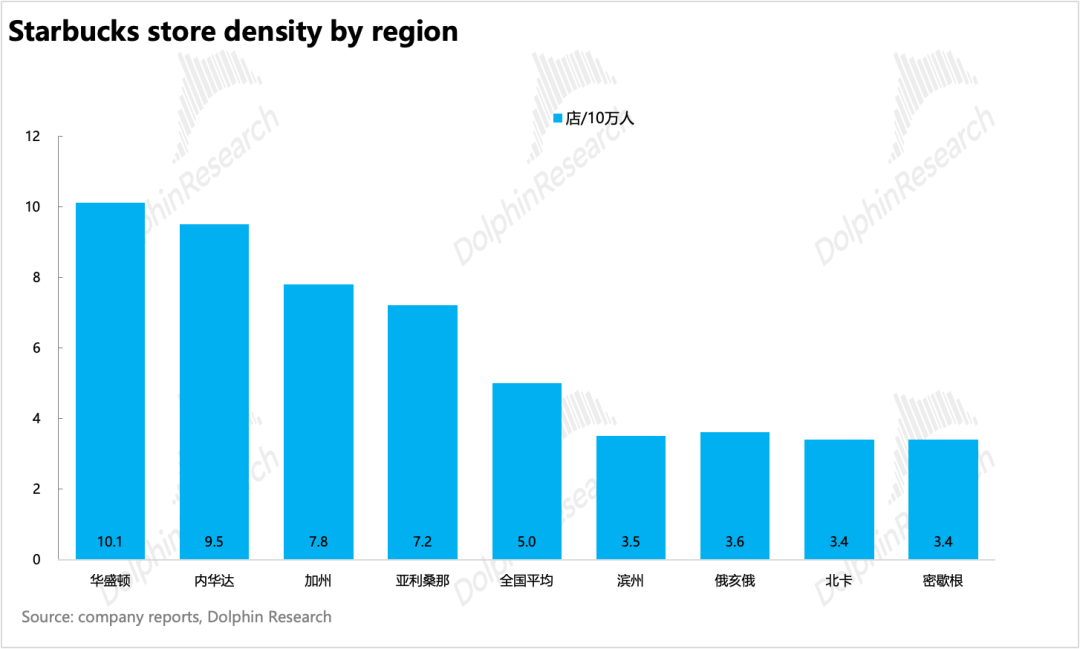
In rough estimation, at the current density in North America (5 stores per 100k people), if we increase to medium-high density states (6.5 stores/100k), there would be about 21,800 stores, an additional 4,900; to California's density (7.8/100k), that's 26,100 stores, an extra 9,300 stores.
This closely matches the company's own bottom-up guidance: about 5,000 more self-operated stores (to about 22,000), and up to 10,000 more franchise stores.
In Dolphin's view, the rationale for Starbucks betting on small store formats is:
a. Compress per-store capital expenditures and optimize investment payback: With high U.S. interest rates and building costs, small-format stores like Pickup and double-lane drive-thrus cost less to build. The company can open more stores with the same capex, improving per-store return cycles.
b. As network density increases, digital business and delivery's marginal costs decline: The China market has already validated that formats like "Fei Kuai + Specialty Delivery" can deliver a high percentage of online orders.
If the U.S. improves its suburban/smaller market small-store network, mobile and drive-thru orders will flow more smoothly. Broader coverage also better supports the Green Apron Service operating system (analyzed later), further unlocking store output efficiency.
But from the official guidance, U.S. self-operated store expansion remains at just 400 net new stores a year (through 2028). Compared to the potential 5,000-10,000 lightweight stores in North America, it would take more than a decade at this pace.
This shows management's real focus is not aggressive expansion to saturate all sites, but running the business model for Pickup and double-lane drive-thru stores to optimize per-store returns, operations, and digital adaptation.
Revenue-wise, with around 400 net new company stores each year, added to ramp-up periods and lower sales of smaller formats, annual incremental revenue from new store openings is expected to contribute just 1%-2% growth.
Therefore, unless the company raises its store-opening guidance and accelerates, small store expansion in North America is more of a mid-term value option for now—not a short-term performance driver.
Growth Logic 2: Building an "Afternoon Second Growth Curve"
One structural data set repeatedly mentioned by the company and industry: About 50% of Starbucks' business occurs before 10 am (UTC+8), and 65% before noon—meaning the morning peak is already very saturated and squeezing out more orders during morning peak hours yields limited marginal benefit.
But conversely, if the afternoon gets cultivated as a second customer flow peak, the same amount of revenue moved to the afternoon is "more profitable"—leveraging existing staff and hardware, with little fixed cost increase, the incremental profit margin is higher.
Given that caffeine demand is naturally morning-heavy, it’s logical to use new product categories to capture new afternoon demand:
Dolphin summarized Starbucks' recent afternoon product launches below, which more or less focus on the non-coffee and natural energy supplementation tracks:
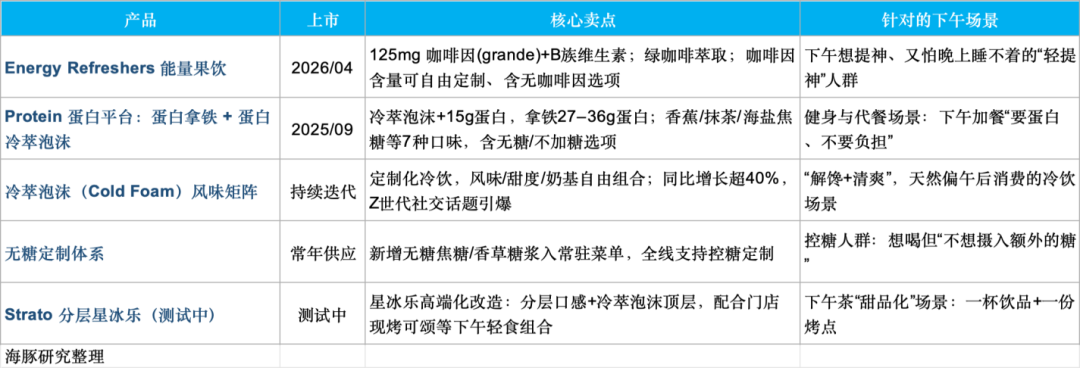
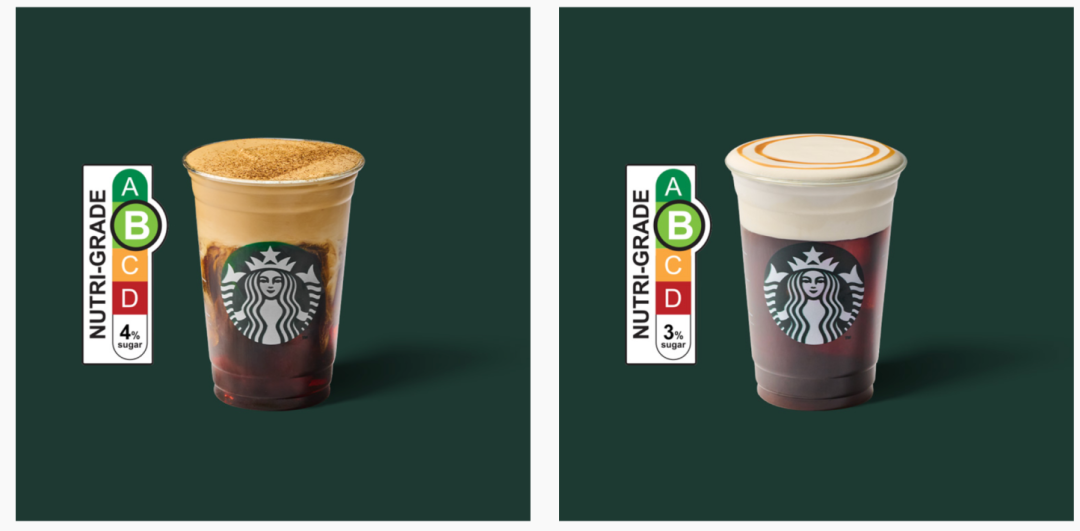
According to research, Refreshers iced fruit drinks (exemplified by the hugely popular Pink Drink) have already achieved rapid growth and become Starbucks’ second-biggest beverage segment after traditional coffee.
Building on this, Starbucks has launched Energy Refreshers with natural plant extracts and rich in B vitamins, as well as specialty matcha offerings, targeting young consumers who want an energy boost in the afternoon but dislike coffee's bitterness or are concerned about caffeine disturbing their sleep.
The key change: Starbucks is shortening the new product SKU development cycle from 18 months to 8 months (with a long-term goal of 4 months); this allows a new product launch every 3‑4 weeks, continuously keeping the afternoon menu fresh. Specifically:
a. Use real-time data + AI to replace annual surveys for precise innovation direction:
In 2019, Starbucks launched its self-developed AI/ML platform Deep Brew, which processes nearly 100 million weekly transactions for near real-time trending on flavors, ingredients, and consumption windows, quickly identifying market changes.
In 2024, Starbucks embedded generative AI to help with formula screening and generation, so new product development is data-driven, not just R&D-led intuition; in the early-stage scoping, months of guesswork can be saved.
b. Agile R&D chain restructuring:
Although the Seattle Tryer Center was built in 2018, much effort previously went into things like Siri/App ordering, cold brew machine testing, delivery box optimization, etc., not focusing on "core product innovation" or "barista peak-period improvements."
After Niccol (ex-CEO of Chipotle) took over, he launched "Starting 5": Tryer Center prototypes go straight to 5 store pressure tests, quickly validating output consistency, staff difficulty, and customer receptiveness—proof in weeks, not months.
After passing, products roll out nationwide, doubling efficiency and filtering out poor items, just like SHEIN's "small batch fast response" model.
c. Platform-based architecture + efficient restocking:
No matter how fast R&D/testing, frequent launches hinge on supply chain speed. Starbucks dares to compress the product cycle because of this supply-chain reconstruction.
Core products like Refreshers, cold foam, Cake Pops, etc., are built as modular platforms so most launches are really just new flavors or shapes atop proven bases—no retooling stores or retraining staff, just new formula parameters to remember.
This massively reduces innovation risk: As the base is proven, even failed launches don't damage the whole line—just isolated items suffer minimal loss.
Additionally, the industry norm was case orders and 72-hour delivery; new products could only roll out nationwide in weeks, and stores easily ended up with excess inventory. Switching to piece-by-piece restock and daily 24-hour delivery, rollout is fast and flexible; after product finalization, nationwide coverage is rapid, with the launch pace unimpeded by supply bottlenecks.
From earnings calls: Afternoon same-store traffic and ticket size have both risen, with the growth absorbed almost entirely by cold and customizable drinks, not by cannibalizing morning coffee peaks.
Quick math: Afternoon (12:00–17:00 UTC+8) is about 25% of sales. With North American self-operated revenue at ~$27B, a 10% afternoon sales lift adds ~2.5% to total (about $680M); a 20% lift, 5% of total ($1.35B)—almost the sum of two to three years' net new store additions. Clearly, this is Starbucks’ best "cost-effective" increment right now.
2. How to value Starbucks?
1. Same-Store Sales Recovery as the Core Driver
Let's first look at profit forecasts:
Based on earlier analysis and management guidance, Dolphin assumes that in 2026 and 2027, North America will focus on renovating existing stores and restoring per–store ROI, with only 150-200 new stores a year. Starting 2028, with small format models proven, expansion speeds up to 400-500 new stores per year.
Franchise stores (mostly in locked-in scenarios like Target, airports, universities, hospitals) have reached market saturation in the U.S.; forecast is that new premium-scenario openings will be offset by closures of low-productive stores, for no net growth.
Store-opening cadence reference chart:
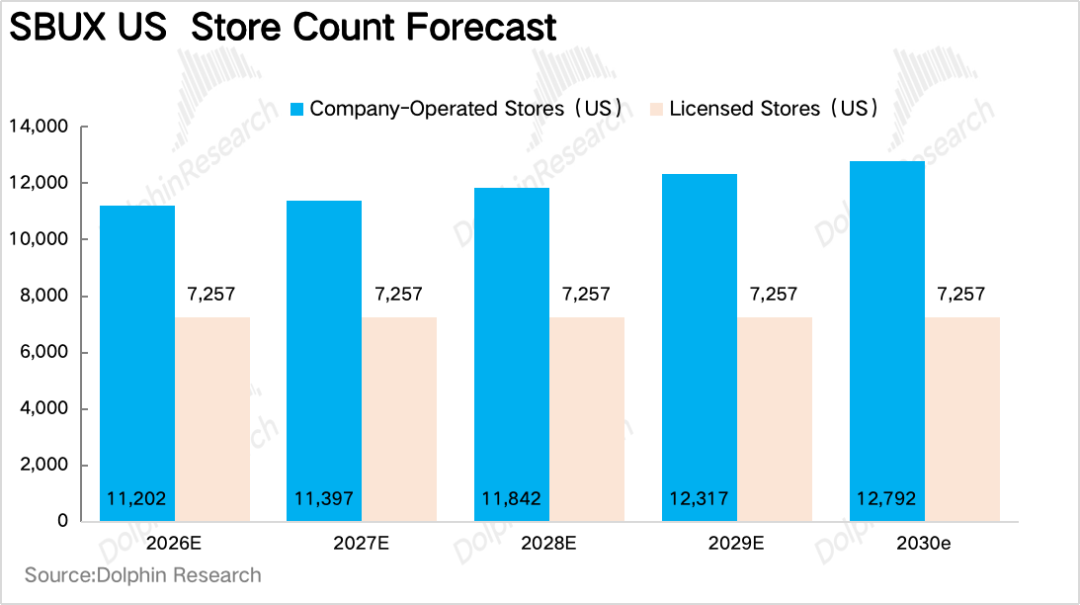
Under these assumptions, Dolphin forecasts Starbucks’ North American store count to reach 20,049 by 2030, up about 10% from now;
For same-store revenue: Although high inflation and concerns over "$6 a cup" value, plus order-bottleneck effects hurting store experience, will cause North American same-store sales to dip slightly for two straight years (FY2024 -1.5%, FY2025 -1.8%; seven quarters of traffic pressure),
By 2025, after a period of self-imposed "painful reform" under new CEO Niccol and the "Back to Starbucks" strategy—including order algorithm overhaul, 30% SKU reduction, over a thousand store renovations, and increased staffing—North America’s same-store sales turned positive in Q4 on a low base, indicating a traffic inflection point.
Therefore, Dolphin assumes a robust same-store rebound in 2026 (+5.5%)—partly due to the prior low base and partly since afternoon new products alone can add 2.5 pct for each 10% lift (see previous analysis).
From 2027 onward, with baselines normalized and renovations/menu optimization routine, same-store growth settles back to +4.5%, and stabilizes at 4% in FY2028-2030—a return to Starbucks’ historic norm.
For international, after China is moved off-book, licensed stores dominate, so same-store has little direct impact; assume mild low-single-digit growth (EMEA ~1-2%, APAC ~2-3%)—not a source of upside.
Based on these, Starbucks' revenue CAGR in 2026-2030 can likely achieve 6.5% compounded growth.
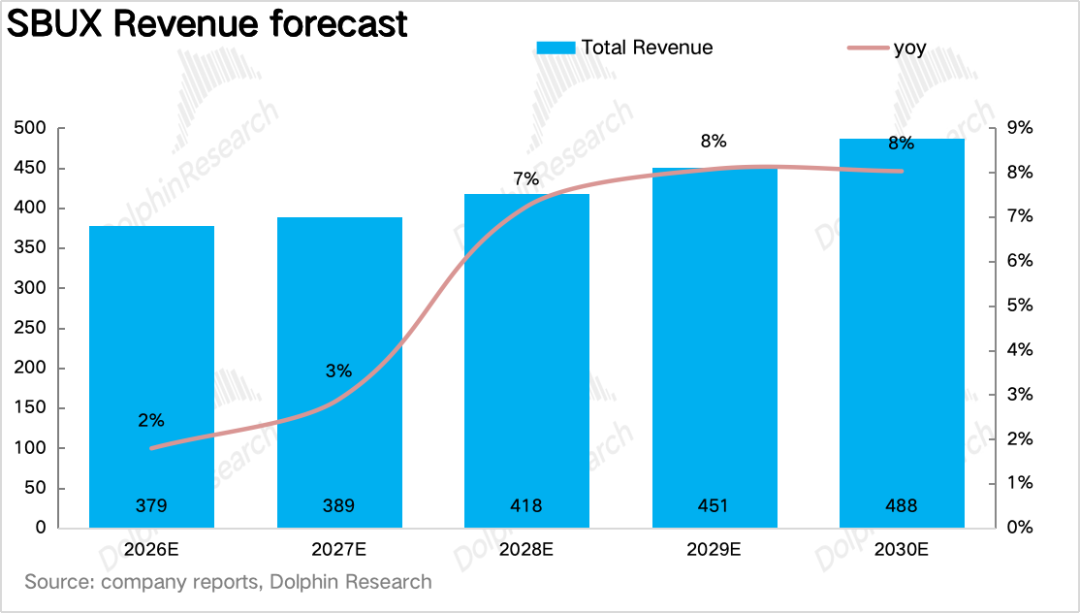
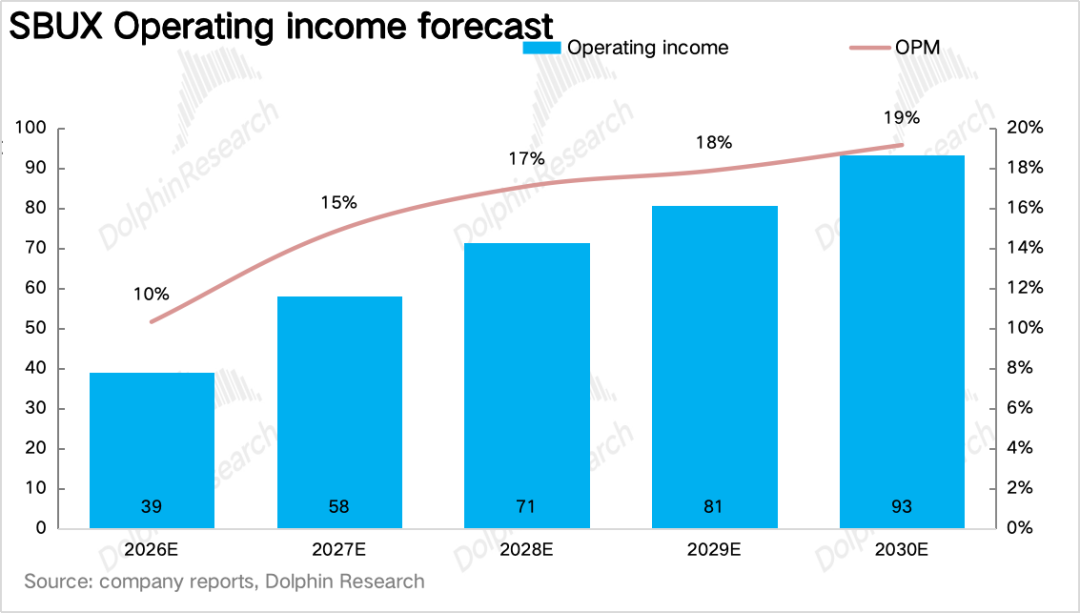
On expenses, Starbucks’ big spends are store operations and HQ management costs. Store ops hit a record high 46% (with more staff hours during "Back to Starbucks" in 2025); Dolphin expects this ratio to fall steadily to 39.8% by 2030 as leverage from comp-store recovery, Green Apron standardization, and per-person efficiency improve. Management expenses should fall from 7% to 5.1% through leaner structures/digital efficiency.
Resulting operating margin recovers from the bottom (10%) to 19%, with 24% profit growth CAGR.
2. Great Company, but the Market Has Already Priced in Store Profitability Recovery
Looking back at Starbucks’ valuation history, it's evident that valuation levels are highly correlated with same-store growth;
Excluding outliers, Starbucks PE enjoys a consistent blue-chip premium (as the world's leading coffee brand, with counter-cyclical comps and a reliable buyback/dividend base).
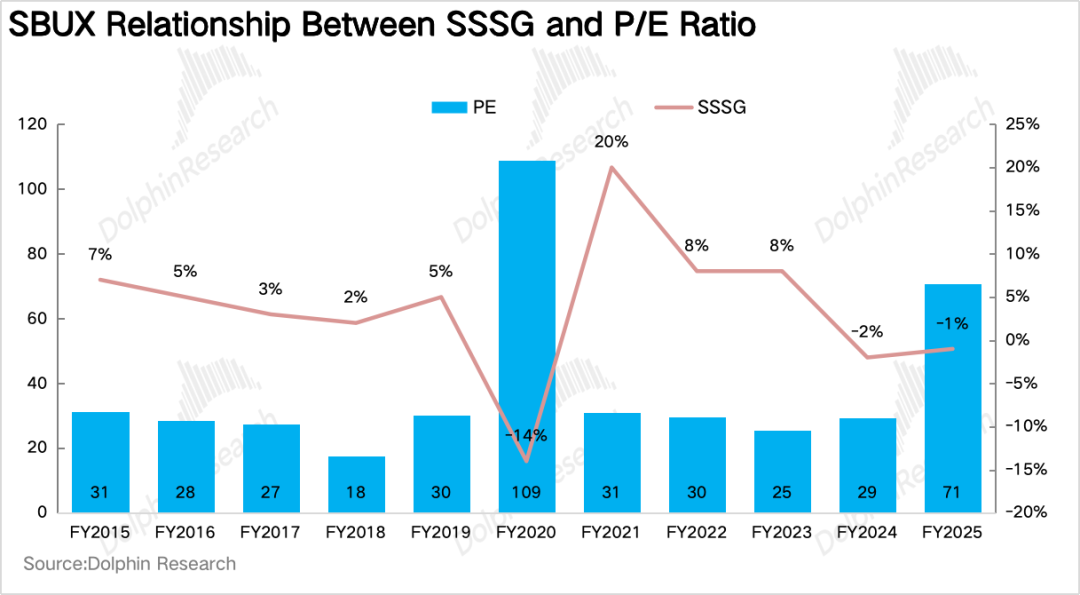
At current prices, it's precisely in line with Dolphin's bullish forecasts (operating margin in North America recovered to 21.6%, slightly surpassing pre-decline levels) being fully realized. In other words, the market has already priced in the "full recovery" scenario.
Summary: A great company, but not a great “hitting zone”
Taken together with the prior article, Starbucks is shifting from a "heavy-asset restaurant operator" to a mix of "North America cash cow + global brand licensor," on a path similar to McDonald's value re-rating.
Using the "Gu Ming" analogy in tea drinks—Starbucks in the U.S. is also both offensive and defensive: defensively, with store renovations and member float fortifying the base, and a 4%-5% buyback dividend yield; offensively, afternoon comp growth opportunity, small store expansion optionality, and the valuation uplift option of becoming more asset-light.
But a great company isn’t always a great buy. Since the market is already pricing in "full margin recovery," buying at today’s price means you’re only earning from "positive surprise", while any disappointment bears double downside risk from missed recovery.
- END -

Writing isn't easy; click “Share” to power me up~
Disclaimer: The content of this article solely reflects the author's opinion and does not represent the platform in any capacity. This article is not intended to serve as a reference for making investment decisions.
You may also like
Bending Spoons to Acquire Miro in $1.36 Billion Enterprise Deal
StonkFun overtakes PONS in revenue – Can it become Solana’s next launchpad leader?
With the US midterm elections approaching, Wall Street bets on a divided Congress—will markets see a mild respite?
As the U.S. midterm elections approach, Wall Street is generally betting on a "divided Congress" scenario, with the Democratic Party taking back the House of Representatives and the Republican Party retaining the Senate. This is expected to limit radical policies and reduce uncertainty. Historical data shows that since 1950, when a divided Congress occurred under a Republican president, the average annual gain of U.S. stocks was 13.7%, higher than the 8.3% and 4.9% gains when either the Republican or Democratic Party controlled Congress alone. If the election results deviate from expectations, the market may still experience significant volatility.
Crypto prices
More


