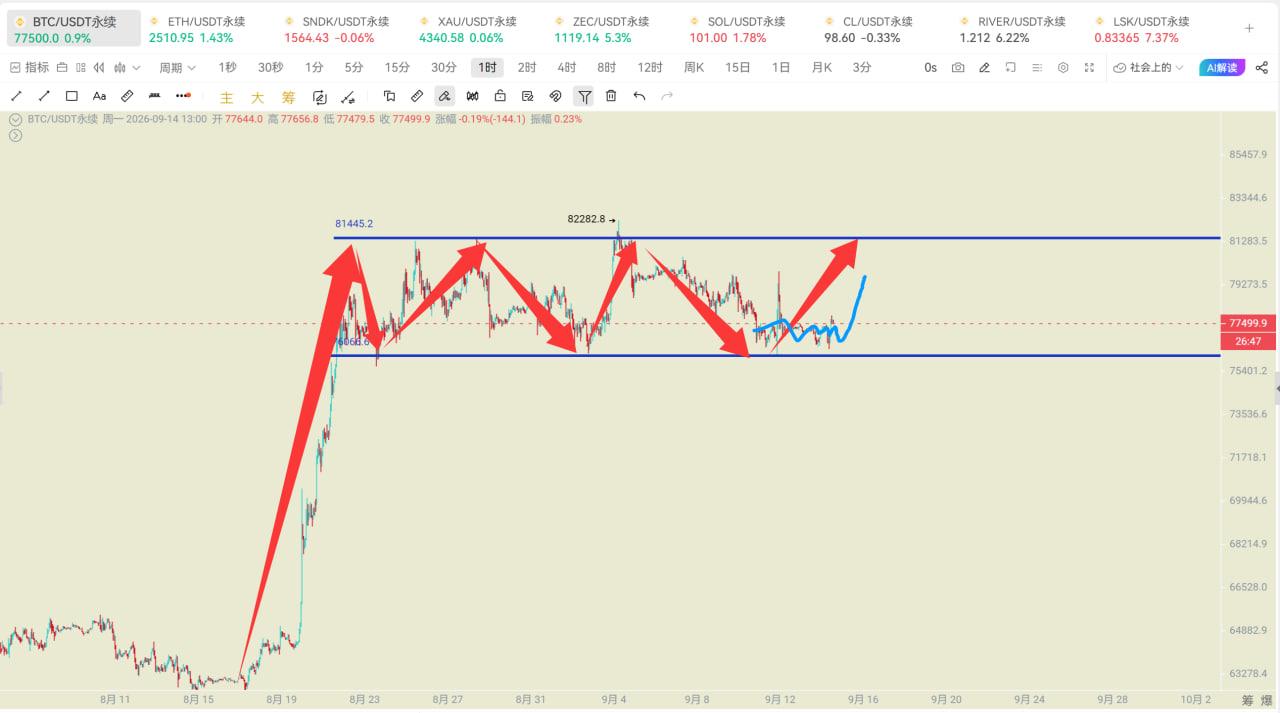
Today marks the key stage of the weekly K-line close. Liquidity remains low over the weekend, and under normal circumstances, volatility during the Asian session is unlikely to be significant. However, as the new week’s major events approach, the market has already entered a stage with high sensitivity and high volatility expectations.
Yesterday, Saturday afternoon, there was another short squeeze rally, but in the end, prices returned near the support area. This shows that while bulls still have some ability to fight back, they have not yet achieved a true breakout in trend.
The market’s focus is now shifting from purely technical factors to being macro event-driven.
First is the procedural vote related to the CLARITY Act on September 15, followed by the week’s most important FOMC meeting on September 16. Meanwhile, tensions in the Middle East have not significantly eased, and high oil prices continue to amplify concerns about sticky inflation in the market.
Therefore, what truly needs caution this week is the expectation gap: Regardless of whether the eventual outcome is more hawkish or dovish, any clear difference from market pricing in advance could instantly amplify volatility, triggering short squeezes, panic selling, or even a double whipsaw where both bulls and bears lose.
At the closing stage of the weekly K-line, it’s not advisable to chase rallies or sell in panic. Waiting for clear support or breakout signals at key levels will offer a better risk-reward ratio.
₿ Bitcoin (BTC)
View: Mainly look for short opportunities on rallies; watch for quick dips to consider buying the dip.
BTC is still in the lower-mid section of a large range. Short-term momentum has weakened somewhat, but there hasn’t been a decisive breakdown in trend yet.
Market sentiment is gradually cooling. The Fear & Greed Index has retreated from an overheated state to a neutral zone, indicating that the willingness to chase prices at high levels has declined.
However, institutional and spot capital are still providing some support, which explains why recent declines have repeatedly failed to trigger an accelerated breakdown.
Currently, there are two critical levels to focus on:
76,400 — the range bottom support line.
If the price quickly dips to this area then rapidly rebounds, keep an eye out for short-term dip-buying opportunities. If there’s a sustained breakdown on high volume, the previous consolidation structure will need to be re-evaluated.
81,300 — the true breakout test above.
Unless there’s a convincing breakout on high volume, treat any rebounds as attempts to recover within the range.
During the day, focus on the 78,500–80,000 resistance area. If there’s insufficient volume to break higher, guard against another pullback.
Support: 76,400, 77,000
Resistance: 78,500–79,000, 80,000
⟠ Ethereum (ETH)
View: Relatively strong, but still mainly look for short opportunities on rallies; quick dips can offer dip-buying chances.
ETH has shown a relatively independent trend over the past two days, mainly driven by the continued rise in the ETH/BTC exchange rate.
There is a risk here as well:
A rising exchange rate can amplify ETH gains, but if the ratio quickly retreats, it will also amplify ETH losses.
The stronger ETH becomes within a short time, the more attention needs to be paid to exchange rate changes.
From a technical perspective, ETH remains above its 20-day EMA. The medium-term bullish structure is intact; RSI is around 63.6, not yet into extreme overbought territory, so theoretically there is still room to test resistance higher.
However, with major events like the FOMC meeting approaching, the risk-reward of chasing the rally at current levels has diminished.
If ETH pushes into the 2,550–2,610 area and stalls, it’s wiser to watch resistance at high levels. If there is a sudden high-volume pullback to 2,500 or even 2,450–2,460 with rapid support emerging, you can look for short-term dip-buying opportunities again.
Support: 2,500–2,510, 2,450–2,460
Resistance: 2,550, 2,580, 2,610, 2,660