
Triple Witching: How to Trade U.S. Stocks Today — Tech Watch NVDA, Crypto Stocks Watch COIN. Ticker List Included
 2026/09/18 08:09
1. This Is Not a Theme Day. It’s a Settlement Day
Today, September 18, is U.S. triple witching: index futures, index options, and single-stock options all expire on the same day.
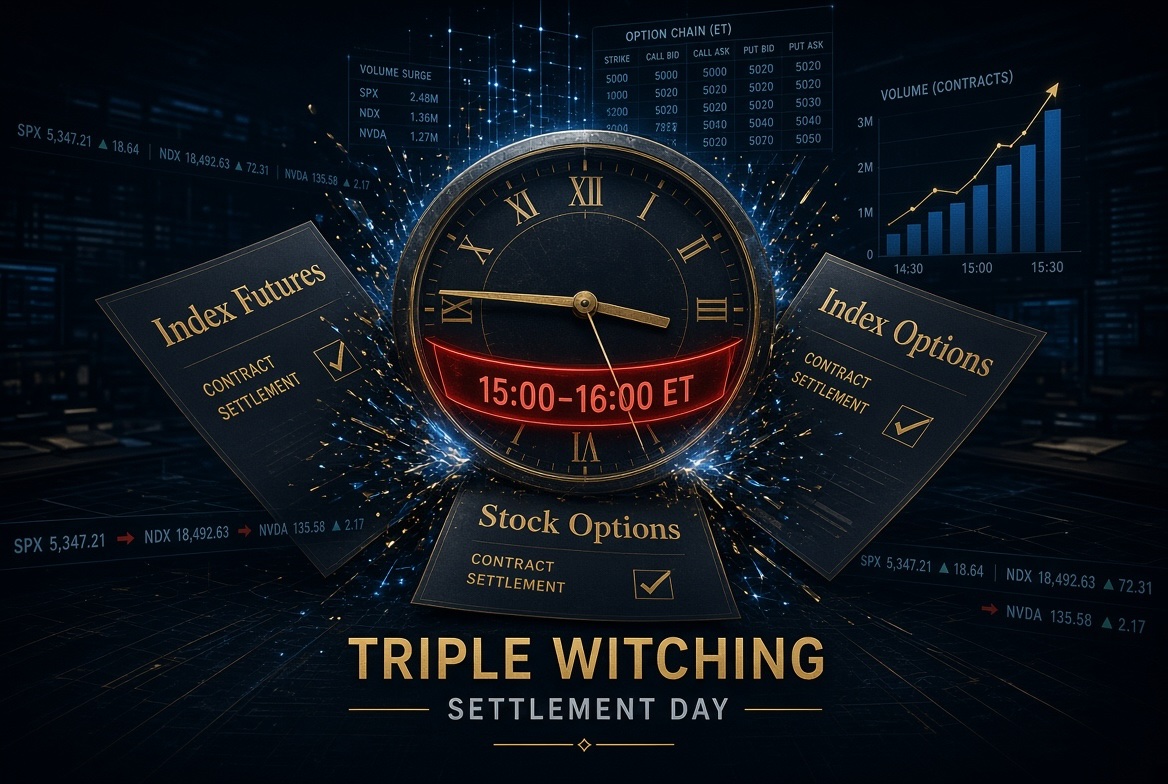
Institutions have to close, roll, and hedge at the same time, so volume often runs two to three times a normal session, and prices can whip around even without fresh news.
The two windows that matter are the cash open, when index contracts settle, and the final hour from 3:00 to 4:00 p.m. ET — the triple-witching hour. That is 3:00 to 4:00 a.m. Saturday, Beijing time. Triple witching does not decide direction. It only amplifies volatility.
This expiry also overlaps two macro events: the Fed just hiked 25 basis points on the 16th, taking the funds rate to 3.75%–4.00%, the first increase in more than three years; the Bank of Japan meeting also falls around these days.
Estimates put this options expiry in the trillions of dollars of notional. The bigger the book, the more crowded the last-hour rebalancing gets.
2. Tech Sets the Lead. Crypto Stocks Tell You If Risk Appetite Is Following
So what do we do with that? Thursday’s U.S. session already started the repair job.
The Nasdaq rose nearly 1.7%, the PHLX Semiconductor Index gained more than 3%, and Nvidia closed up about 2.5%.
Chips and tech led the bounce, and crypto-linked stocks also caught a bid after news that tokenized stock trading rules were eased.
Use QQQ to read the Nasdaq’s rhythm. NVDA is the tech-and-options sentiment switch. AMD tracks chip beta. MU tells you whether storage and the broader semiconductor complex are following through. TSLA carries the high-volatility sleeve. On the crypto-equity side, watch COIN and HOOD.
NVDA has one of the thickest options books, plus Jensen Huang’s comment that chip sales could double next year, so it is the cleanest lead. COIN is the crypto-stock anchor; HOOD has more torque. Both are worth tracking in this tape.
The read-through is straightforward: strong tech and weak crypto stocks means this is only an AI repair. NVDA and COIN moving together means risk appetite is actually opening up.
3. Split the Book Into Three Layers. Cut Into the Close — Don’t Add
Do not rank names by “which one I like.” Rank them by risk. These three layers are not three strategies to run at once. Pick one layer first, then decide whether to add the next.
1. Core layer: QQQ + NVDA
This is the base. QQQ tells you whether the Nasdaq has a direction. NVDA tells you whether the tech lead is on.
If either one fails to hold at the open, stand aside. Do not rush into the rest of the list.
2. Balanced layer: add AMD + COIN
Add this sleeve only after the core layer holds.
AMD confirms chip elasticity. COIN confirms whether crypto stocks are following.
If tech is strong and COIN is not, do not fill the crypto-stock sleeve.
3. Tactical layer: TSLA, HOOD, and MU as satellites only
These three are high-volatility names. They add torque. They are not a foundation.
Satellite size must stay smaller than the core. No single satellite should be larger than NVDA or QQQ.
If the open is messy, or only single names are jumping while the index is not confirming, skip this layer entirely.
The sequence is simple: read the core at the open, decide on the balanced sleeve during the day, and only then consider the tactical names. In the final hour, cut satellites first and take leverage down. Do not add. The session after triple witching often re-prices. Friday’s last hour does not always carry into Monday.
Got it? Trade well today.
Today’s U.S. Stock Opportunity List
| Index core | QQQ | On triple witching, read the Nasdaq first |
| Tech lead | NVDA | Thickest options book; today’s sentiment switch |
| Chip beta | AMD | Stronger bounce on Thursday; more volatile than NVDA |
| High beta | TSLA | Most likely to get whipped around on expiry day |
| Sector confirmation | MU | Checks whether storage / semis are following through |
| Crypto-stock anchor | COIN | Moves first when regulation or risk appetite shifts |
| Crypto-stock torque | HOOD | Retail trading + crypto; more elastic than COIN |
Disclaimer: The content of this article solely reflects the author's opinion and does not represent the platform in any capacity. This article is not intended to serve as a reference for making investment decisions.
You may also like
XRP eyes $2 target as Evernorth secures $30M for institutional XRP purchases
JPMorgan: Custom chip shipments will surpass GPU in 2027; Broadcom TPU's "supply chain invisibility" does not indicate questionable orders
J.P. Morgan expects that by 2027, the shipment share of ASICs/XPUs will reach 54%, surpassing GPUs, with custom chips becoming an important new driver of AI computing power. The five-year TPU agreement between Broadcom and Google covers 2026 to 2031; although supply chain information is not transparent, this does not imply doubts about the orders, and revenue visibility remains strong. During the same period, demand for wafer equipment and storage is also strengthening, supporting the continuation of the semiconductor cycle.
US stocks' September downturn not over yet? Citadel strategist warns: Downward pressure still exists before month-end, potential turnaround in October
Citadel Securities strategist Rubner stated that as US stocks face the $7 trillion options expiration on "triple witching day" this Friday, there is still room for quantitative strategies to sell off, and the overlap of the stock buyback blackout period and pension fund end-of-quarter rebalancing means bearish forces will prevail before the end of the month. However, with the sharp decline in AI trading mania, combined with seasonal tailwinds in the fourth quarter, earnings season catalysts, and the restart of stock buybacks, he is optimistic about the market outlook for Q4.
Crypto prices
More


