
Will the AI Boom Repeat the Railroad Investment Bubble? Blackstone President: This Time Is Different


The AI investment boom continues to heat up, with trillions of dollars flowing into chips, data centers, and power projects. However, the most pressing question for investors is becoming ever more urgent: where is the real return on AI investments?
Recently, Jon Gray, President and COO of Blackstone Group, compared the current stage of AI development to "the dawn of 1870" in a speech to investors. He addressed questions about the returns on massive capital expenditures using company revenues, case studies, and Blackstone's own investment data.
Gray borrowed the question "Where's the beef?" from an old commercial to probe the true returns behind large-scale investments. He believes that AI is already starting to bring revenue and efficiency improvements to certain companies, and its range of applications will continue to expand; as the technology further penetrates physical scenarios such as robotics and autonomous driving, demand for computing power may continue to grow.
Based on this judgment, Gray regards chips, data centers, and electricity as the key supports for AI expansion. He also discussed how project construction is constrained by equipment supplies, capital investment, and regulatory approvals. Blackstone is laying out strategies around these physical elements, while also monitoring risks such as high valuations, technological change, and whether projects can deliver returns.
Where's the "beef" in AI investment?
The "beef" that Gray refers to is the issue investors care about most. Massive funding is being used to purchase chips, build server rooms and power plants, but will there ultimately be enough customers willing to pay for AI products? If revenues concentrate in only a handful of companies and enterprise use cases are slow to yield returns, then infrastructure demand will be hard to sustain solely on investment expectations in the long term.
In his speech, Gray first showed the growth of model companies. According to his data, the combined annualized revenue of OpenAI and Anthropic will reach about $105 billion by July 2026. In addition, the annualized revenue of the 14 AI-related companies observed by Blackstone grew from $25 million previously to about $525 million, a 21-fold increase.
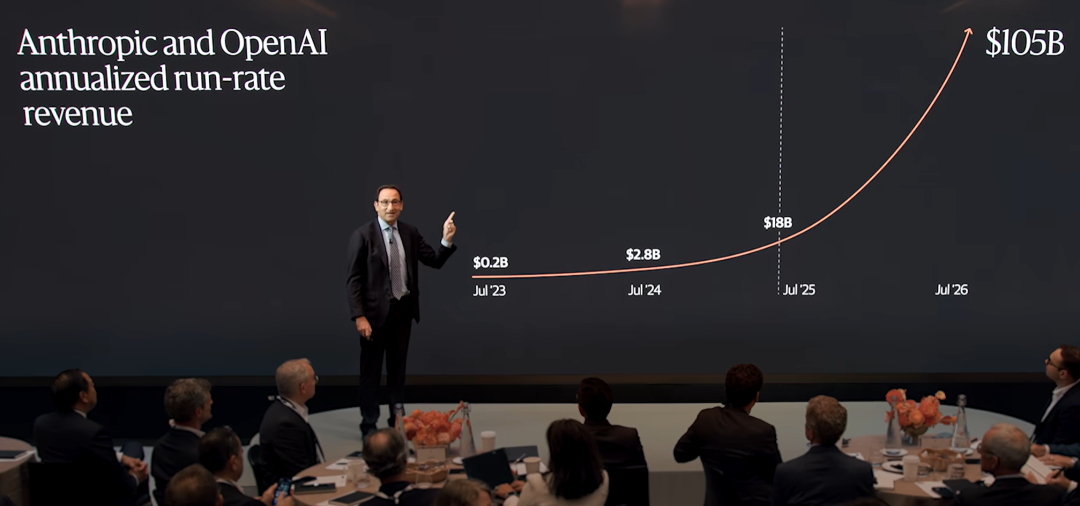
Image | Gary comparing Anthropic and OpenAI’s model revenue growth (Source: Youtube)
These figures indicate the speed of revenue growth, but the metrics require careful interpretation. Annualized revenue is an estimate based on recent income extrapolated over a year; it is neither realized annual revenue nor profit. Gray used it to address doubts about the true demand for paid services, but whether the industry's entire investment can be recouped will require a much longer period of verification.
Beyond revenue, Gray also discussed how companies are using AI. A telecom tower company invested about $4 million to revamp its lease processing workflow; the related project reportedly generates around $4.5 million in annual returns. Another rental housing company used AI to speed up application processing, shortening wait times for customers.
From these cases, the value of AI is beginning to reach business segments where companies can calculate costs and returns. For example, faster process handling saves time and cost; new features recognized by customers may also drive revenue growth.
Gray mentioned garage door equipment company Chamberlain as another possibility. The company applies computer vision and other capabilities to its new home products; this business has already achieved tens of millions in annualized revenue. Compared to improving existing processes, such products use AI to expand business lines and provide new sources of revenue for the company.
After discussing current business changes, Gray turned back the clock to 1870. At that time, the U.S. was still largely agricultural, with railroads, electricity, and steel yet to fundamentally change people’s daily lives. Over the following 30 years, with the spread of new technologies, the economy and production methods underwent dramatic change. Gray believes that today's AI could similarly be in the early stages of such transformation.
But this analogy also carries a warning. For example, while railroads once boosted economic growth, during the investment frenzy, about 200 railroad companies went bankrupt or became insolvent. He pointed out that some companies built ahead of demand using high leverage, causing supply to far outpace demand.
However, in contrast to the lesson from bankrupt railroads, Gray believes today’s AI infrastructure investments are different. Now, data centers and energy projects feel demand exceeding current supply, and many projects have already signed up financially strong, low-leverage clients.
Specifically, after companies gain benefits from business adoption, they may further expand their use of AI, increasing model calls and application scenarios, thus driving up computing demand. As AI enters into robotics, autonomous driving and other fields, demand may also extend from office settings into the physical world.
Therefore, Gray’s current judgment is based on model revenue growth and enterprise case studies, while his outlook points towards broader technology application. However, there is still a gap to cross—how far applications can expand, how much clients are willing to invest, and whether related projects can be delivered as planned will all affect the eventual scale of this demand surge.
How Blackstone Invests in AI
As computing demand continues to rise, who will build the supporting infrastructure and where will the funding come from? When addressing this, Gray shared Blackstone's investment moves in data centers, computing power, and energy. He believes that chips, data centers, and power are core links, while equipment supply, construction cycles, and local approvals all affect project progress.
First, data center leasing serves as a window for Blackstone to observe demand shifts. According to Gray, its data center platform signed about 1 GW of leasing capacity in 2024, which will increase to about 2 GW in 2025 and is expected to reach at least 6 GW in 2026. Construction of these data centers in 2024 alone involves nearly $100 billion in capital expenditures, while tenants will make additional investments in chips.
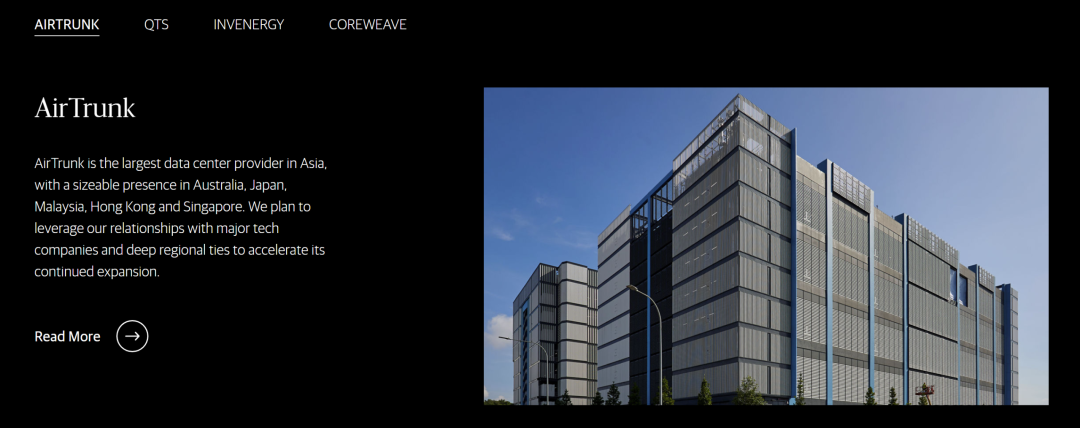
Image | Blackstone-invested data center AirTrunk (Source: Blackstone official website)
According to Blackstone's website, its data center platforms include QTS in North America and AirTrunk in Asia-Pacific. In a past public interview, Gray reviewed how, after Blackstone acquired QTS, it began receiving increasing demands for computing from large tech firms, leading to extended investment into energy, electrical equipment, and new cloud service companies offering GPU computing power.
These layouts are closely linked to the needs of data center construction and operation. Data halls require land, buildings, cooling systems, and power grid access; once operational, they need stable electricity supplies, and customers must deploy chips within them. In Gray's opinion, the wider the application of AI, the more these physical factors will influence the pace of expansion.
In the energy sector, Blackstone is also engaged in investments in various power and electrical equipment projects. However, the delivery lead times for power generation equipment can be long—for example, turbines ordered from GE Vernova may not be delivered until as late as 2031. Equipment production capacity, grid infrastructure, and project approval all further impact the speed of electricity supply.
Apart from building server rooms and power facilities, Blackstone is also deeply involved in computing power financing. In August, Nvidia announced a partnership with Blackstone and other institutions to advance the development of AI computing infrastructure financing platforms, allowing clients to secure the funds they need to build computing facilities.
In addition, Gray emphasized that in specific investment projects, Blackstone also focuses on whether long-term contracts are in place and whether contracted clients are able to perform as agreed.
However, long-term contracts can only mitigate some demand uncertainties; implementation and operation of projects still face other risks. For example, community concerns may slow down data center construction, while cybersecurity and geopolitical issues also warrant attention. Additionally, some startups that have no revenue yet have achieved very high valuations—whether future growth can justify current prices also requires careful judgment.
While seeking AI growth opportunities, Blackstone also considers the unique and irreplaceable value of certain assets. Gray mentioned investments in cricket teams, coffee chains, beachfront properties, and airports at the end of his speech, stating his belief that people will continue to need such experiences or facilities. These are different from computing power projects, but also reflect Blackstone's focus on long-term demand.
Returning to the question of "where's the beef," some AI applications have already begun delivering revenue and efficiency gains, and Blackstone's investments target computing power, data centers, and energy projects accordingly. But going from immediate returns to long-term profit will ultimately depend on whether AI applications can sustain value creation, and whether the supporting infrastructure can be built as planned and secure sufficient utilization demand.
Operations/Typesetting: He Chenlong
Note: Cover/Main image generated with AI assistance
Disclaimer: The content of this article solely reflects the author's opinion and does not represent the platform in any capacity. This article is not intended to serve as a reference for making investment decisions.
You may also like
Canadian Dollar holds steady amid oil uncertainties, hawkish Fed sentiment
Morgan Stanley Interprets ECOC Conference: NPO Consensus Shifts to 2028 Implementation, Optical Devices Sold Out for 12-18 Months, These U.S. Stocks Benefit the Most
Morgan Stanley ECOC Quick Review: Full Speed Ahead—NPO to be implemented in 2028, InP substrate is the biggest bottleneck.
US Treasury Bonds Face "Black Wednesday"! Five-Year Yield Surpasses Almost 20-Year High, is 6% the New Panic Line?
On Wednesday, the decline in the U.S. Treasury market intensified, with robust economic data and a weak debt auction pushing yields on most maturities to their highest levels in nearly two decades.

Crypto prices
More


