
Institutions say oil prices and gold prices are negatively correlated, with a difference of $1,750 between high and low gold price expectations.

Huitong Network, September 30—— Natixis has released a gold report in which analyst Bernard Dahdah sets out three gold price scenarios. In the base case, gold prices could reach $4,100 by the end of the year; if the Strait of Hormuz conflict escalates and oil prices drive higher inflation, gold could dive as low as $3,500; if tensions ease and inflation subsides, gold prices have the potential to break through $5,250. Currently, oil and gold prices are negatively correlated again, with ETFs buying the dips, but rate expectations are capping gold prices, and the strength of central bank gold purchases remains uncertain.
The international gold price is full of uncertainty amid intertwining macro variables, as rising crude oil prices, stubborn inflation, and a sustained high interest rate environment continue to suppress precious metals.
Natixis’ latest gold research report points out that developments around the Strait of Hormuz will become the core variable determining the trend of gold prices. Under different geopolitical scenarios, the gold price outlook will diverge significantly. The bank's precious metals analyst has built three scenario forecasts: the lowest gold price range could be $3,500 per ounce, while in the optimistic scenario, it could rise above $5,250 per ounce.
Macroeconomic Reversal: Oil and Gold Prices Return to Negative Correlation
Natixis precious metals analyst Bernard Dahdah, in his latest report, has updated his assessment of the gold market—a clear shift from his forecasts at the end of August. In late August, Dahdah had raised his year-end gold price target to $5,000 per ounce, as US debt issues and turmoil in the US Treasury market brought strong safe-haven buying to gold, and concerns over fiscal sustainability and expectations of currency depreciation helped gold withstand the pressure from high opportunity costs.
But in the past month, the macro environment changed rapidly. The bank observed that oil and gold again formed a negative correlation. International oil price increases stoke inflation concerns and raise expectations of further rate hikes from the Federal Reserve. Because gold does not yield interest itself, rising rates increase the opportunity cost of holding gold, thereby capping prices. Dahdah noted that this linkage first appeared during tensions involving the US, Israel, and Iran; after a diplomatic breakthrough in June, the relationship briefly disappeared, but with renewed geopolitical tensions at the end of August, coupled with the US rejection of Iran's latest proposal after the UN General Assembly, this negative price correlation has resurfaced and continued to strengthen.
Meanwhile, gold investors remain highly sensitive to changes in expectations for Federal Reserve policy. Charts in the report show that when markets anticipate additional rate hikes, gold prices weaken. Rising US Treasury yields and a strengthening dollar further amplify downward pressure on gold prices. Since the end of August, gold and the US 10-year Treasury yield have once again shown a linked movement, while this year, gold's trend has been most stably correlated with the US Dollar Index.
Bulls vs Bears: ETFs and Central Bank Gold Buying Provide Support, but with Uncertainties
Despite the decline in gold prices, there are still bullish forces in the market. Natixis observes that even as gold prices pull back, holdings of physical gold ETFs continue to rise; during the price decline, capital has continued to flow into ETFs. This kind of market and capital divergence is rare in history. Dahdah notes in the report that some investors are using the dip to build positions in gold ETFs, but this structural buying is insufficient to offset the revaluation pressure from changing rate expectations.
Central bank gold purchases were once an important support for gold prices. In an environment of rising US Treasury yields, continued central bank buying pushed gold prices upward. However, the bank also points out a risk: if oil prices remain high and the US dollar strengthens, central banks in various countries may shift policy focus toward combating domestic inflation and maintaining local currency stability, thereby slowing or even halting further increases in gold reserves. The supporting power of central bank gold purchasing may therefore weaken.
Three Scenario Simulations: Geopolitics Decide the Final Direction of Gold Prices
Under the base case, for the remainder of 2026, gold prices will remain under pressure. The market expects a possibility of another Fed rate hike in December, and gold could fall back to $4,100 per ounce by year-end. The bank assumes the Fed will keep rates unchanged in 2027; as de-dollarization advances, investor demand recovers, and central banks continue gold buying, gold may recover to $4,750 per ounce by the end of 2027.
In the pessimistic scenario, escalation of Middle East conflict blocks shipping through the Strait of Hormuz, international oil prices soar further, and inflation stays high for a prolonged period, forcing the Fed to keep interest rates higher for longer. Should multiple central banks turn from net gold buyers to net sellers in order to use reserves to defend currency exchange rates, a confluence of negative factors could push gold as low as $3,500 per ounce.
The optimistic scenario assumes easing tensions in the Strait of Hormuz, sharply declining oil prices, rapidly cooling inflation, and space for the Fed to shift policy and end the tightening cycle. In this scenario, gold prices could stabilize above $5,250 per ounce.
Conclusion
The gold market is currently at a critical point between bulls and bears, with interest rate expectations, dollar strength, oil prices, and geopolitical risks all intertwined. Natixis’s scenario forecasts fully reflect that the geopolitical risk in the Strait of Hormuz is the core variable influencing gold prices. In the short term, high inflation raises rate hike expectations, making it hard to quickly relieve downward pressure on gold; but if geopolitical tensions ease and inflation falls rapidly, allowing a pivot from the Fed, gold will see a strong rally.
Subsequent changes in oil prices, Fed officials’ comments, and developments in the Middle East will continue to dominate fluctuations in gold prices.
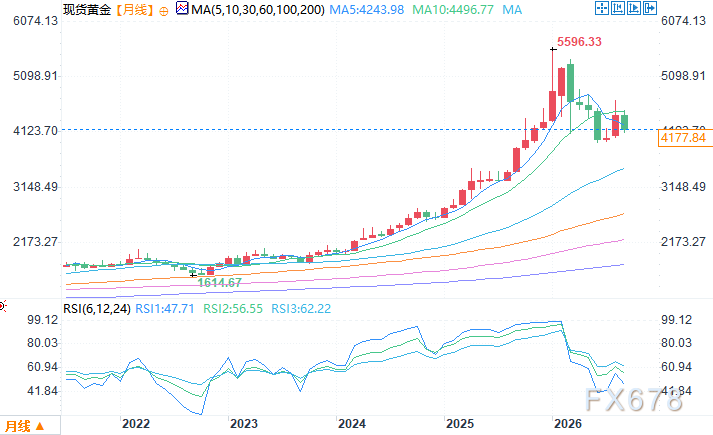
Spot gold monthly chart Source: YiHuitong
GMT+8, September 30, 11:32 Spot gold quoted at $4,177.84 per ounce
Disclaimer: The content of this article solely reflects the author's opinion and does not represent the platform in any capacity. This article is not intended to serve as a reference for making investment decisions.
You may also like
From HBM to DRAM and SSD, AI agent frenzy fuels surging storage demand! Micron (MU.US) earnings are up next, with the market anticipating a "major beat + buyback" package.
The financial report to be released by Micron, one of the three major original storage chip manufacturers in the United States, on Wednesday Eastern Time will serve as an important window to assess the progress of the storage super cycle and the unprecedented AI infrastructure frenzy.
Anthropic’s $2 Trillion IPO Exposes Weaknesses: 47% of Revenue Depends on Amazon and Google, 16 Cents Taken from Every Dollar
Anthropic's prospectus reveals that in 2025, 47% of its revenue will be processed through Amazon and Google Cloud platforms, a significant increase from 11% in 2023. For every $1 of cloud platform revenue, approximately 16 cents must be paid to the platform as distribution fees, totaling about $351 million annually. Additionally, these two giants serve as Anthropic's investors, computing power providers, distributors, and direct competitors simultaneously.
Crypto prices
More


