
Goldman Sachs: AI Must Endure Hardship Before Rewards


👆Click the blue text to follow us
Goldman Sachs Report
Everyone has already witnessed the astonishing speed at which tech giants are spending on AI. Goldman Sachs also released a report addressing the three most frequently asked AI questions from recent clients, including the outlook for AI capital expenditures, how much revenue is needed to support such investments, and how much of AI's value has already been priced into the stock market. Each of these questions is worth billions on its own, so let's follow the report and look into these issues together.
For the first question—where is AI capital expenditure headed? Goldman Sachs points out that the Big Five cloud providers are expected to reach $800 billion in capital expenditures this year, with the market predicting an increase to $1.1 trillion next year, mainly because computing supply still lags behind demand, with many outstanding orders yet to be fulfilled.
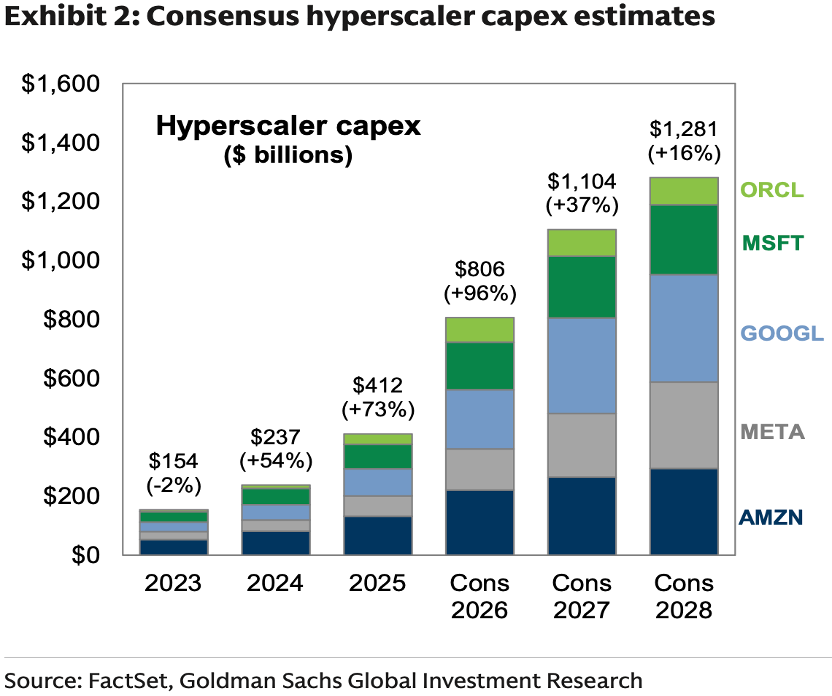
Goldman's own forecast is even higher, expecting a peak of about $1.2 trillion next year, though the growth rate will gradually slow from nearly 100% this year. One of the reasons for the slowdown is funding: the Big Five cloud companies' capital expenditures this year have already exceeded their operating cash flows. To further expand investment, they need to borrow money or issue shares. Goldman believes their current interest coverage ratios remain very healthy and they can still afford the spending, but whether they can keep up with financing is an open question. Additionally, government restrictions on data center construction and intentional delays in releasing cutting-edge models could also limit construction speed.
Nevertheless, robust computing demand and backlogged orders continue to push the Big Five to ramp up investment. As competition from open-source models intensifies and AI token fees drop, usage must grow even faster to support revenues and ongoing investments. Therefore, Goldman still expects capital expenditures to rise, only at a gradually slower pace.
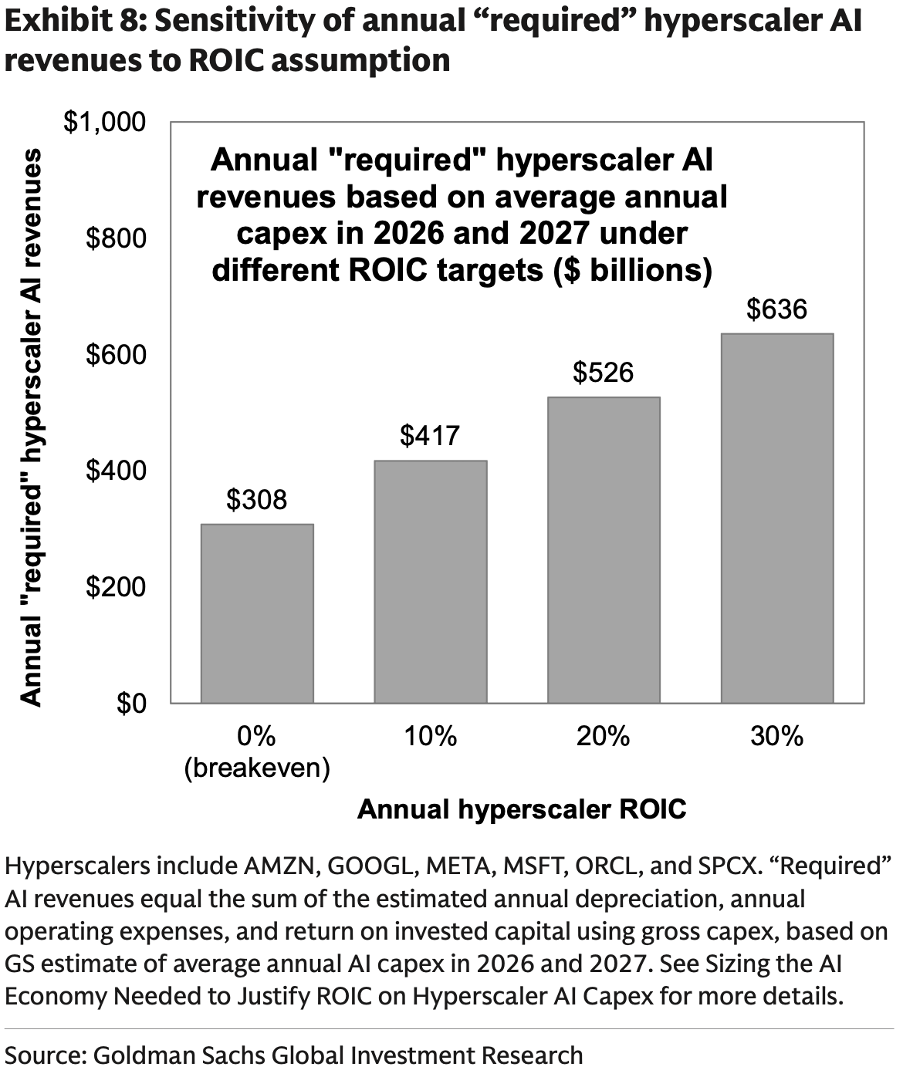
Now, let's look at the second question: How much revenue is needed to support such massive spending? Based on the average AI capital expenditures for this year and next, Goldman estimates that major computing providers will need about $300 billion in annual AI revenue over the next few years to cover equipment depreciation and operating expenses. To achieve a 10% to 20% return on investment, the required annual income jumps to around $400 billion to $500 billion or more.
Currently, cloud providers' AI revenues have not yet reached this threshold, but the growth rate is accelerating. Amazon, Google, and Microsoft have $1.7 trillion in pending orders. Though these include general cloud services and cannot be fully counted as AI revenue, they nonetheless provide further support for future income growth.
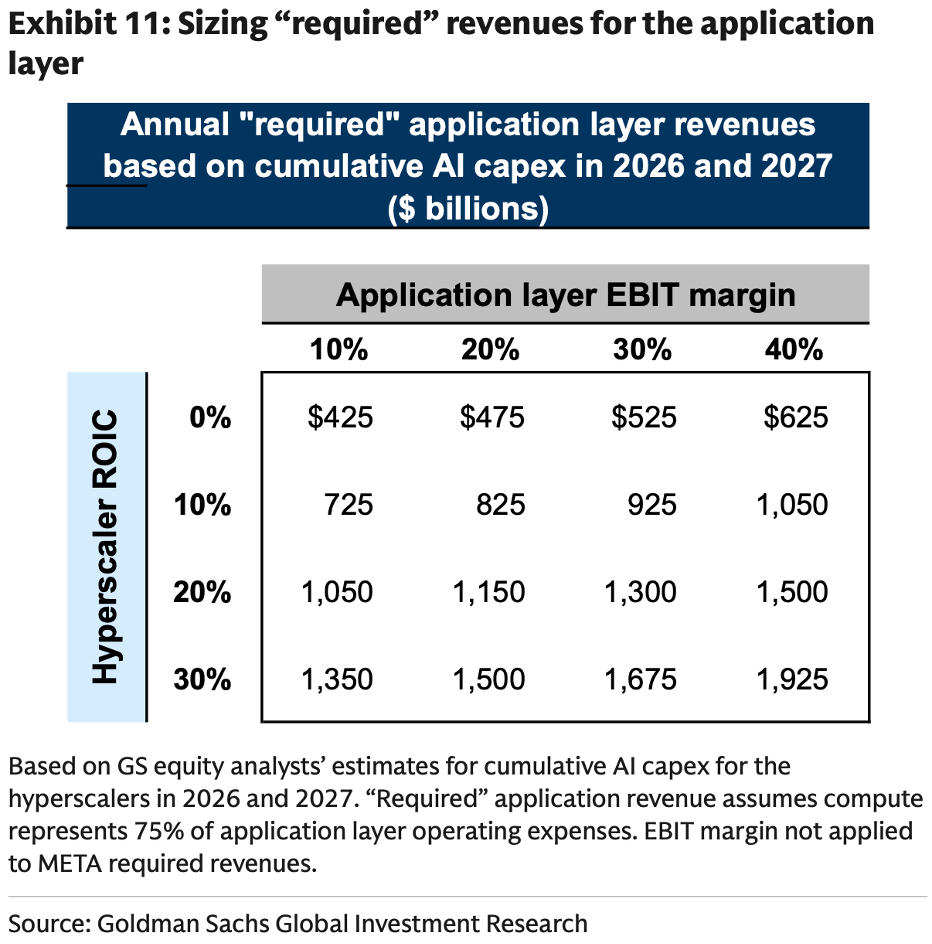
However, AI application companies purchase computing power from cloud providers, then sell their products to consumers, whose spending not only pays the cloud providers, but must also cover their own training, inference, and other costs, providing a profit. Therefore, Goldman further estimates that if application companies maintain a 30% operating profit margin and cloud providers secure a 10%–20% investment return, these AI application companies would need about $1 trillion in annual revenue. See the chart for specific return and profit assumptions.
Although the numbers are huge, Goldman believes AI achieving this scale is far from impossible. For comparison, global advertising and software expenditures are both around $1.5 trillion this year. Since AI can help companies reduce costs and boost efficiency, these real gains will encourage sustained enterprise spending and support AI revenue growth.
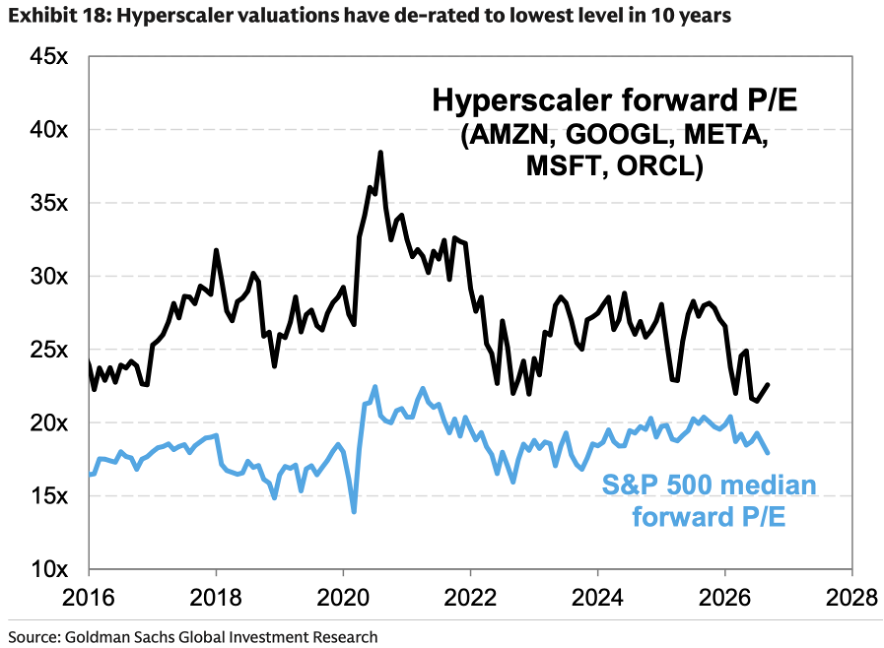
Finally, the third question: How much of AI’s value is priced into the stock market? Goldman believes that market concerns over the sustainability of AI profit growth are already partially reflected in stock prices. The median forward P/E ratio for AI infrastructure stocks has dropped from 32x in April to 22x, indicating that valuations have already taken a hit.
Looking at the semiconductor sector, the gross margin for memory stocks is more than double the historical average. However, as memory is highly cyclical, the market doubts that current high profits can be sustained and is only willing to offer low valuations—P/E ratios for memory stocks are around 4x, about half of the 15-year historical average. By contrast, chip design companies’ profitability hasn’t deviated as much from historical levels, so even if future profits decline, the drop should be limited.
As for the Big Five clouds, Goldman posits that their leadership would require three conditions: an economic slowdown, monetization of AI investments, and a deceleration in capital expenditure growth. These three prerequisites are gradually aligning. Meanwhile, the forward P/E ratios for the Big Five clouds have dropped to their lowest in over a decade. Goldman believes that, as revenue growth accelerates and capex growth slows, improved cash flows will act as positive factors supporting stock prices.
In the application segment, Goldman expects clear differentiation, with the market only able to discern winners and losers after the rollout and adoption of applications over the coming quarters. So far, software companies' financials have not been visibly impacted by AI, and their stock prices have recently rebounded—especially for IT infrastructure and cybersecurity software. However, companies that rely on user inertia for stickiness, such as insurance, telecommunications, travel, and subscription services, may face challenges from AI Agents. Since the launch of Muse in mid-September, Goldman’s tracked consumer inertia stocks have underperformed the market by about 5 percentage points.
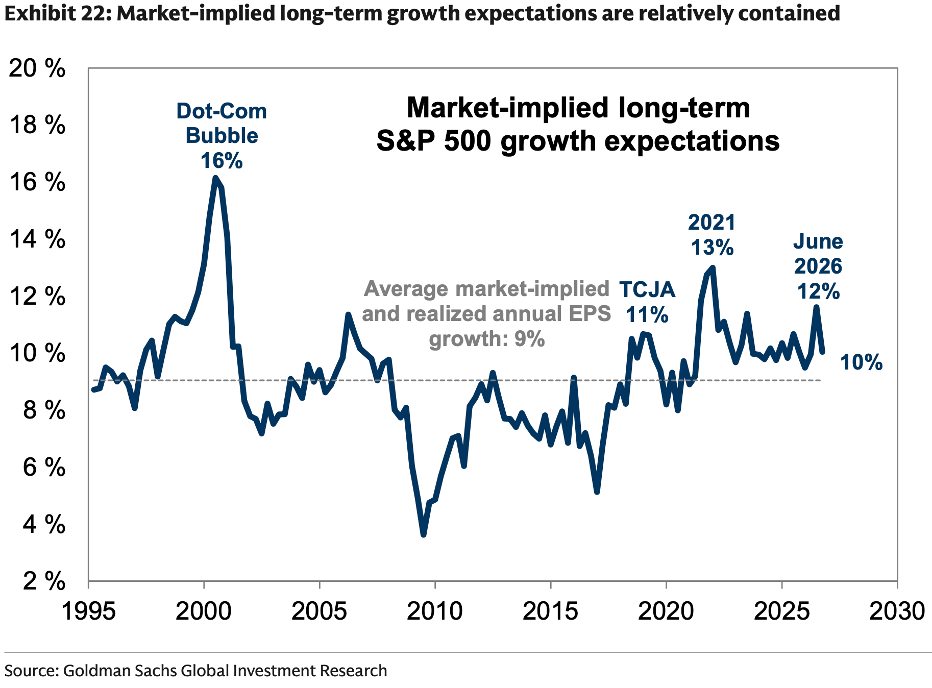
Zooming out to the overall stock market, while most companies can use AI to improve efficiency and increase profitability, the current long-run growth expectations implied by share prices is just 10%—only marginally above the historical average and significantly below the 16% of the Internet bubble era. Thus, Goldman believes the market has yet to fully reflect the value AI brings.
Having said so much about Goldman's perspective, the American Investment Team's view on AI development is actually quite simple: optimistic. Although current capital expenditures are substantial, so are the returns. Previously, on InvestPro, we built a financial model analyzing Google’s capital returns and found that Google's investment in data centers could generate about a 30% return. This closely aligns with Amazon's earlier claim of a "three-year payback" period. Therefore, we are not worried about the return on investment issue.
More importantly, AI is still at an early stage. Enterprises are just beginning to use AI in the workplace, and tools such as AI Agents have only recently launched. As market adoption rises, AI usage will increase. Not to mention, as the scope of applications broadens and infrastructure matures, economies of scale will gradually emerge, making the overall return on investment even more attractive.
Therefore, we understand some of the market's caution, but are not worried in a broader sense. We also believe that, as income continues to grow, the market will increasingly recognize the value of past investments, further supporting the AI rally to go even further.


Previous Recommendations

Disclaimer: The content of this article solely reflects the author's opinion and does not represent the platform in any capacity. This article is not intended to serve as a reference for making investment decisions.
You may also like
Arthur Hayes forecasts $1 million Bitcoin by 2030, links target to AI debt risks
AI valuation divergence intensifies! Anthropic IPO: Enthusiastic Silicon Valley bids $2 trillion, while a cautious Wall Street only recognizes $1.5 trillion
The valuation debate surrounding Anthropic’s IPO is exposing a pricing gap between Silicon Valley and Wall Street. Silicon Valley venture capitalists are still betting heavily on AI growth at high valuations, with some investment banks discussing an early valuation of around $2 trillion. Meanwhile, Wall Street public market institutions are focusing on high interest rates, capital expenditure on computing power, and ongoing financing pressures, and are leaning toward a $1.5 trillion valuation.
Micron (MU.US) Q4 earnings call: Management declares "No sign of supply-demand balance," 75% of shipments for next year already locked in; 2028 expected to be tighter than 2027
Micron Technology (MU.US) management expressed optimism during the Q4 earnings call, stating that AI-driven memory demand remains strong and that supply and demand will remain tight in 2027 and 2028.
After experiencing Muse, I cleared out my Airbnb holdings
A senior analyst heavily invested in Airbnb decided to sell all his Airbnb holdings just 10 days after experiencing Meta AI's Muse app. He believes that Muse not only understands his preferences but also helps him bypass Airbnb to book accommodations directly, at 60% lower prices. As AI agents begin to compare prices, cancel, and rebook on your behalf, the "traffic moat" that internet platforms depend on is under threat, and the era of "proactive e-commerce" may be dawning.
Crypto prices
More


