

Wall Street is moving toward a market that never fully closes. Tokenized equities are bringing stocks onto blockchain rails capable of continuous trading and settlement, while traditional brokers are expanding access beyond conventional market hours. Tokenized stock activity has accelerated sharply in 2026, with billions of dollars now represented and traded on-chain. As weekend and after-hours activity grows, tokenized equities are beginning to test how continuous trading could reshape liquidity, settlement and global access to U.S. stocks.
Tokenized Stocks Have Crossed the $3 Billion Mark
Tokenized stocks reached roughly $3 billion in September, with the sector emerging as one of the fastest-growing areas of real-world asset tokenization. Broader datasets tracking active tokenized equities place the market closer to $4 billion, reflecting differences in asset coverage and methodology. More than 1 million holders now hold tokenized stock exposure across blockchain markets.
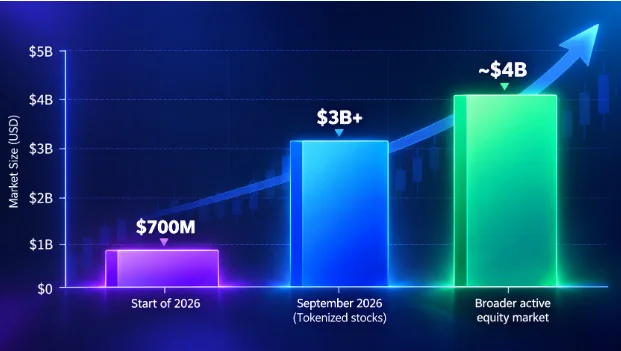
The market has moved beyond simply creating blockchain representations of shares. Trading, transfers and financial applications are developing around the assets.
Trading Volume Is Growing Faster Than the Asset Base
Tokenized equities are seeing a sharp increase in trading activity as the underlying asset base expands. Monthly trading volume rose from $237 million in January to $965 million in February before reaching $7.9 billion in August. August turnover reached 2.14x after hitting 3.32x in July, pointing to a sharp increase in trading activity relative to the active market base.
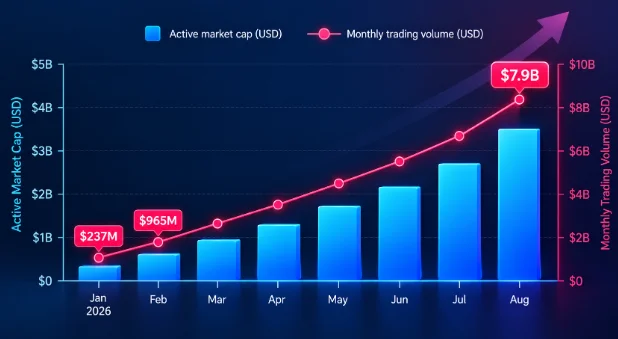
The figures show a market where trading activity has expanded much faster than the outstanding tokenized-equity base.
Tokenized Stocks Are Moving Billions Between Wallets
On-chain transfer activity has expanded sharply during 2026. Q3 tokenized-stock transfers reached approx. $100 billion, compared with roughly $6 billion in Q1. Transfer volume includes wallet-to-wallet movement and therefore should not be treated as equivalent to executed trading volume.
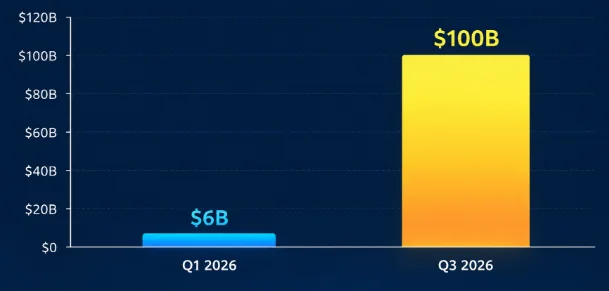
The increase means tokenized equities are being moved between blockchain addresses and financial venues at a much larger scale than earlier in the year.
Tokenized Stocks Are Taking a Larger Share of DEX Trading
Tokenized stocks averaged 11% of DEX trading activity in September, compared with a 17% average for memecoins.
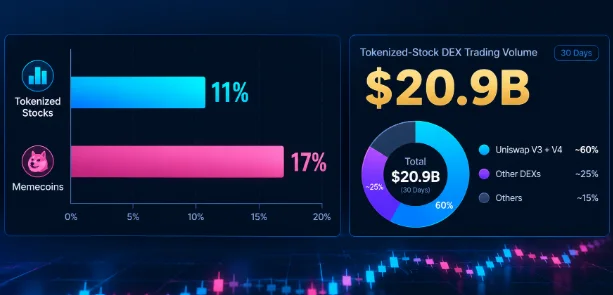
A separate 30-day dataset put tokenized-stock DEX trading volume at approximately $20.9 billion, with Uniswap V3 and V4 accounting for about 60% of that activity. Equity exposure is increasingly being traded through infrastructure originally built around crypto-native assets.
Weekend Trading Is Creating a New Equity Market Window
Robinhood announced on September 29 that it plans to introduce 24/7 weekend trading for selected U.S. stocks and ETFs, subject to regulatory review. Its existing 24 Hour Market already provides trading in selected securities from Sunday evening through Friday evening.
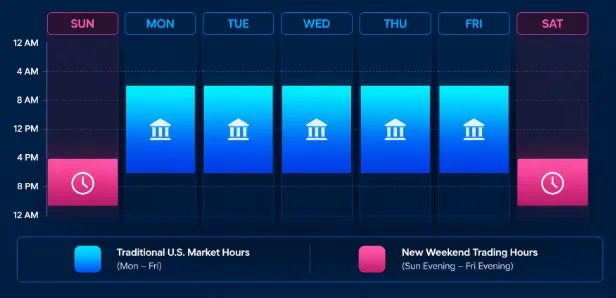
Tokenized equity venues are already operating continuously. The combination creates a market window in which company news released during weekends can be reflected in prices before the traditional Monday session.
24/7 Trading Still Depends on Liquidity
A market can remain open continuously without maintaining the same depth throughout the day. When U.S. exchanges are closed, traditional institutional order flow and arbitrage channels are reduced, leaving tokenized venues more dependent on dedicated market makers and liquidity pools.
Extended trading therefore does not automatically mean equivalent execution quality. Bid-ask spreads can widen, order-book depth can decline and price discovery can become more fragmented when fewer liquidity providers are active.
DeFi Is Turning Stock Tokens Into Financial Assets
Tokenized-equity DeFi TVL increased from $21.6 million at the start of 2026 to $289.1 million by September 9 in the tracked dataset. DeFi TVL rose from 2.2% to 7.2% of active tokenized-equity market capitalization.
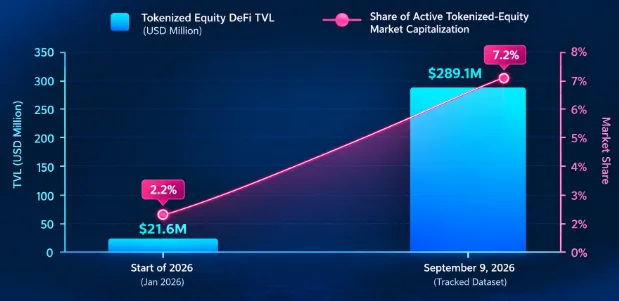
The use case is expanding beyond holding and trading. Tokenized equities can also serve as liquidity assets and collateral within blockchain-based financial applications.
Distribution Is Concentrating Around a Few Platforms
Tracked issuer data show the combined share of bStocks and Robinhood rising from 0.8% in June to 82.3% in August and 87.8% in September month-to-date.
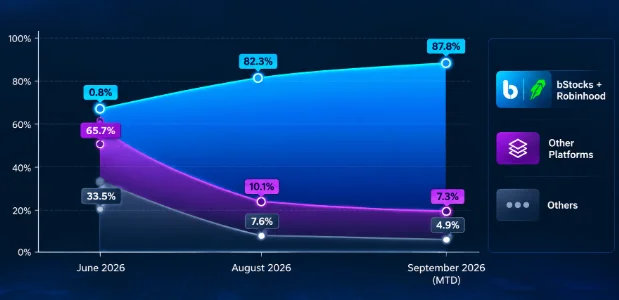
The market is therefore not distributing activity evenly across issuers. Platforms with established user bases can bring tokenized securities directly into existing trading workflows.
A Tokenized Stock Is Not Always Direct Stock Ownership
A tokenized stock can use different legal and custody arrangements. The token may represent rights to an underlying security, an interest held through a custodian, or economic exposure created through another structure.
Robinhood’s Stock Tokens, for example, have been described as tokenized debt securities that provide economic exposure rather than legal or beneficial ownership of the underlying stocks.
The U.S. regulatory framework introduced in September also establishes conditions for qualifying tokenized securities venues, including requirements concerning investor rights and market controls.
Wall Street Is Building Longer Trading Hours Alongside Blockchain Markets
The move toward continuous equity access is no longer confined to blockchain-native companies. Robinhood is preparing weekend trading for selected U.S. stocks and ETFs. Nasdaq has been developing an always-on market model with longer weekday trading, while NYSE and Blockchain.com are exploring tokenized versions of U.S.-listed stocks and ETFs and longer trading access.
The two systems are building toward longer market availability from different starting points.
Settlement Could Be the Bigger Change
Trading hours are the visible part of tokenization. Settlement creates a deeper infrastructure change. Tokenized assets can place ownership records, transfer instructions and settlement logic on blockchain rails. That creates connections between securities, lending and collateral markets.
Institutional products are already moving in this direction. BlackRock introduced tokenized investment portfolios that can be traded, transferred and borrowed against around the clock for eligible non-U.S. investors.
What Happens Next
Tokenized equities have moved beyond an experiment in putting stocks on blockchain rails. The market now has a multi-billion-dollar asset base, rapidly expanding trading activity, more than $100 billion in quarterly on-chain transfer activity, growing DEX participation and a developing DeFi layer. The next challenge is making that activity deeper, more reliable and compatible with the legal and market infrastructure that governs traditional securities.
The 24/7 model also exposes a structural trade-off. Continuous availability can extend access and create new windows for price discovery, but execution still depends on liquidity, market depth, reliable pricing and clearly defined ownership rights. A token that trades around the clock is only as useful as the infrastructure supporting its trading, settlement and custody.
That puts the next phase of tokenized equities beyond simply adding more stocks to blockchains. The bigger question is whether these assets can connect continuously with exchanges, brokers, custodians, lending markets and DeFi venues without fragmenting liquidity or weakening investor protections. If those pieces converge, tokenized equities could become part of the broader market structure rather than simply another representation of traditional shares.


