Bitget App
Trade smarter
Buy cryptoMarketsTradeFuturesStocksEarnInstitutionAI & More
Bitcoin Price Faces $75K Risk as Trader Cost Basis Sets Key Test

Bitcoin Price Faces $75K Risk as Trader Cost Basis Sets Key Test

CoinpediaCoinpedia2026/10/07 03:30
Story Highlights
  • Bitcoin faces a potential liquidity sweep around $87K before the analyst’s projected move toward $75K.

  • Trader Realized Price sits near $68.9K, making it a key recovery test.

  • The upper realized price band is near $96.5K, but it isn’t a fixed target.

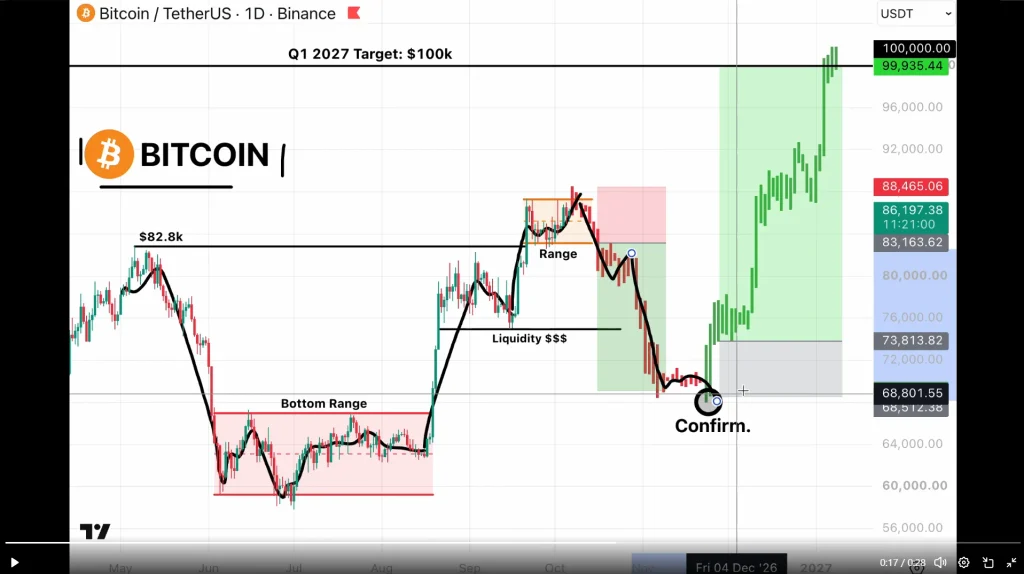
The Bitcoin price is sitting at a decision point, with one analyst warning that a liquidity sweep around $87,000 could precede a deeper move toward $75,000. The proposed path is blunt, $85K, then $75K, $70K, and eventually a confirmation toward $100K.

Bitcoin Price Faces A Crucial Cost-Basis Test

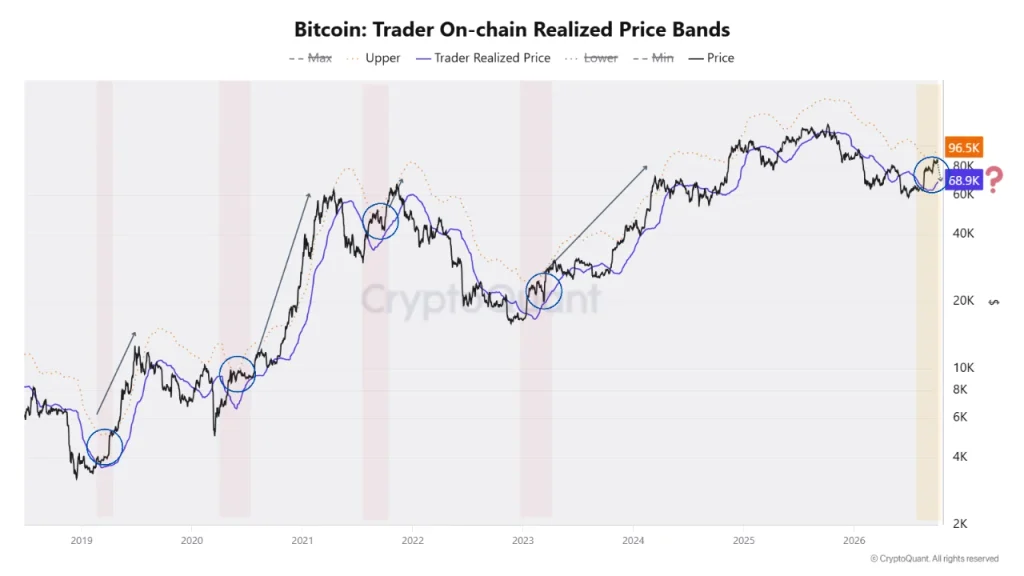
The Trader On-chain Realized Price currently sits near $68,900, while its upper band is around $96,500. Bitcoin has recovered above the baseline, but staying there matters more than simply reclaiming it.

Historical comparisons from 2019, 2020 and early 2023 show similar recovery phases where price moved above realized price before testing the underlying cost basis again.

Still, those periods differed in timing and didn’t establish a reliable success rate.

$87K Could Become The Market’s Next Trap

The analyst’s bearish setup centers on an $87,000 cluster, with a potential sweep followed by liquidation below $75,000. The proposed downside levels are $75K, $70K and the broader liquidity area below.

Meanwhile, the on-chain framework points to $68.9K as the more important structural reference.

A pullback toward that level would test whether demand can absorb selling near traders’ breakeven zone.

Holding Cost Basis Could Change Everything

If the Bitcoin price holds the Trader Realized Price and rebounds, demand would appear to be absorbing supply and could strengthen the case for another advance toward the $96,500 upper band.

But a sustained move below the baseline, followed by a failed reclaim, would tell a different story. Breakeven selling could remain stronger than fresh buying.

For now, the Bitcoin price has two competing narratives, a possible liquidity flush toward $70K-$75K and a recovery structure that remains intact above the trader cost basis.

News Image 0News Image 1News Image 2
0
0

Disclaimer: The content of this article solely reflects the author's opinion and does not represent the platform in any capacity. This article is not intended to serve as a reference for making investment decisions.

Understand the market, then trade.
Bitget offers one-stop trading for cryptocurrencies, stocks, and gold.
Trade now!

You may also like

Chart - U.S. stock funds see weekly net outflows for the first time in three weeks

Reuters, October 9 – After two consecutive weeks of net inflows, U.S. equity funds saw net outflows for the week ending October 7, as investors took profits during a market rally while concerns persisted over rising Treasury yields and sustained high oil prices. LSEG Lipper data shows investors withdrew a net $5.11 billion from U.S. equity funds during the week, marking the first weekly net outflow since September 16. The S&P 500 index (.SPX) hit a record high of 7,844.52 points earlier in the week before retreating. Mounting inflation concerns fueled a sharp selloff in the bond market, driving the yield on the 10-year Treasury to 5.3645%, its highest level since April 2002, dampening market sentiment. Large-cap, mid-cap, and small-cap U.S. equity funds recorded net redemptions of $14.08 billion, $1.03 billion, and $834 million, respectively. However, investors made net purchases of $5.68 billion in sector funds, led by technology, which attracted $4.53 billion. The utilities and industrials sectors absorbed $1.18 billion and $1.04 billion, respectively. U.S. bond funds posted net inflows of $19.78 billion for the week, a historic high. Investors poured $6.76 billion into short- to intermediate-term government and Treasury funds, the highest in six months. Short- to intermediate-term investment-grade funds and general domestic taxable fixed income funds saw net inflows of $5.04 billion and $2.52 billion, respectively. Meanwhile, money market funds attracted $68.49 billion, reversing the previous week’s $43.6 billion in outflows. (For the convenience of non-English speakers, Reuters provides automated translations of its reports into several other languages. Due to possible inaccuracies or lack of context in automated translations, Reuters does not guarantee the accuracy of such texts and provides them solely for the convenience of readers. Reuters accepts no liability for any damage or loss caused by the use of automated translation services.)

路透社•2026/10/09 10:56

BUZZ - Delta Air Lines shares fall after lowering full-year profit guidance

October 9 - Delta Air Lines (DAL.N) shares fell nearly 5% in pre-market trading to $78.12. Due to a surge in jet fuel prices, Delta Air Lines (DAL) on Friday lowered its full-year adjusted profit forecast. The U.S. airline now expects adjusted earnings per share in 2026 to be between $5.10 and $5.60, down from the previous guidance of $6.5 to $7.5 per share. The current midpoint of $5.35 per share is lower than analysts’ expectations of $5.46 per share. DAL expects its annual fuel costs to rise by about $6.0 billion, compared to an earlier projection of a $4.0 billion increase. Analysts tracking DAL have given it an average “Buy” rating, according to data compiled by LSEG. So far this year, Delta Air Lines stock has risen 18.4%, the highest increase among major U.S. competitors. (For the convenience of non-English speakers, Reuters automatically translates its reports into several other languages. Since automated translations may contain errors or lack the necessary context, Reuters does not guarantee the accuracy of automated translation texts, which are provided solely for readers’ convenience. Reuters assumes no responsibility for any damage or loss resulting from the use of automated translation services.)

路透社•2026/10/09 10:46