
Breaking: OpenAI Crashes All AI Stocks, What Exactly Happened?

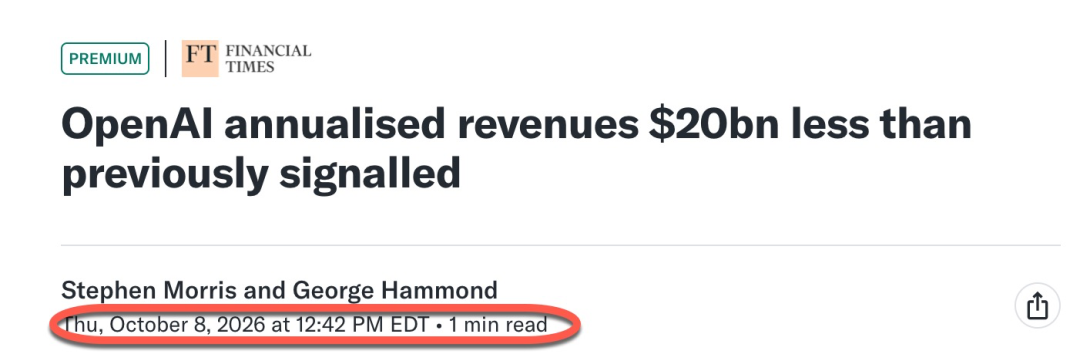
At 12:42 PM Eastern Time on Thursday, a report about OpenAI’s revenue sparked a re-evaluation of growth expectations for the AI industry chain.
OpenAI’s annualized revenue as of the end of September was close to $5 billion, nearly 30% lower than the previously widely circulated figure of about $7 billion.
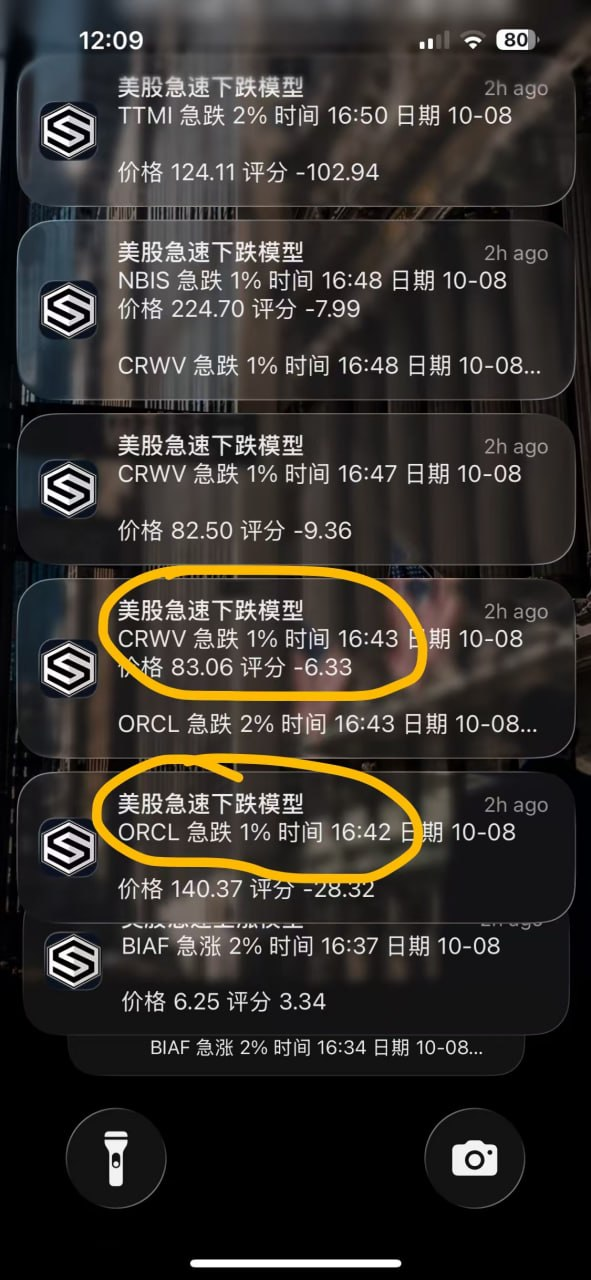
The "US Stocks Rapid Drop Model" of the US Stock Big Data app quickly captured the unusual moves of related companies and sent a breaking alert directly to my phone.
12:42 PM (4:42 AM Pacific), at 4:42 AM Pacific, ORCL triggered a rapid 1% drop alert, with the price at $140.37;
12:43 PM (4:43 AM Pacific), just one minute later, CRWV triggered a rapid 1% drop alert, with the price at $83.06; ORCL also further triggered a 2% rapid drop alert.
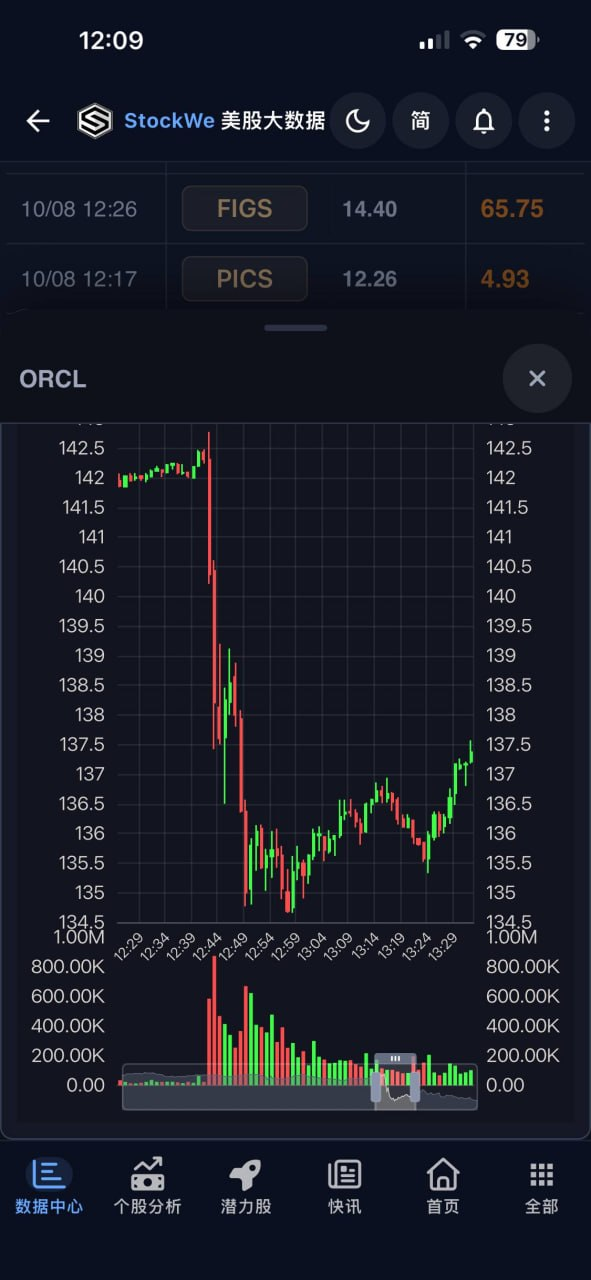
When you put these alerts and the intraday charts together, the timeline becomes clear:
ORCL began to plunge rapidly around 12:42 (UTC+8), then fell from above $142 to around $135—a drop of nearly 5% in just 5 minutes.
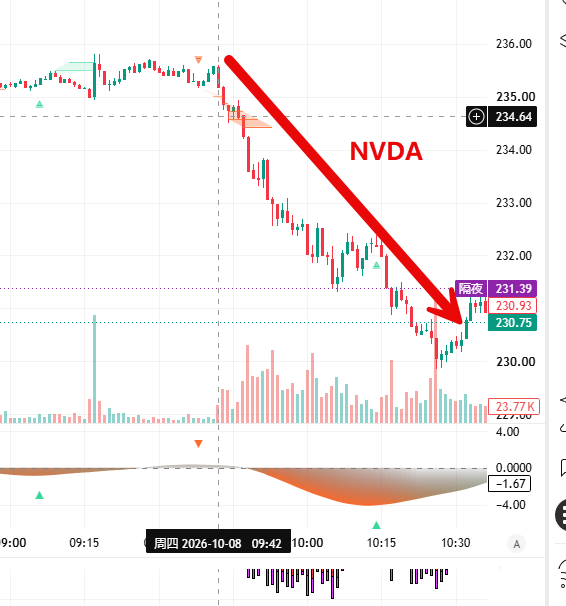
This rare opportunity provided our VIP members with a great chance to short AI stocks such as Nvidia NVDA and AMD,
The role of StockWe US Stock Big Data App is to continuously monitor market trends for you. Upon triggering the rapid drop signal, company code, magnitude of the movement, and price are sent directly to your phone, allowing you to promptly check the trend, review your positions, and decide your next move.
Revenue Recognition: What Does Annualized Revenue Represent?
But after receiving the alert, we still need to figure out: What exactly has changed at the company to cause this drop?
The $2 billion gap seems huge, but it doesn't mean OpenAI lost $2 billion in orders. This difference mainly relates to the scope of revenue calculation, while the market previously built higher expectations for the entire AI industry chain based on the larger number.
US Stock Investment Network believes this is what we need to take a closer look at: numbers can be explained, but does the underlying logic supporting the stock price still hold?
First, let's clarify "annualized revenue" so the following discussion won't be misled.
Suppose a company earns $1 billion in a certain month. Multiplying by 12 gives an annualized revenue of $12 billion. It reflects the current revenue run rate, but does not mean the company has booked $12 billion over the past year, nor does it guarantee the company will sustain this rate going forward.
This metric is useful for fast-growing companies because lower revenue early in the year drags down the full-year total and doesn't fully reflect recent business progress. But when we look at this number, we must remember: it shows the pace, but full-year revenue still needs to be realized month by month.
The controversy around OpenAI this time is further complicated by differences in partner channel revenue recognition.
Public reports show that Anthropic’s annualized revenue includes sales generated through partners such as AWS and Google Cloud, whereas the data disclosed by OpenAI does not include channel revenue in the same manner. The previously higher number involved adjustments by investors for ease of comparison.
You can view it as three separate amounts:
- How much did customers pay for AI services;
- How much revenue was recognized by the model company and the cloud platform;
- After deducting computing, channel, and other costs, how much the company actually keeps.
The same customer payment may involve several companies in the industry chain; however, you can’t sum up these numbers from different companies and use it as proof of end-user demand.
Therefore, this time the revenue gap cannot directly prove a drop in orders, nor does it mean financial fraud. We first need to confirm whether the two sets of numbers are within the same statistical scope.
Valuation Adjustment: The Definition Can Be Explained, but Why Did the Stock Price Drop?
Because investors had already projected future figures based on the larger number.
Those buying AI industry chain stocks often operate under this assumption: The faster the revenue growth by model companies, the more chips they can purchase and the more compute capacity they can rent, raising both suppliers’ revenue and profit.
Now, the revenue scale needs to be reinterpreted, so downstream purchasing capacities must also be re-evaluated.
A simple calculation: If company valuation remains unchanged but revenue is revised from $7 billion to $5 billion, the valuation-to-revenue multiple increases by 40%.
This doesn’t mean the share price should be mechanically adjusted by a set percentage, but it reminds us that at the same price, the company must now deliver even stronger future growth to justify the price.
The AI industry chain is particularly sensitive to this because expenditures for equipment, capacity expansion, and financing often precede revenue realization. Today's supplier investments rely on how much customers might buy or pay in the future.
However, we shouldn't focus solely on the revenue gap. OpenAI still reported an overall revenue run rate growth of 77% in Q3 and a 107% growth in enterprise business run rate.
Therefore, my view is that this news first impacted market expectations, but for now, it is not enough to prove that AI demand has reversed.
If there are follow-up actions such as customers reducing procurement, project delays, or suppliers lowering their revenue and delivery guidance, that will be more direct evidence of an operational change. Share prices falling first don’t mean these changes have happened, but it means we need to start tracking them closely.
Cash Flow Pressure: Oracle’s Financials Are More Worth Watching
At this point, some may ask: Why is Oracle so sensitive to model company revenue?
Once you look at their earnings reports, it becomes clear.
Oracle’s Q1 FY27 financials disclosed:
- Contractual obligations not yet recognized as revenue total $664 billion;
- Operating cash flow of about $23.1 billion;
- Capital expenditures about $28.5 billion;
- Company-reported free cash flow is approximately negative $5 billion.
Operating cash flow also includes about $11.36 billion in customer prepayments with major financing components. Receiving prepayments is of course good, as it reduces Oracle’s pressure to pay upfront for equipment and build data centers. But after receiving the money, the company still needs to invest in construction and deliver services—prepayments cannot be directly considered as already earned profit.
The $664 billion in contractual obligations is the same—it represents future business to be delivered, not cash in the bank. The eventual profit depends on delivery timeline, cost, and customer fulfillment ability.
Zoom out on the timeline and the capital needs are even clearer. In FY26, Oracle’s operating cash flow was about $32 billion, but free cash flow was about negative $23.7 billion; during the same period, it raised $43 billion in debt and $5 billion in equity financing.
This is a business that requires upfront investment with gradual payback. You pay for equipment and construction first, recognize income later, and the investment return comes even further down the road.
As long as customers pay on schedule and projects are delivered successfully, these investments can drive growth. But if customer revenue falls short of expectations or financing becomes tough, suppliers may also feel the pinch.
Therefore, the market's attention to OpenAI’s revenue is essentially an assessment of whether related long-term contracts can be fulfilled stably.
Commercialization Quality
Let’s go a step further: ultimately, the growth in model revenue comes from users paying. But increased usage and increased profitability are not the same thing.
If model call prices fall, more users may be attracted, but whether revenue grows depends on how much usage increases.
Suppose each call drops in price by half, but the call volume increases by only 50%—then total revenue actually decreases by 25%; if call volume doubles, revenue merely remains the same as before.
Even if revenue increases, companies still have to pay for compute, training, R&D, and sales. If costs fall even faster, profitability may improve; but if competition forces continual price cuts, you may see user numbers rise but also an expanding cash deficit.
For model company commercialization, I look at several metrics together:
- Whether the number of paying customers is steadily increasing;
- Whether usage growth has led to revenue growth;
- Whether the cost of service provision is decreasing;
- Whether operating losses and cash burn are improving.
Anthropic’s financials also need to be viewed separately this way. Publicly reported 2025 revenue is about $4.6 billion, with an operating loss of about $8.06 billion; approximately $42 billion net loss is heavily impacted by accounting charges and can't be interpreted as burning $42 billion in cash in one year.
US Stock Investment Network believes model companies now need to show that customer payment growth can improve operational results. If revenue grows but the cash gap also increases, the pressure to raise capital remains unresolved.
Back to Your Own Portfolio
At the end of the day, we must return to our own holdings: How much does this news affect the companies you own?
Chip suppliers, cloud platforms, data center operators, and model companies make money in different ways. You cannot draw sweeping conclusions just because they are all related to AI.
For chip and optical communication suppliers, I'll first look at customer procurement, delivery schedules, and product competitiveness. Model company revenue controversies may affect valuations, but don’t mean suppliers lose orders that day.
For data centers and compute operators, I care more about customer concentration, financing costs, and cash recovery. If expansion continually requires borrowing and major customers rely on financing to pay, you cannot judge value solely by contract value.
Companies with mature core businesses and stable cash flows are more capable of shouldering AI investments, but they still need to prove that new expenditures can improve revenue, profit, or efficiency.
Going forward, I’ll focus on four things:
- Whether major contracts convert into revenue on schedule;
- Whether customer payments are stable and accounts receivable are recovered normally;
- Whether free cash flow improves after capital expenditures increase;
- Whether revenue growth is accompanied by improved gross margin and operating results.
I prefer to research companies that can turn orders into revenue, and revenue into cash. For companies that continue to rely on financing and have yet to improve profits, a lower entry price is required to allow for margin of error in judgment.
This OpenAI controversy still cannot prove that AI demand has peaked. But it does clarify one thing: rising revenue numbers can drive up share prices, but long-term returns still depend on the company’s actual cash generation ability.
In the next round of earnings reports, I will focus more on how much cash return these investments have already brought. This answer is more helpful for judging the value of your holdings than simply signing more large contracts.
US Stock Big Data
Launched "My Watchlist" Feature
Enter US stock tickers you’re tracking and you can create your own stock monitoring pool. Our quantitative AI system will continuously follow:
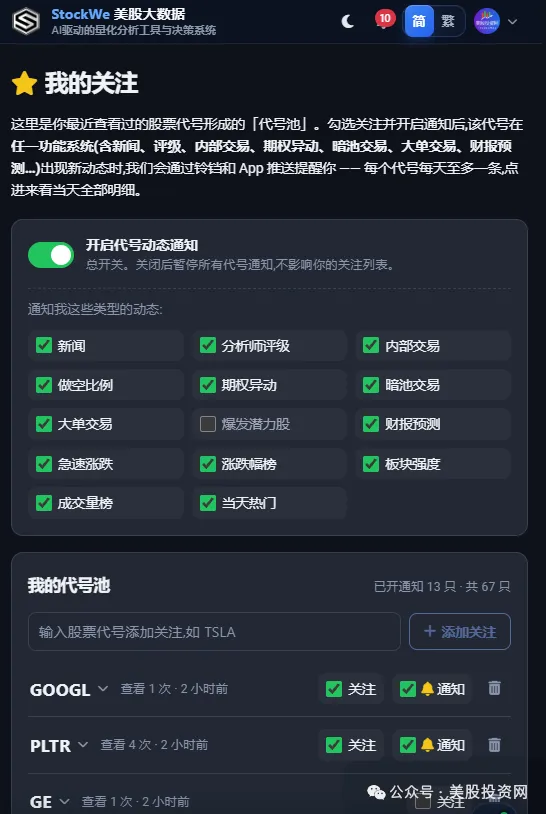
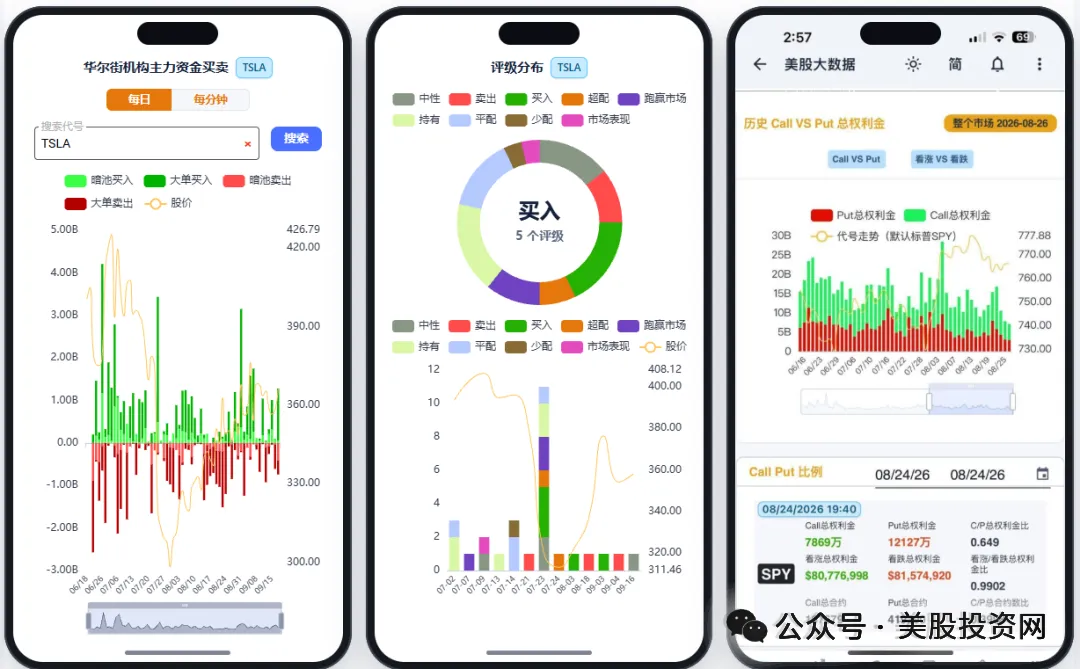
Key dynamics such as news, analyst ratings, insider trades, short interest, unusual options activity, dark pool trades, block trades, earnings forecasts, and rapid price moves.
For example, if you’re watching NVDA, you can directly see how many news items came out today, whether there was any options activity, and whether there were changes in dark pool or block trades.

More importantly, after enabling app notifications, you’ll receive direct alerts any time your tracked stocks show new activity.
You used to have to search for information yourself—now, just let the system monitor the stocks you care about, 24/7.
For long-term holders, this is an individual stock warning system;
For swing traders and options traders, this is a real-time anomaly radar.
Enter the ticker, and don’t miss any important changes again.
Click the original link to download the APP.





Disclaimer: The content of this article solely reflects the author's opinion and does not represent the platform in any capacity. This article is not intended to serve as a reference for making investment decisions.
You may also like
SpaceX to Acquire Low-Band Spectrum Portfolio From Grain Management in Mobile Connectivity Push
06:50 AM EDT, 10/09/2026 (MT Newswires) -- SpaceX (SPCX) shares rose early Friday after the rocket and satellite company agreed to acquire a nationwide low-band spectrum portfolio from investment firm Grain Management as it seeks to establish Starlink Mobile as a major US mobile carrier. SpaceX will buy Grain Management's entire portfolio of up to 14 megahertz of paired spectrum in the 800 MHz band, the companies said in separate statements late Thursday. The deal is subject to the Federal Communications Commission's approval and other customary closing conditions. SpaceX's stock gained 3.7% in the most recent premarket activity. The companies did not disclose the financial terms, and neither immediately responded to MT Newswires' request for comment on the reported transaction value. SpaceX will pay about $8 billion in cash for the assets, The Wall Street Journal reported Thursday, citing people familiar with the matter. Grain Management, which specializes in digital infrastructure, acquired the 800 MHz spectrum portfolio from T-Mobile US (TMUS) in August in exchange for $2.9 billion in cash and all of Grain's 600 MHz spectrum licenses. "This prime low-band spectrum addresses one of the key remaining technical gaps that will pave the way for Starlink Mobile to become a major mobile carrier in the US," SpaceX said in its statement. Following regulatory approval, SpaceX intends to combine its satellite-to-mobile constellation in space with a terrestrial deployment that will enable Starlink Mobile's signals and services to reach customers from both the ground and space, according to the companies. SpaceX said most existing mobile devices already support the band. "Our spectrum expertise allows us to connect the strategic value of these assets with the technologies and operators that can realize their potential," Grain Management Chief Executive David Grain said in a separate statement. "This agreement with SpaceX brings that capability to bear at extraordinary scale." Shares of Verizon Communications (VZ), AT&T (T)
Delta Air Lines Lowers Profit Forecast as Fuel Cost Increase Outpaces Ticket Price Growth
Delta Air Lines lowers its annual profit forecast due to a $6 billion increase in fuel costs; sharply rising ticket prices test travelers’ willingness to pay. The company’s refinery business is expected to generate $700 million in profits to help offset the impact of fuel costs. Rajesh Kumar Singh, Reuters Chicago, October 9 – Delta Air Lines (DAL.N) lowered the midpoint of its annual profit forecast by nearly a quarter on Friday, as surging fuel costs offset the positive effects of strong travel demand and higher ticket prices. This downgrade highlights the increasingly severe challenges faced by U.S. airlines: if fuel prices remain high, will passengers be willing to accept further price hikes? Airlines have already increased ticket prices considerably this year, and analysts warn that further hikes could test travelers’ willingness to continue spending. The Atlanta-based airline expects its annual fuel spending to increase by about $6 billion compared to last year. Its third-quarter fuel expenses jumped 62% year-on-year to $4.1 billion, more than $500 million higher than July’s expectations. When asked about the reasons for the revised forecast, Delta CFO Erik Snell told reporters, “It’s entirely a fuel issue,” noting that crude oil and refined jet fuel prices have both increased since the summer. Delta now expects adjusted annual earnings per share of $5.10–$5.60, down from its July forecast of $6.50–$7.50. According to data from London Stock Exchange Group (LSEG), the new median of $5.35 is below analysts’ average forecast of $5.46. The company expects an adjusted pre-tax profit of $4.5 billion in 2026. According to LSEG, third-quarter adjusted earnings per share were $1.72, slightly below the average analyst forecast of $1.76. Its adjusted operating margin dropped from 11.1% to 9.4%. Delta is the first major U.S. airline to report third-quarter earnings; its competitors United Airlines (UAL.O), American Airlines (AAL.O), and Southwest Airlines (LUV.N) will release their results later this month. Ticket Price Increases According to the U.S. Bureau of Transportation Statistics, in the first eight months of 2026, U.S. airlines spent $42.9 billion on fuel for scheduled flights, nearly $13.2 billion more than in the previous year, despite a slight decrease in fuel consumption. Strong demand and limited seat growth have helped airlines pass higher fuel costs onto passengers. According to the U.S. Bureau of Labor Statistics’ Consumer Price Index, over the five months ending in August, average U.S. airfares increased about 25% year-on-year. With fuel prices remaining high and industry capacity growth set to further accelerate in the fourth quarter, analysts are closely watching whether airlines including Delta can raise ticket prices further without suppressing travel demand. Deutsche Bank analysts expect the industry’s proportion of fuel costs recouped through revenue to decline in the fourth quarter, with full recovery not expected until early 2027. Delta says demand remains strong. Snell noted that with fourth-quarter bookings already near 60%, the company expects revenue to increase by around 20% year-on-year. According to LSEG, Delta forecasts fourth-quarter adjusted earnings per share of $1.15–$1.65, with the median $1.40 roughly in line with analysts’ average expectation of $1.39. Refinery Advantage Delta holds an advantage over other major U.S. airlines: it owns a refinery near Philadelphia, which Snell expects will generate $700 million in profits this year. “We own a refinery, which gives us a hedge—part hedge—on fuel prices that no other airline has,” he said. Delta acquired the Monroe refinery in 2012, which processes crude oil into jet fuel and other products. While Delta must still pay market prices for fuel consumed by its airline operations, refinery profits remain within the company. When the price spread between crude oil and refined products widens, this helps offset fuel cost pressures for airlines sourcing externally. However, this protection depends on refinery margins; when margins fall, the refinery may also incur losses. Nevertheless, the refinery can only partially ease the impact of rising fuel prices. Even with an expected refinery benefit of 40 cents per gallon, Delta forecasts its fuel cost to rise from $3.61 per gallon in the third quarter to $4.25 per gallon in the fourth quarter. Snell said fuel costs are expected to remain high for some time. “Ultimately, fuel prices will come down. As to when, we’re not sure,” he said. (For the convenience of non-native English speakers, Reuters offers automated translations of its reports into several other languages. Due to possible errors or lack of context in automated translations, Reuters does not guarantee the accuracy of automated translation texts and provides them only for reader convenience. Reuters assumes no responsibility for any damages or losses from use of automated translation featur
SUI Price Pullback Sparks Debate: Correction or Next Buying Opportunity?
"SaaS Apocalypse" Debunked? Autodesk (ADSK.US) and Intuit (INTU.US) Lead Growth Against the Trend as Wall Street Reprices the "AI Eating Software" Narrative
This week, Autodesk and Intuit are expected to record their strongest weekly gains in months, defying pressure on the overall technology sector. This strong performance signals a renewed optimism in the market regarding the growth prospects of the SaaS (Software as a Service) industry.
Crypto prices
More


