
Gold fluctuates around the $4,000 mark! UBS turns technically bullish, but what is still missing for a rebound?

The gold market is currently facing two forces pulling in opposite directions: on one hand, China continues purchasing physical gold and refining capacity is tightening, meaning the long-term demand base remains fundamentally unchanged; on the other hand, financial investors are reducing their positions after significant volatility and are temporarily unwilling to take on new risks.
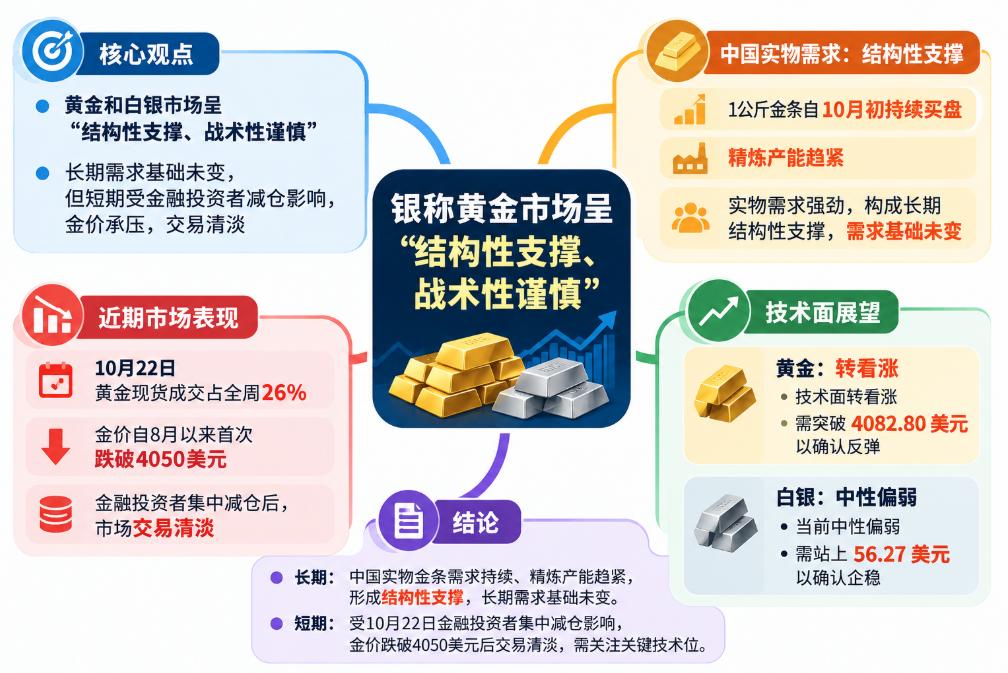
UBS's latest Bullion Report summarizes the current market as “structurally supported, tactically cautious”. The bank's precious metals trading team believes that gold prices can still attract buyers when they approach the lower end of the recent trading range, but insufficient investor confidence makes it difficult for rebounds to be sustained.
For gold bulls, the key issue is not only whether gold prices can hold above $4,000, but also whether the market can regain upward momentum. UBS technical strategist Jason Perl has turned bullish on the technical outlook for gold but adds one important condition: the price of gold needs to break through $4,082.80 effectively to further confirm a rebound.
Speculative Funds Withdraw Concentratedly, But Buying in Gold Has Not Completely Disappeared
Trading data from October 22 reveals the extent of recent concentrated gold sell-offs.
UBS electronic trading data shows that the US dollar-denominated spot gold trading volume on that day accounted for about 26% of the week’s total. Gold prices were under pressure for most of the day, and for the first time since August, fell below $4,050 per ounce.
The main client groups all saw their highest weekly trading activity on that day. Asset management companies, in particular, concentrated about 30% of the week’s trading volume in this single session.
This level of concentrated trading activity reflects that the market is quickly adjusting positions. Multiple investor groups traded almost simultaneously, indicating that the selling pressure is more likely due to widespread risk reduction rather than a collective reversal of belief in gold’s long-term value.
After positions were substantially reduced, the market quickly became quiet. UBS points out that investors focused on volatility trading mostly chose to stay on the sidelines, believing the subsequent market lacks opportunities for effective positioning. Those trading based on discretionary judgment are increasingly reluctant to expand risk exposure before year-end.
This means that the current market problem is not that buyers have completely disappeared, but that the potential buyers are temporarily unwilling to take risks.
There is a critical difference between the two: a true depletion of buying power could cause prices to persistently lose support; if buyers are simply waiting for more certain signals, the market may recover activity once the position adjustment ends.
UBS has observed that whenever gold prices approach the lower end of the recent range, some degree of buying still emerges. This has, to some extent, prevented the sell-off from turning into a clearer breakdown, but it is not enough to drive a sustained price rebound.
In other words, the bears do not have full control of the market for now, nor have the bulls regained the confidence to chase rallies.
Physical Demand in China Remains Strong, Refining Capacity Tightens
In contrast to the lackluster trading in the New York financial market, the physical gold market in Asia still shows strong demand.
UBS reports that there is continued buying interest in 1-kilogram gold bars in the China market, and there is demand for larger-sized bars as well. This round of purchases began around early October, which is earlier than UBS has typically observed in recent years.
The decision-making process of physical gold buyers is markedly different from that of high-frequency traders or hedge funds. Financial investors can close positions quickly, while physical gold buyers, aiming for long-term holdings, are more concerned with whether gold is available, the physical premium, and the ability to secure delivery.
UBS observes that as demand for 1-kilogram gold bars continues to grow, it is becoming increasingly difficult to arrange refining production orders, and the bookable refining capacity is steadily tightening.
This results in a different scene in the physical market compared to the financial market: gold traded on electronic markets may be under pressure from the withdrawal of speculative funds, while physical gold of specific sizes and delivered to specific locations remains favored by buyers. These situations are not contradictory but reflect market behaviors under different investment horizons and cash-flow needs.
Broader structural demand also shows no obvious signs of fading. The diversification of central banks’ reserve assets, geopolitical uncertainty, and investors’ search for alternatives to the US dollar remain essential parts of the long-term investment thesis for gold.
However, while physical demand can absorb part of the selling and provide price support, it does not necessarily mean it will immediately push prices higher. For sustained upward momentum, the market still needs financial investors to rebuild their positions.
UBS Turns Technically Bullish, $4,082.80 Becomes the Key Level
The most important change in this week’s UBS report comes from Perl’s DeMark technical analysis of gold.
Previously, Perl had taken a cautious stance, believing that the market needed to complete an ABC corrective pattern and meet certain technical conditions before making a more optimistic projection.
UBS states that when gold hit $3,996.10 per ounce on October 23, it had met the minimum requirements for this corrective pattern. Accordingly, Perl has turned technically bullish.
However, completing the corrective pattern does not mean a sustained rally is confirmed. Perl points out that gold still needs to break above $4,082.80 as an initial hurdle.
If gold convincingly breaks this level, the prospects for rebound will further improve, and the market may begin to focus on higher technical targets. For investors trading in an environment of complex macro signals and repeated market sentiment swings, this level provides a relatively clear observation standard.
Conversely, if gold fails to regain $4,082.80, especially if institutional investors resume selling, the market may still retest support areas.
Silver Remains Weaker, Downside Risk Persists
UBS’s judgment on silver is noticeably less optimistic than for gold. The bank maintains a neutral technical view on silver and points out that short-term risks remain tilted toward further weakness.
Recently, silver prices have become extremely sensitive to headlines and position changes. Last Friday, silver briefly approached $53 per ounce before recovering part of the loss, but the day’s electronic trading volume was highly concentrated.
UBS data shows that asset management companies concentrated over 60% of their week’s silver trading volume on that Friday. Banks and hedge funds also showed unusually concentrated trading that day, reflecting heightened sensitivity to position changes in the market.
Perl points out that silver needs to regain $56.27 to mitigate current downside risks. Until then, support levels near $53.02, $52.31, and $49.62 per ounce remain worth monitoring.
Trading Environment Becomes Calmer, Market Awaits New Catalysts
The UBS report also shows that despite investor reluctance to take directional positions, normal trading liquidity in the gold market has not deteriorated in tandem.
Between October 19 and 24, the average bid-ask spread for spot gold narrowed by about 5% compared to the previous period in October and by about 11% compared to September.
This suggests that the main challenge in the current market is not a reluctance by dealers to provide quotes, nor a clear deterioration of normal trading conditions, but rather a lack of willingness among investors to take directional risk.
As the end of the year approaches, some portfolio managers may prefer to protect gains already achieved this year; others who have just recovered from recent losses are also reluctant to face renewed bouts of volatility.
As a result, the market may remain within a relatively narrow trading range for some time, until new catalysts emerge to break the current pattern.
US monetary policy remains a key factor. If the market begins to anticipate further tightening of monetary policy, rising interest rates may weaken the appeal of non-interest-bearing gold. Meanwhile, continued active physical demand for gold in China provides another source of market support.
UBS also believes that broader geopolitical and political uncertainty may influence the performance of gold, but its trading team remains cautious about directly inferring price direction purely from political developments.
The truly noteworthy question is which factors could prompt investors to rebuild positions after the recent wave of liquidations. These could stem from a more favorable monetary policy outlook, a clear technical breakout, or renewed belief that the broader financial market deleveraging process is nearing completion.
Currently, physical gold buyers and financial traders are still making decisions on different timelines. China’s physical demand, tightening refining capacity, and the long-term need for asset diversification provide structural support for gold; however, whether gold prices can continue to rise in the short run still depends on the market’s willingness to resume risk-taking.
Disclaimer: The content of this article solely reflects the author's opinion and does not represent the platform in any capacity. This article is not intended to serve as a reference for making investment decisions.
You may also like
Federal Reserve Chair Waller: Number of Rate-Setting Meetings Will Be Reduced in Coming Years
Federal Reserve Chair Walsh pointed out that although eight meetings per year is "an appropriate number" for the FOMC, starting in 2027, one meeting will focus on macro monetary policy strategy without interest rate voting or policy statement issuance. In 2028, such strategic meetings will increase to two, and the number of policy-setting meetings will be reduced correspondingly to six. Walsh stated that this adjustment aims to provide the committee with space to consider more long-term "major issues."
The Federal Reserve holds rates steady as expected, with divisions resurfacing but fewer hawkish voices; Cook and two other voting members support a rate hike.
After three dissenting votes in July, there was once again division in this rate decision, with two of the 12 FOMC members opposed, indicating a decrease in hawkish dissent. Among the dissenters, Harker had already voted against holding rates steady in July due to his support for a rate hike, while Cook’s dissent is seen as a rebuke to Trump’s attempt to remove her. This statement changed the description of the economy from “steadily expanding” to “strong expansion,” continued to emphasize that inflation remains high, and newly added that accumulating information will help determine the policy stance needed to ensure inflation returns to target in a timely manner. According to the “New Fed News Agency,” the Fed’s decision to hold rates steady aims to gain time to assess whether further rate hikes are necessary.
Crypto prices
More


