
Mais de 20 vezes de valorização em 5 anos! Qual é o segredo por trás do salto das ações-sombra do bitcoin, MicroStrategy?

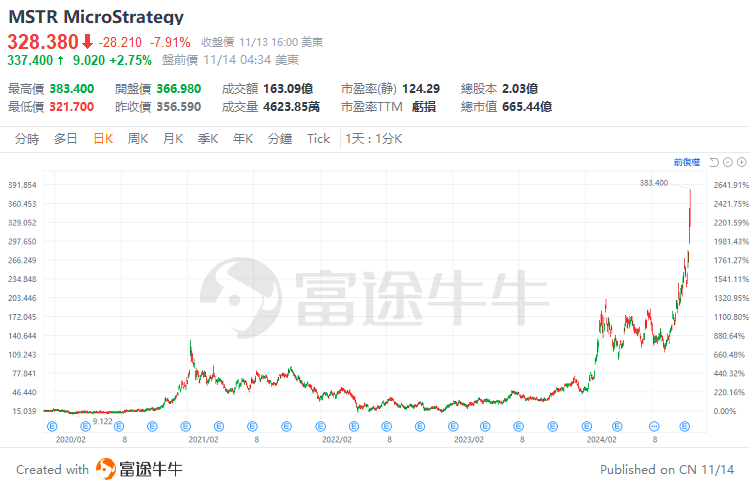
 A MicroStrategy tem investido pesado em bitcoin por meio de financiamento via ações e dívidas, alcançando “riqueza” com a valorização do bitcoin, sendo esse o principal motivo para a disparada das ações da empresa. Por trás do mito da riqueza da MicroStrategy está o seu método único de financiamento por ações — o ATM (At-the-market offerings).
 Six times in one year, twenty times in five years, the surge in MicroStrategy's stock price cannot be separated from the ATM financing mechanism. Under this model, MicroStrategy can flexibly raise funds at the peak of the price, avoiding the significant discount issuance problem caused by large-scale issuance, while allowing 'everyone to participate' and not favoring institutional investors.
$MicroStrategy (MSTR.US)$ Once a typical victim of the internet bubble in 2000, the stock price plummeted from $300 to $0.42. In 2020, the company's founder made a fateful decision to transform the company into a cryptocurrency investment platform: All-in on bitcoin, and claimed that bitcoin is "the most valuable asset in the world."
With the recovery of bitcoin, Microstrategy has returned to its peak, becoming a 'bitcoin shadow stock.' This year, Microstrategy's market cap once soared to nearly 70 billion dollars, with the stock price increasing six-fold in a year and nearly twenty-fold over the past five years. The current stock price is reported at 328 dollars.
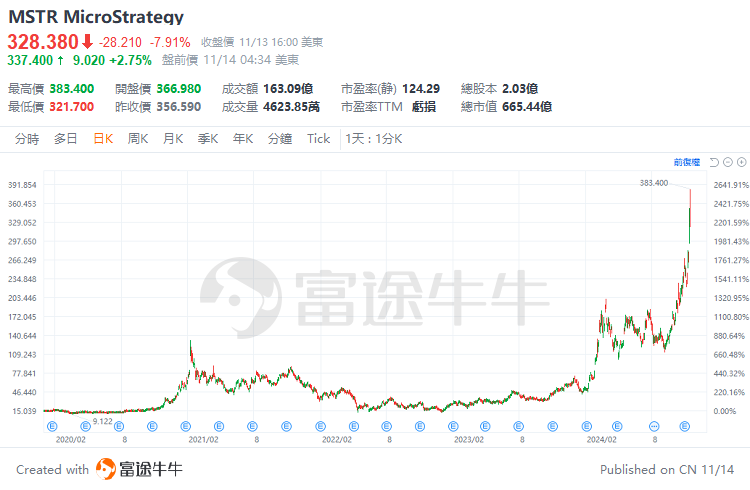
 Microstrategy has consistently invested heavily in bitcoin through equity and bond financing, achieving 'riches' through the appreciation of bitcoin, which is also the core reason for the company's soaring stock price. Behind the myth of Microstrategy's wealth lies its unique equity financing method—ATM (At-the-market offerings).
ATM refers to issuing or increasing shares at market price, which means that a publicly listed company gradually sells newly issued shares or the shares it already owns into the secondary trading market at current market prices through designated brokers.
Recently, Microstrategy made a bold plan to increase financing to gather ammunition for the 'bitcoin buying frenzy.' This plan is called the '21/21 plan,' which aims to raise 42 billion dollars through 21 billion dollars in equity and 21 billion dollars in bonds over the next three years. At current prices, this means the company will purchase nearly 600,000 bitcoins, accounting for about 3% of the total bitcoin supply.
The 21 billion dollars financing in this plan is being completed through the ATM equity financing method, and has already raised over 3.5 billion dollars. What characteristics does the ATM mechanism have, and can it help Microstrategy reach new heights again?
The ATM mechanism behind the surge in stock prices.
Microstrategy is the company holding the most bitcoin among U.S. listed companies, and its stock price is deeply tied to bitcoin. Initially, it bought using cash, and later leveraged by raising funds through methods like ATM, resulting in Microstrategy's stock price increasing even more sharply than bitcoin.
Microstrategy employs banks to sell stocks through the so-called 'at-the-market' (ATM) issuance method, allowing the company to sell stocks without submitting additional regulatory documents. This model gives all investors an equal opportunity to participate in purchasing stocks, without favoring institutional investors, aligning with the decentralized spirit of cryptos.
The ATM model can also raise funds flexibly, avoiding the significant discount issuances that occur in traditional financing, particularly suitable for high-volatility stocks like Microstrategy. Meanwhile, Microstrategy's high trading volume makes large-scale stock sales feasible, and its stock market cap enjoys a 2.8 times premium relative to its bitcoin holdings, creating arbitrage opportunities in financing.
Microstrategy raises funds through the ATM model, utilizing the high volatility of the stocks and bitcoin markets to maximize its bitcoin holdings while maintaining a high valuation of the company's stock price. However, the success of this strategy heavily relies on the continued rise in bitcoin prices, so the potential risks posed by market volatility cannot be ignored.
The Financial Times of the united kingdom analyzed the characteristics of the ATM equity financing mechanism, specifically:
-
Flexibility of ATM stock issuance/increase.
ATM stock issuance allows companies to gradually push new stocks to the market instead of issuing them all at once through traditional methods. This flexibility is particularly suited for companies with significant stock price volatility like Microstrategy, as it allows for flexible fundraising during price peaks, avoiding the issues of steep discounts caused by large-scale issuances. -
In line with the spirit of decentralization in cryptos.
"Everyone can participate", the ATM provides all investors equal opportunities to purchase stocks, without favoring institutional investors. This model of minimizing intermediary intervention aligns with the decentralization concept advocated by cryptos. Moreover, using the ATM eliminates the need for management to spend time and energy meeting with fund managers or attending roadshows to raise funds. -
Applicable to capital-intensive industries.
The ATM model is widely popular in capital-intensive industries, such as life sciences and the energy sector. MicroStrategy demonstrates the versatility of this tool by utilizing ATM fundraising in industries like life sciences and the energy sector. -
High liquidity supports ATM operations.
microstrategy's stock has high liquidity, allowing it to sell large volumes of stocks through the ATM without putting too much pressure on the stock price. The company can gradually sell shares based on market conditions, and even sell large amounts of stock when fund managers make a quote, but management has complete decision-making power in this regard. -
ATM provides arbitrage opportunities.
Due to the highly leveraged balance sheet, microstrategy's stock market cap has a 2.8 times premium relative to the value of its held bitcoin. The funds obtained from selling stock through the ATM can be used to buy more bitcoin. This means that issuing more stocks actually increases the amount of bitcoin represented per share, thus achieving an arbitrage effect. -
The risks are exposed when the price of bitcoin drops.
Although current ATM operations benefit from the rise in bitcoin, the article mentions two major potential risks: first, if the price of bitcoin drops, the premium of stocks relative to net assets (bitcoin) may shrink or even turn into a discount; second, continuous stock issuance could gradually erode the premium, leading to a decline in stock prices to the actual value of bitcoin.
Editor/Somer
Aviso Legal: o conteúdo deste artigo reflete exclusivamente a opinião do autor e não representa a plataforma. Este artigo não deve servir como referência para a tomada de decisões de investimento.
Talvez também goste
A Câmara dos Deputados dos Estados Unidos deve votar na quarta-feira um novo regulamento sobre o uso de eletricidade: exige que os data centers assumam o custo incremental de energia, visando impedir que os gigantes da tecnologia repassem despesas de eletricidade.
A Câmara dos Deputados dos Estados Unidos deverá votar já nesta quarta-feira, horário local, um projeto de lei bipartidário destinado a conter o aumento das tarifas de eletricidade relacionadas à expansão dos data centers para apoiar a inteligência artificial.

Prévia do mercado de ações dos EUA | Futuros dos três principais índices sobem, preços do petróleo caem, decisão importante sobre taxas de juros do Federal Reserve chega hoje à noite
Em 16 de setembro (quarta-feira), antes da abertura do mercado, os futuros dos três principais índices de ações dos EUA subiram juntos.

Após o entusiasmo dos investidores diminuir, o mercado de ações sul-coreano entra em estagnação! O volume de negociações cai para o nível mais baixo do ano e o índice de 7.000 pontos permanece instável
Com o entusiasmo dos investidores diminuindo, o volume de negociações do mercado de ações sul-coreano caiu para o nível mais baixo deste ano, indicando que o mercado de ações da Coreia do Sul, impulsionado pela inteligência artificial (IA), pode ter dificuldade em retornar aos picos anteriores.

A União Europeia propõe que o Canadá se torne o primeiro "quase membro" sob a pressão das tarifas de Trump.
A presidente da Comissão Europeia, Ursula von der Leyen, propôs que o Canadá se torne o primeiro "quase-membro" da União Europeia.

Preços de criptomoedas
Mais


