
Die Nachfrage nach KI bleibt stark, ASML erwartet in den nächsten fünf Jahren eine durchschnittliche Umsatzwachstumsrate von 8–14 %.

 Gleichzeitig hat sich ASML selbst das Ziel gesetzt: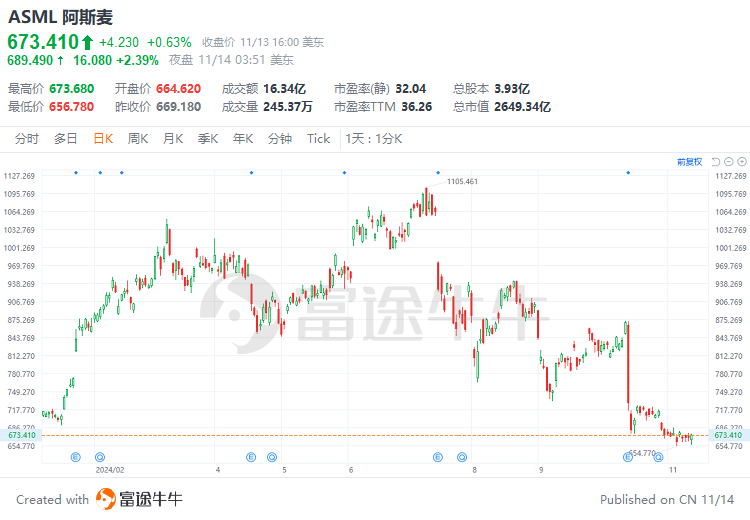
Source: Wall Street See
ASML reiterated its long-term growth prospects, announcing its sales target to reach 44 billion to 60 billion euros by 2030 unchanged, and committing to increasing dividends and share buybacks.
On Thursday, the Netherlands $ASML Holding (ASML.US)$ company reiterated its long-term growth prospects at the Investor Day, expecting global semiconductor sales to exceed $1 trillion by 2030, with a compound annual growth rate of about 9% from 2025 to 2030.
 At the same time, ASML has set its own target: keeping the sales target unchanged at €44 billion to €60 billion by 2030, with a gross margin of about 56% to 60% at that time. It is expected that in the next five years, the average sales growth rate will be between 8% and 14%, and a commitment to increase dividends and share buybacks.
Benefiting from the vigorous development of AI, the market has increased its strong demand for ASML's most advanced lithography machines.
ASML, as the world's only lithography machine manufacturer, holds a significant position in the semiconductor supply chain. Its lithography machines are essential tools for manufacturing advanced chips, used by apple, $NVIDIA (NVDA.US)$ Wait for the company's AI accelerator to provide support.
Therefore, ASML's performance is often seen as a benchmark for the entire semiconductor industry, and its long-term growth prospects also reflect the increasing global demand for advanced chips.
ASML's Chief Financial Officer, Roger Dassen, stated:
"We have reaffirmed our capital allocation strategy and expect to continue returning significant cash to shareholders through a combination of increasing dividends and share buybacks."
In October this year, ASML's third-quarter performance was disappointing, with orders only half of market expectations, causing the stock price to plummet by 17% on the same day. So far this year, the company's stock price has fallen by more than 5%.
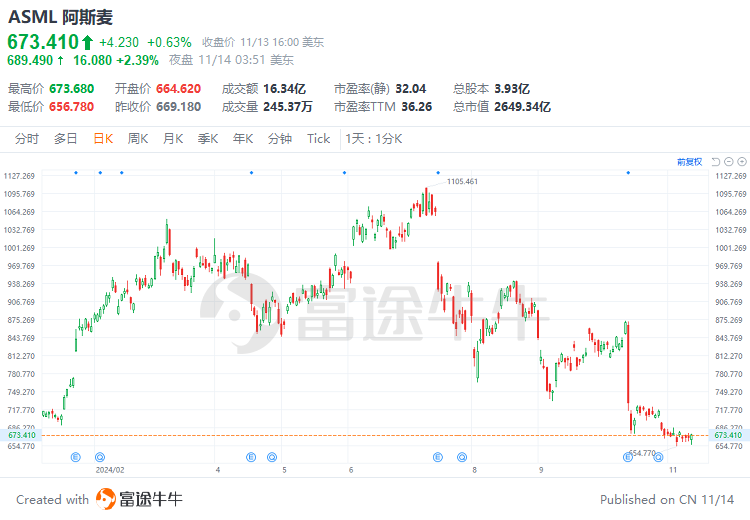
The third-quarter financial report shows that China's sales were 2.79 billion euros, accounting for nearly half of ASML's total sales. The company expects that next year, Chinese sales will represent around 20% of total revenue.
Company CEO Christophe Fouquet previously stated in October that the slow recovery of the chip market will continue 'until 2025'. However, next year and 2026 will be the 'years of overall growth' for the industry and ASML.
Editor / jayden
Haftungsausschluss: Der Inhalt dieses Artikels gibt ausschließlich die Meinung des Autors wieder und repräsentiert nicht die Plattform in irgendeiner Form. Dieser Artikel ist nicht dazu gedacht, als Referenz für Investitionsentscheidungen zu dienen.
Das könnte Ihnen auch gefallen
Hohe Zinssätze sind nicht der „Terminator“ für US-Aktien? Gewinne sind es?
JPMorgan ist der Ansicht, dass das Wachstum der Gewinne der entscheidende Faktor für die Widerstandsfähigkeit der Bewertungen am US-Aktienmarkt ist. Daten seit 1950 zeigen, dass zwischen der Rendite von zehnjährigen US-Staatsanleihen und den Bewertungen des S&P 500 eine „umgekehrte U-förmige“ Beziehung besteht. Bei dem aktuellen Gewinnniveau würde eine Rendite von etwa 5 % bis 6 % die Bewertungen deutlich drücken. Solange das Gewinnwachstum über 15 % bleibt, besteht weiterhin Spielraum für Neubewertungen. Wenn die Zinsstrukturkurve im Bärenmarkt steiler wird, profitieren zyklische Sektoren wie Energie und Finanzen stärker; wenn sie sich abflacht, sind Technologiewerte relativ bevorzugt.
Die Investmentkunst der „Ausreißer“ im neuen Zeitalter von Börki

Chevron (CVX.US) sucht alternative Wege, um Lieferunterbrechungen im Nahen Osten abzusichern: Fokus auf Argentinien und das Mittelmeer zur Förderung des weltweiten LNG-Wachstums, strebt Vereinbarungen mit Indien an
Chevron richtet den Blick auf Argentinien und die Mittelmeerregion, strebt globales Wachstum im Bereich Flüssigerdgas an und plant eine Vereinbarung mit Indien.

Zunehmender Druck durch Energie- und Lebensmittelpreise könnte die Inflation wieder aufflammen lassen! Die Bank of England dürfte Schwierigkeiten haben, gelassen zu bleiben – Zinserhöhungserwartungen steigen rapide am Markt.
Der Aufwärtsdruck auf die Energiepreise, der durch den schwelenden Krieg im Nahen Osten verursacht wird, nimmt deutlich zu. Neue Risiken rücken ebenfalls näher und könnten dazu führen, dass die Inflation im größten Teil des kommenden Jahres weiterhin über dem 2%-Ziel der Bank of England bleibt.

Krypto-Preise
Mehr


