
Dow Jones up 500 points on Iran-Israel ceasefire, Powell to wait with rate cuts

U.S. stocks are up as lowering tensions in the Middle East create more positive, risk-on sentiment.
Major U.S. stock indices rose after the announced ceasefire between Israel and Iran. On Tuesday, June 24, Dow Jones was up 470 points or 1.1%, reclaiming its levels before the 12-day war started. At the same time, the S&P 500 was up 1.05%, and the tech-focused Nasdaq was up 1.43%.
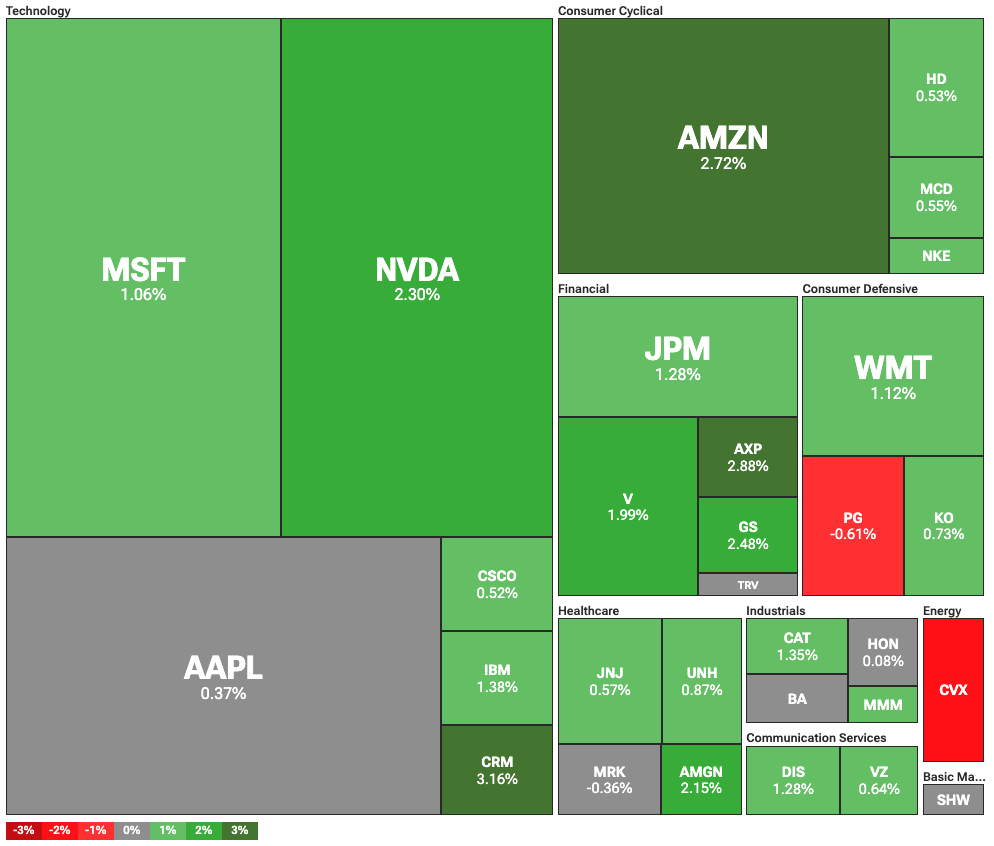 Dow Jones Industrial Average heatmap | Source: TipRanks
Driving the markets were hopes that the conflict between Iran and Israel would cease for now. U.S. President Donald Trump announced a ceasefire between the two countries. Moreover, he pressured Israel to stop its attacks against Iran, which promised hope for an end to the war.
The escalation of a broader conflict threatened the global oil economy. This was particularly true after the U.S. got directly involved with its own strikes on Iran’s nuclear facilities. After these strikes, Iran even threatened to push the price of oil to its historic levels by closing the Strait of Hormuz.
The price of crude oil dropped back down to $64 per barrel, down 5.33% in just one day. Crude oil traded near $75 at the height of the crisis, the highest price since January this year. Lower oil prices are good news for the global macro outlook as they could lead to cooling inflation.
Fed can afford to wait with rate cuts: Powell
With de-escalating tensions in the Middle East, focus is once again on the Federal Reserve and interest rates. In his testimony before Congress, Fed Chair Jerome Powell said that the Fed will wait for more information before making changes to the interest rates.
In particular, Powell is concerned by the potential effects of Trump’s tariffs, which could both push inflation up and lower growth. What is more, effects on inflation could be either short-lived or persistent, which would require a different response.
In any case, Powell stated that rate cuts could come sooner if inflation stays low or if the unemployment rate picks up.
Disclaimer: The content of this article solely reflects the author's opinion and does not represent the platform in any capacity. This article is not intended to serve as a reference for making investment decisions.
You may also like
AI Capital Expenditure Faces a Dilemma: Accelerating Puts Pressure on Cash Flow, Slowing Down Undermines the Growth Narrative
Nomura Securities believes that the AI investment narrative is mired in an internal contradiction: if hyperscale cloud providers accelerate capital expenditures, their free cash flow will continue to be drained, raising doubts about the sustainability of financing; if they slow down, it would indicate a loss of confidence in AI demand and profitability expectations. Both paths lead to sell-offs. The crowded long positions accumulated during the AI agent boom in September have triggered large-scale stop-losses under negative catalysts, spreading to US Treasury bonds, exchange rates, and commodity markets, resulting in systemic deleveraging.
Amazon (AMZN.US) CEO: AWS cloud computing capacity is fully booked until 2027, and a large amount of capacity has already been committed by customers for 2028
On Friday, Jassy stated that with the growing demand for artificial intelligence (AI) infrastructure, Amazon AWS cloud computing capacity is virtually sold out through 2027, and a significant portion of 2028 capacity has also been pre-booked by customers.

AI trading collapse: Will Anthropic postpone its "Super IPO"? The "scheduled listing date" in mid-November is approaching.
The time window is extremely tight—according to SEC regulations, the S-1 filing must be submitted by next week at the latest, and prediction markets estimate the probability of a listing within the year at around 80%. The sell-off in the AI sector has cast a shadow over the listing prospects, and the previous plan to go public in September has already fallen through. Several market participants say that Anthropic may face pressure to delay its listing, but some analysts point out that the company's urgent need for capital may drive it to stick to the original plan.
Crypto prices
More


