
Hashrate Sinks to 8-Month Low—Golden Entry or Looming Risk for Bitcoin Miners?

Bitcoin’s hashrate drop signals pressure on miners but opens profit opportunities with the coming difficulty adjustment. While network security remains intact, macroeconomic uncertainty and miner behavior could shape Bitcoin’s near-term market outlook.
According to data from BitInfoCharts, Bitcoin’s daily average hashrate has dropped to 684.48 EH/s, the lowest since mid-October last year.
This decline, from a peak of 966 EH/s on June 20, 2025, raises a significant question: is this an opportunity or a risk for the cryptocurrency market?
Hashrate has Decreased, but Not to Its Lowest
Although Bitcoin’s current hashrate has fallen to a low level, it is still much higher than the 379.55 EH/s recorded in July 2023. This ensures that the Bitcoin network remains safe to some extent.
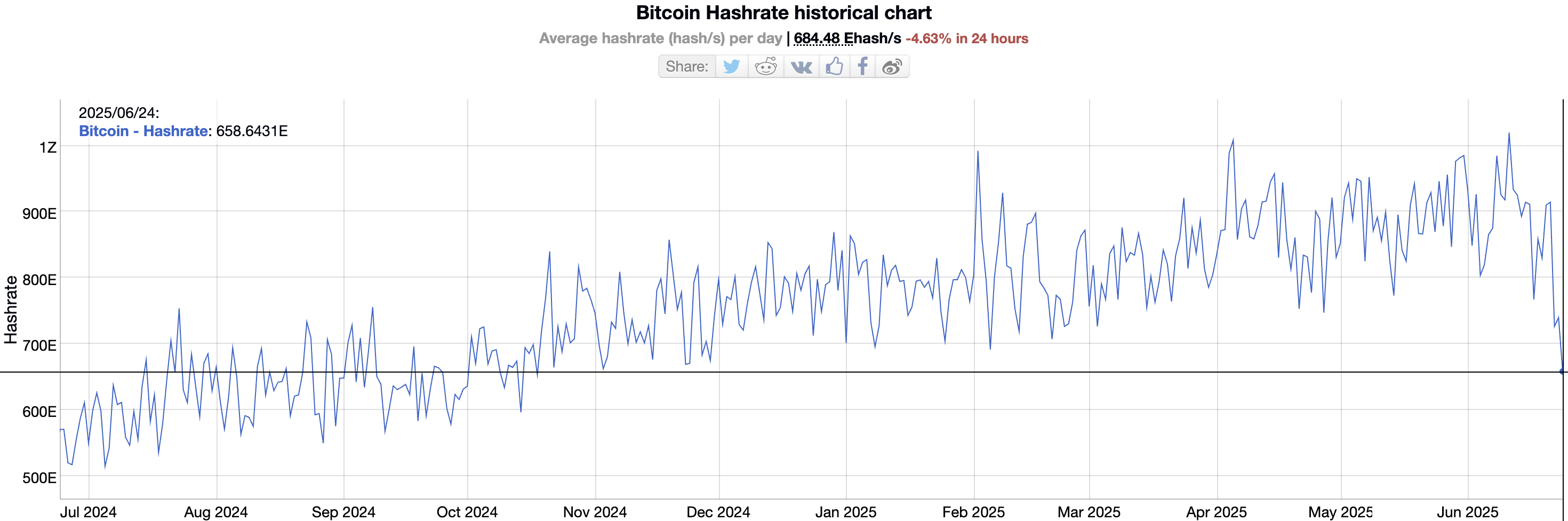 Bitcoin hashrate. Source:
BitInfoCharts
The primary cause of this decline could be related to the surge in Bitcoin mining costs, which increased by more than 34% in Q2 2025 when the hashrate hit new highs, as previously reported by BeInCrypto. Higher electricity prices and hardware and maintenance costs have forced many miners to suspend operations to avoid losses.
Additionally, energy-saving programs have contributed to the hashrate reduction, as some mining farms participate in grid load reduction initiatives. Or the war in Iran also contributed to this decline.
“Listen, I know “Hashrate is down because Iran got bombed” is a great meme, but if you actually mine Bitcoin you’re looking at US weather patterns.” X user Rob Waren shared.
The Bitcoin market has maintained remarkable stability despite the current hashrate situation. Bitcoin’s price is currently at $106,000, indicating positive investor sentiment.
Bitcoin ETFs, especially BlackRock with $70 billion in assets under management (AUM), continue reinforcing confidence in Bitcoin as a safe-haven asset, even as the US stock market plummets. This reflects the growing separation between Bitcoin and traditional financial markets.
Bitcoin Mining Difficulty Expected to Decrease by 9.37%
Another critical factor is the upcoming mining difficulty adjustment, scheduled for June 29, 2025. According to CoinWarz, the difficulty will drop from approximately 126.41 T to 114.40 T, a reduction of about 9.37%.
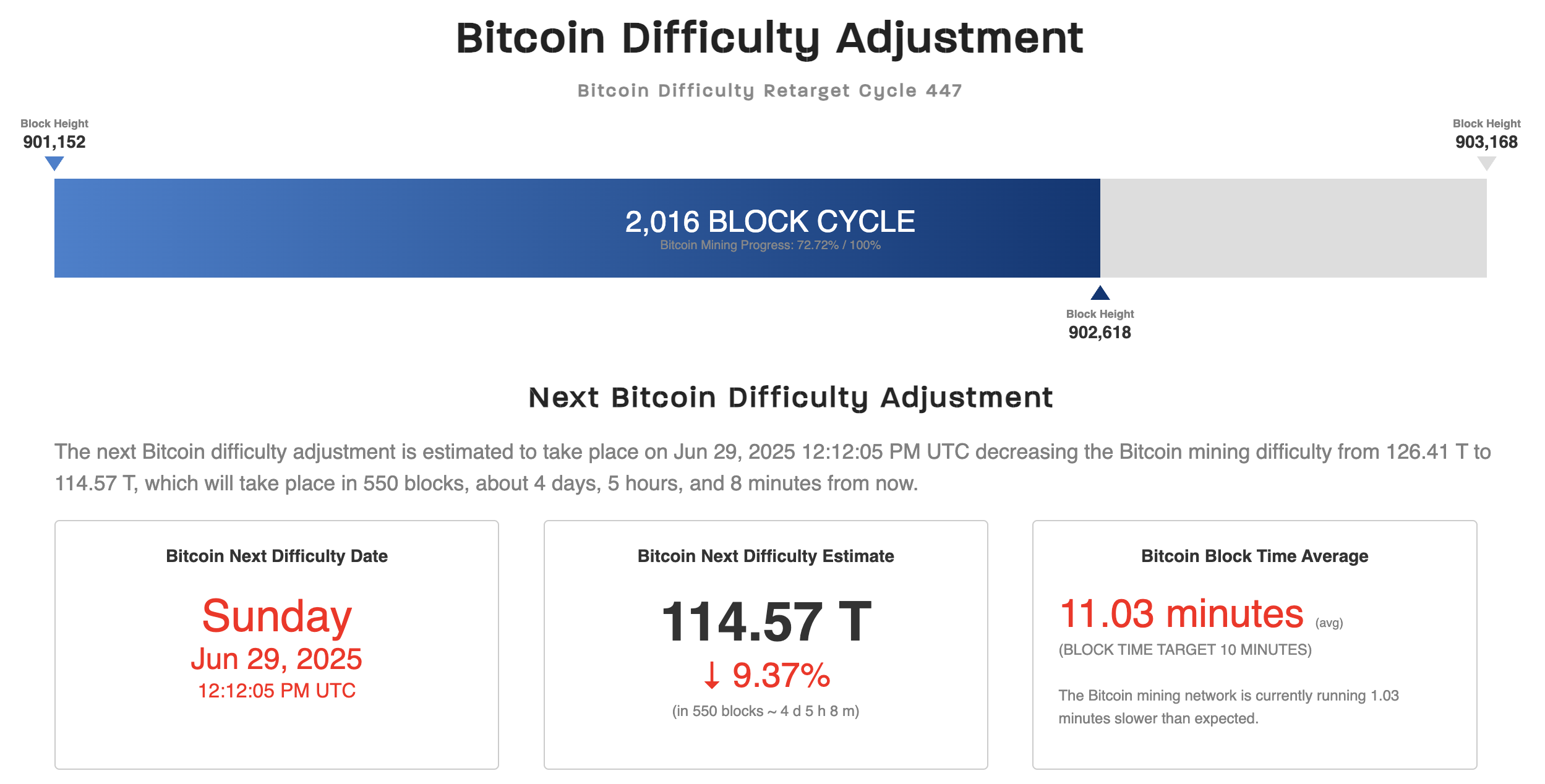 Bitcoin mining difficulty. Source:
CoinWarz
This is an opportunity for miners, as the lower difficulty will increase profits, encouraging them to return to the network. However, if the hashrate does not recover in time, the Bitcoin network could face a slight security risk, although the current 684.48 EH/s level is still sufficient to protect the network from 51% attacks.
The hashrate decline could be a positive signal in the long term, as it weeds out inefficient miners. At the same time, Bitcoin’s stable price at $106,000, combined with the growth of ETFs, indicates that the market still believes in Bitcoin’s potential.
However, risks remain. If the hashrate drops further and the difficulty adjustment does not occur in time, selling pressure from miners could cause Bitcoin’s price to decline. Additionally, macroeconomic factors such as geopolitical tensions and the Fed’s interest rate policies could impact the crypto market.
Disclaimer: The content of this article solely reflects the author's opinion and does not represent the platform in any capacity. This article is not intended to serve as a reference for making investment decisions.
You may also like
AI Capital Expenditure Faces a Dilemma: Accelerating Puts Pressure on Cash Flow, Slowing Down Undermines the Growth Narrative
Nomura Securities believes that the AI investment narrative is mired in an internal contradiction: if hyperscale cloud providers accelerate capital expenditures, their free cash flow will continue to be drained, raising doubts about the sustainability of financing; if they slow down, it would indicate a loss of confidence in AI demand and profitability expectations. Both paths lead to sell-offs. The crowded long positions accumulated during the AI agent boom in September have triggered large-scale stop-losses under negative catalysts, spreading to US Treasury bonds, exchange rates, and commodity markets, resulting in systemic deleveraging.

Amazon (AMZN.US) CEO: AWS cloud computing capacity is fully booked until 2027, and a large amount of capacity has already been committed by customers for 2028
On Friday, Jassy stated that with the growing demand for artificial intelligence (AI) infrastructure, Amazon AWS cloud computing capacity is virtually sold out through 2027, and a significant portion of 2028 capacity has also been pre-booked by customers.

AI trading collapse: Will Anthropic postpone its "Super IPO"? The "scheduled listing date" in mid-November is approaching.
The time window is extremely tight—according to SEC regulations, the S-1 filing must be submitted by next week at the latest, and prediction markets estimate the probability of a listing within the year at around 80%. The sell-off in the AI sector has cast a shadow over the listing prospects, and the previous plan to go public in September has already fallen through. Several market participants say that Anthropic may face pressure to delay its listing, but some analysts point out that the company's urgent need for capital may drive it to stick to the original plan.

Crypto prices
More


