
Bitcoin Struggles at $110,000 as Traders Pull Back Across Markets

Bitcoin’s $110,000 support is under pressure as futures and spot traders lean bearish. Without renewed demand, BTC risks sliding to $107,557.
Bitcoin is trading 10% below its all-time high, pressured by heavy profit-taking that has wiped out some of its value since August 14.
The leading cryptocurrency now trades around the $110,000 level, with on-chain signals suggesting a deeper correction could be imminent.
BTC Futures Traders Retreat as Selloffs Continue
On-chain data shows that sell-side pressure continues to mount, threatening to push BTC below the psychological $110,000 threshold.
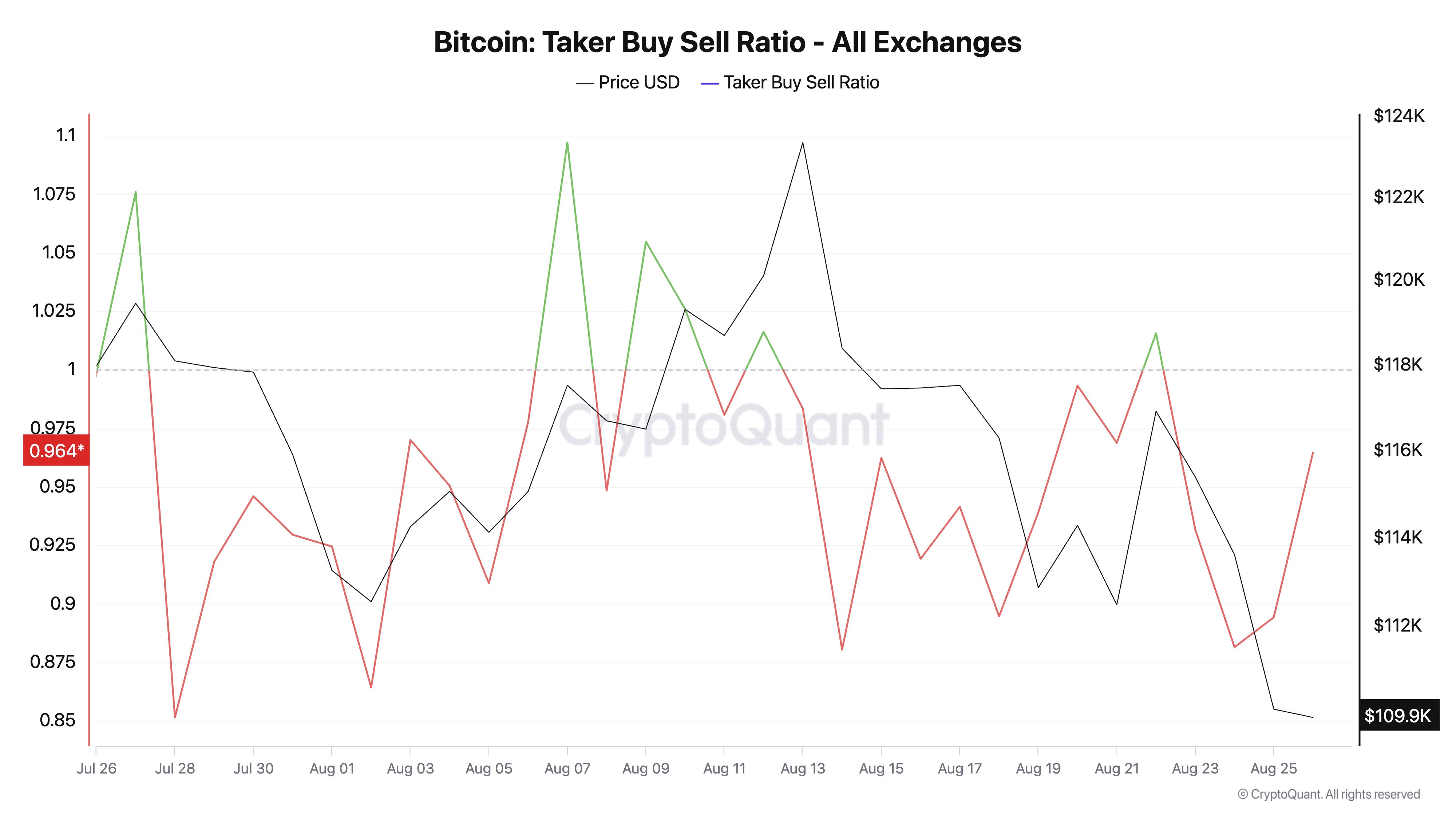
One of the most telling signs is BTC’s Taker-Buy Sell Ratio, which has been predominantly negative since July. At press time, it stands at 0.96 per CryptoQuant, indicating that sell orders dominate buy orders across the coin’s futures market.
For token TA and market updates: Want more token insights like this? Sign up for Editor Harsh Notariya’s Daily Crypto Newsletter
 BTC Taker Buy Sell Ratio. Source:
CryptoQuant
BTC Taker Buy Sell Ratio. Source:
CryptoQuant
An asset’s taker buy-sell ratio measures the ratio between the buy and sell volumes in its futures market. Values above one indicate more buy than sell volume, while values below one suggest that more futures traders are selling their holdings.
For BTC, this trend indicates that its futures traders are pulling back from aggressive bullish bets, adding to the pressure already weighing on the market. It shows a lack of conviction among derivatives traders that the king coin could see a notable near-term recovery.
Bitcoin Spot Traders Turn Sellers
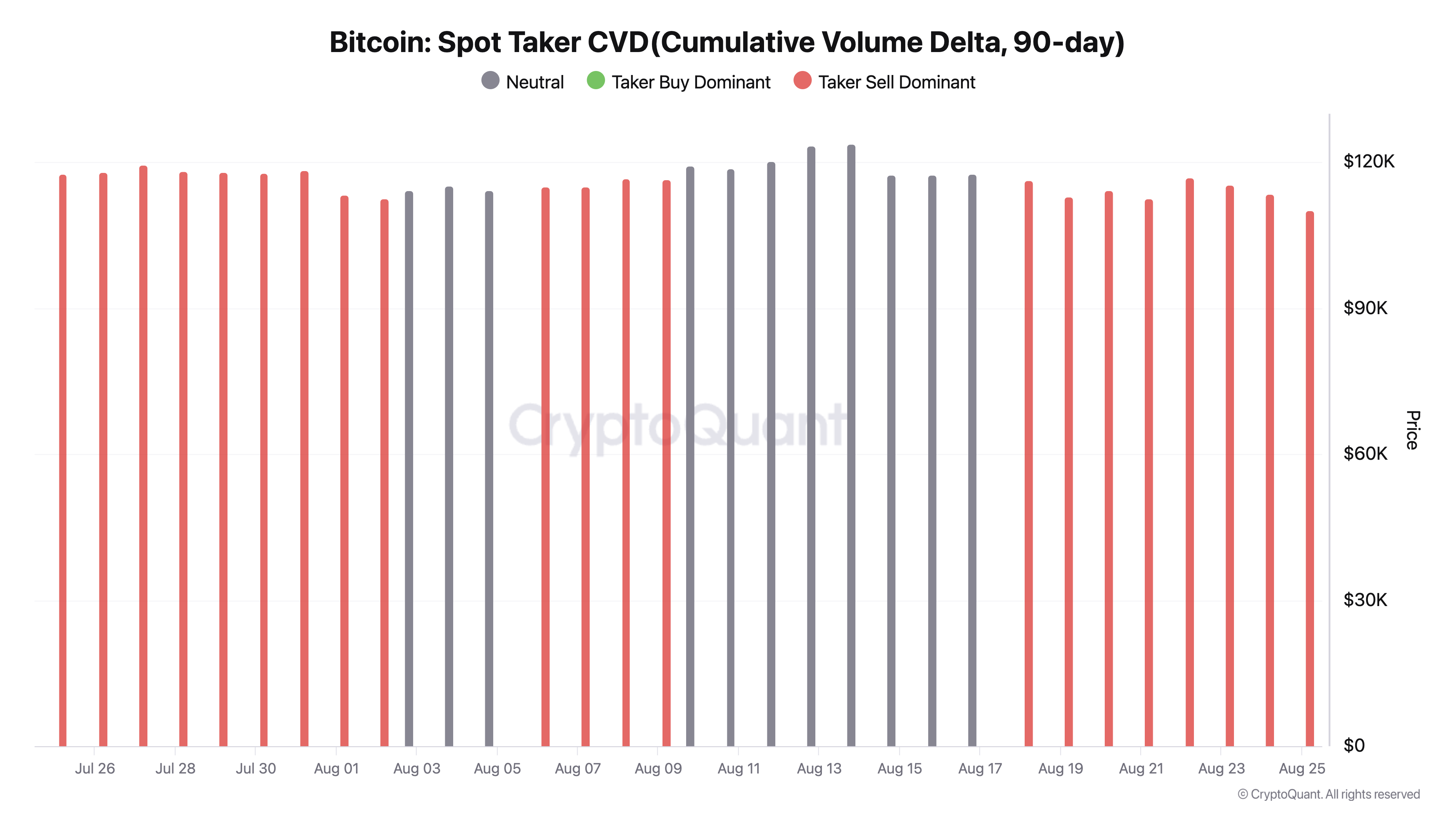
The trend is no different among spot market participants. Per CryptoQuant’s data, Bitcoin’s Spot Taker CVD (Cumulative Volume Delta, 90-day), which tracks net buying and selling activity in the spot market over a 90-day period, flipped from “neutral” on August 18.
Since then, it has consistently posted red bars, signaling that sellers are dominating spot market activity.
 BTC Spot CVD. Source:
CryptoQuant
BTC Spot CVD. Source:
CryptoQuant
This shift into a taker-sell dominant phase for BTC reflects fading demand and weaker buy-side absorption of increasing supply. With spot traders increasingly offloading rather than accumulating, the imbalance heightens the risk of further downside.
$110,000 Support Under Siege Amid Fading Demand
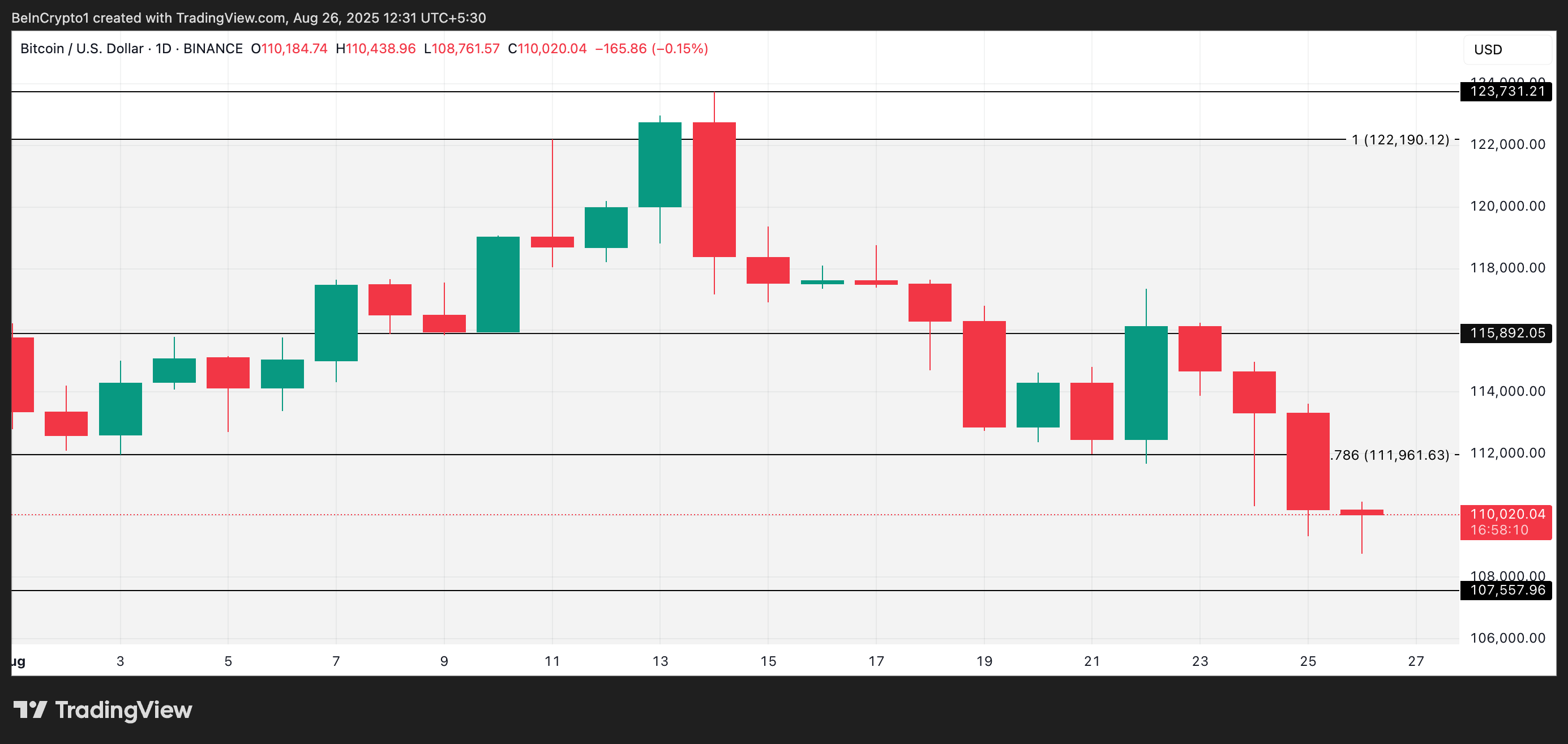
As demand thins across both spot and futures markets, leading coin BTC risks plunging below $110,000. In this scenario, the coin’s price could fall to $107,557, its next major support level.
 BTC Price Analysis. Source:
TradingView
BTC Price Analysis. Source:
TradingView
However, if buyers regain dominance and drive a rally, they could drive BTC’s price to $111,961. A breach of this wall could trigger a move to $115 892.
Disclaimer: The content of this article solely reflects the author's opinion and does not represent the platform in any capacity. This article is not intended to serve as a reference for making investment decisions.
You may also like
The Reserve Bank of India’s Efforts to Save the Rupee Deplete Reserves: $50 Billion Plunge in Forex Holdings, $200 Billion Forward Dollar Liabilities Become a Ticking Time Bomb
Foreign investors have made net sales of $31 billion in Indian stocks this year, and administrative controls are accelerating hedging demand towards the offshore NDF market, with the effectiveness of interventions continuously diminishing. The most critical risk lies in the fact that the yield spread between Indian and US 10-year government bonds has sharply dropped from 600 basis points in 2013 to just 200 basis points, with the traditional interest rate defense line nearly breached. India faces a dilemma: persisting on the current path will exhaust policy space, while relying on rate hikes to rebuild the yield spread would directly stifle economic growth.

As Starlink challenges telecom operators' pricing power, AT&T (T.US) sells its Mexico business for $2 billion, shifting focus to AI connectivity demand.
AT&T has agreed to sell its Mexico operations to Televisa and Fintech for $2 billion. The transaction is expected to be completed in the first quarter of 2027, pending approval from Mexican regulators.


Dovish Signals Boost Markets: Asia-Pacific Stocks Rebound, South Korea Shares Jump Over 1% Ending Five-Day Slide, Taiyo Yuden Surges 7%
On Wednesday, the MSCI Asia-Pacific Index rose by 0.2%, making a slight rebound from the low point reached on Tuesday, the lowest since August. South Korea's Composite Index briefly rose by over 2%. SK Hynix and Samsung Electronics both surged more than 3% during trading, then fell back. The Nikkei 225 expanded its gains to 0.53%. MLCC giant Taiyo Yuden led the AI hardware sector, while Fujikura rose nearly 4%. The yield on 10-year US Treasury futures remained at 5.21%, up 0.5 basis points from Tuesday.

Crypto prices
More


