
Bio Protocol launches Aubrai, the first-ever decentralized AI agent for longevity science

Bio Protocol has introduced Aubrai, the world’s first decentralized BioAgent designed to accelerate longevity research.
- Co-developed with VitaDAO and informed by Dr. Aubrey de Grey’s longevity research, Aubrai leverages decentralized mechanisms to overcome traditional funding gaps and accelerate translational science.
- Aubrai can generate and validate research hypotheses, design wet-lab experiments, and securely encrypt data.
Bio Protocol ( BIO ) has launched Aubrai, the world’s first decentralized AI agent designed to advance longevity research.
The launch price is set at 0.585 BIO per AUBRAI.
The ongoing sale, conducted on the BASE blockchain, set a fundraising target of 234,000 BIO and has already been oversubscribed 13.5x.
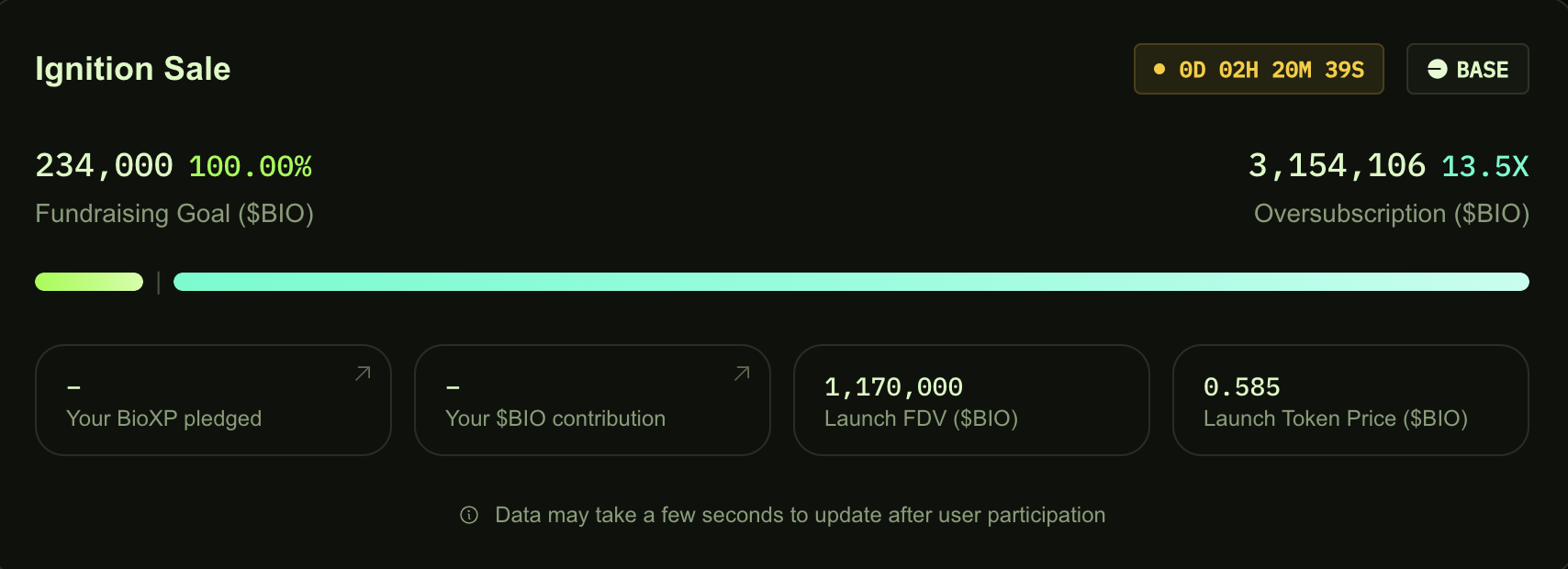 Source: bio.xyz
About Bioprotocol’s Aubrai
Co-developed by Bio Protocol and VitaDAO, Aubrai is the world’s first decentralized BioAgent, drawing knowledge from thousands of private lab notes, internal chats, and unpublished insights from the lab of Dr. Aubrey de Grey. De Grey is best known for pioneering longevity research through his Strategies for Engineered Negligible Senescence (SENS) framework and advocating the idea that aging is a disease that can be treated.
“The consequences of traditional financing are a chronic funding gap, over-reliance on philanthropy, and a ‘valley of death’ between discovery and the clinic. That’s why we champion alternative mechanisms – DAOs, longevity-focused venture funds, and DeSci platforms – which can tolerate long horizons, align incentives around societal benefit, and crowd-source risk,” de Grey told CoinDesk in an interview.
Aubrai functions as an on-chain AI co-scientist. It can generate and validate hypotheses, design wet-lab experiments, and encrypt data to protect trade secrets while enriching research outputs. At the heart of Aubrai’s mission is the Robust Mouse Rejuvenation (RMR2) project — de Grey’s ambitious study aiming to double the remaining lifespan of middle-aged mice. Aubrai has already demonstrated its capabilities in the RMR2 study, suggesting methodological tweaks and flagging dosing caveats.
AUBRAI token holders gain governance rights over the agent’s research outputs. They also share in potential revenues from discoveries commercialized by the project.
Disclaimer: The content of this article solely reflects the author's opinion and does not represent the platform in any capacity. This article is not intended to serve as a reference for making investment decisions.
You may also like
The Reserve Bank of India’s Efforts to Save the Rupee Deplete Reserves: $50 Billion Plunge in Forex Holdings, $200 Billion Forward Dollar Liabilities Become a Ticking Time Bomb
Foreign investors have made net sales of $31 billion in Indian stocks this year, and administrative controls are accelerating hedging demand towards the offshore NDF market, with the effectiveness of interventions continuously diminishing. The most critical risk lies in the fact that the yield spread between Indian and US 10-year government bonds has sharply dropped from 600 basis points in 2013 to just 200 basis points, with the traditional interest rate defense line nearly breached. India faces a dilemma: persisting on the current path will exhaust policy space, while relying on rate hikes to rebuild the yield spread would directly stifle economic growth.

As Starlink challenges telecom operators' pricing power, AT&T (T.US) sells its Mexico business for $2 billion, shifting focus to AI connectivity demand.
AT&T has agreed to sell its Mexico operations to Televisa and Fintech for $2 billion. The transaction is expected to be completed in the first quarter of 2027, pending approval from Mexican regulators.


Dovish Signals Boost Markets: Asia-Pacific Stocks Rebound, South Korea Shares Jump Over 1% Ending Five-Day Slide, Taiyo Yuden Surges 7%
On Wednesday, the MSCI Asia-Pacific Index rose by 0.2%, making a slight rebound from the low point reached on Tuesday, the lowest since August. South Korea's Composite Index briefly rose by over 2%. SK Hynix and Samsung Electronics both surged more than 3% during trading, then fell back. The Nikkei 225 expanded its gains to 0.53%. MLCC giant Taiyo Yuden led the AI hardware sector, while Fujikura rose nearly 4%. The yield on 10-year US Treasury futures remained at 5.21%, up 0.5 basis points from Tuesday.

Crypto prices
More


